
Turkey’s Constitutional Court has rejected an appeal filed on behalf of victims of the 2015 Ankara train station bombing, ruling the application inadmissible in a decision lawyers say ignores possible state negligence, Turkish Minute reported, citing the Evrensel daily.
The ruling concerns a petition challenging a criminal court verdict issued on August 3, 2018, in the main trial involving the attack, carried out by the Islamic State in Iraq and the Levant (ISIL) during a peace rally in Ankara.
The court’s decision was formally served to applicants on April 25, according to lawyers.
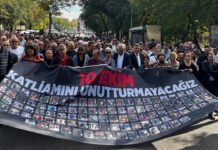
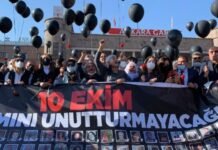
The bombing, in which twin suicide blasts tore through a Labor, Peace and Democracy rally outside Ankara’s main train station on October 10, 2015, remains the deadliest attack in modern Turkish history, killing 104 people and injuring hundreds.
In the original criminal case, nine defendants were sentenced to aggravated life on charges of attempting to overthrow the constitutional order, premeditated murder and attempted murder.
Nine others received prison sentences on charges such as membership in or leadership of a terrorist organization and possession of explosives.
Lawyers for the families said the verdict failed to satisfy the public conscience and did not adequately show how the attack was allowed to happen or whether state negligence played a role.
They said intelligence units had prior information before the bombing but failed to take necessary precautions, adding that the responsibility of some public officials was never fully examined.
They also alleged that evidence, including Interior Ministry reports, surveillance records and witness testimony, was ignored during the judicial process.
In its ruling the Constitutional Court said the application had been examined within the limits of individual petition procedures and based on submitted documents.
“It has been understood that there is clearly no violation within the scope of the state’s obligations under Article 17 of the constitution,” the court said, referring to the protection of life and physical integrity.
The decision sparked criticism from a group of lawyers representing the victims.
In a written statement, the lawyers said the ruling lacked sufficient reasoning and legal assessment, adding that it ignored both the responsibility of public officials and claims that the bombing constituted a crime against humanity.
The lawyers also pointed to the recent creation of a Justice Ministry unit tasked with examining unsolved and high-profile crimes, saying the court’s decision raised further questions about the scope of promised accountability.
Justice Minister Akın Gürlek recently announced that seven new departments had been established within the ministry, including a “Department for the Investigation of Unsolved Crimes.”
He said the body would review cases that had “left deep marks on the public conscience.”
The lawyers said the Constitutional Court ruling showed the limits of those assurances and vowed to continue seeking justice until “the real perpetrators” are punished.
Despite a series of trials in which ISIL members received multiple life sentences, families say accountability remains incomplete. Sixteen suspects remain at large, and no public officials have faced charges, even though internal reports showed police and intelligence services had prior warnings.
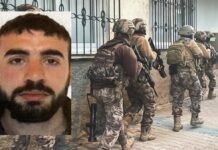
Turkey’s Supreme Court of Appeals upheld life sentences against nine ISIL members in 2024 but confirmed that former intelligence and police officials would not face prosecution after the Ankara Governor’s Office refused to grant permission for an inquiry.
The bombing took place during a period of heightened political tension. Four months earlier, President Recep Tayyip Erdoğan’s ruling Justice and Development Party (AKP) had lost its parliamentary majority in national elections. A fragile peace process with the outlawed Kurdistan Workers’ Party (PKK) collapsed that summer, and both ISIL and PKK attacks surged.