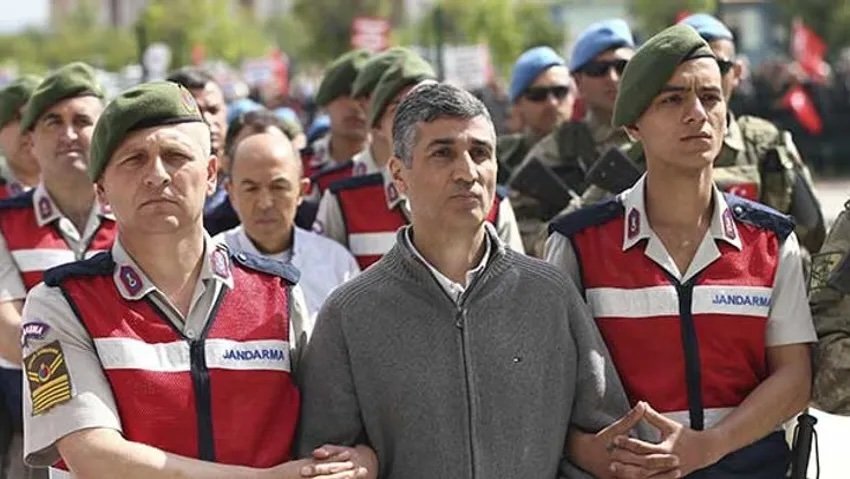
A former Turkish brigadier general convicted over the operation to detain President Recep Tayyip Erdoğan during a failed coup in Turkey in 2016 told a court that the plan was led by the country’s highest military commanders, the same officers later portrayed by Ankara as loyalists or hostages rather than coup leaders.
Gökhan Şahin Sönmezateş made the claim in his defense against the prosecutor’s final opinion in a retrial of a major coup trial, Turkish Minute reported, citing journalist Müyesser Yıldız, who observed the hearing.
The case concerns events at General Staff headquarters, the Turkish military’s command center in Ankara, on the night of July 15, 2016.
Sönmezateş, who says he was assigned to lead the team sent to Erdoğan’s hotel in the southwestern resort town of Marmaris that night, accepted his role in the coup attempt but denied any link to the faith-based Gülen movement, which Ankara accuses of masterminding the coup attempt. The Gülen movement, inspired by the late Turkish Islamic scholar Fethullah Gülen, denies any involvement in the coup.
Sönmezateş said his dispute with the courts was not over an act he had committed but over being punished for acts he said he did not commit.
“My task, given to me by my commanders, was to take Erdoğan,” Sönmezateş told the court, according to Yıldız.
He said the plan was to detain Erdoğan, not assassinate him.
The official case has long presented the Marmaris operation as an assassination attempt against Erdoğan.
Sönmezateş said the planning began in September 2015 and was centered not on the 38 people listed in indictments as members of the Peace at Home Council, the alleged coup command body, but on the chief of General Staff and the commanders of the land, air, naval and gendarmerie forces.
“There was a council, the Peace at Home Council, on July 15,” he said. “But it was not the 38-person council written in the indictments.”
“The council in the planning was, just like on September 12 [1980], made up of the chief of General Staff and the four force commanders,” he said, referring to Turkey’s 1980 military coup, which was led by the top command.
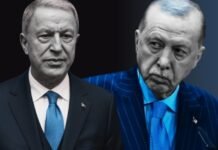
That claim strikes at the center of Ankara’s account of the night because then-chief of General Staff Hulusi Akar as well as other force commanders were later described as hostages of the coup plotters, not as the commanders behind the plan.
Sönmezateş said the commanders had reached the necessary agreement before July 15 but later positioned themselves to deny involvement if the attempt failed.
“If it failed, they would say, ‘Look, we are not in it,’ and that is what happened,” he said.
“If it succeeded, they would say, ‘Yes, boys, where were we? Let’s fix the country,’” he added.
Sönmezateş claimed the commanders were called one by one to Erdoğan’s presidential palace in the months before the coup attempt and switched sides after those meetings.
He called for the assets of the commanders and their close relatives to be investigated, claiming they suddenly became wealthy after the meetings.
“They sold us for a few houses and a few million dollars,” he said.
Sönmezateş also said there had been no formal planning seminars and that meetings were held face-to-face in secure environments.
He said the lower-ranking soldiers among the defendants bore no responsibility.
The former general also said Akın Öztürk, a former air force commander, and Adem Huduti, a former army commander, were neither members of the Gülen movement nor coup plotters.
He blamed their imprisonment on Akar; Yaşar Güler, who later became chief of General Staff and then defense minister; and other senior generals.
His latest statement follows other testimony that has challenged the official account of Akar’s role.
Orhan Yıkılkan, Akar’s former chief adviser, told the same retrial court in 2025 that Akar was still giving orders at military headquarters and called Sönmezateş on the night of the coup to warn him that Erdoğan’s security team in Marmaris was ready, according to Yıldız.
Yıkılkan also claimed that Akar went to Akıncı Air Base, a military airfield outside Ankara described by prosecutors as the coup plotters’ command center, because he thought Erdoğan had been taken there and wanted to speak to him.
The retrial was ordered after Turkey’s Supreme Court of Appeals partially overturned verdicts in the General Staff case, citing insufficient reasoning and incomplete examination for 149 defendants.
The General Staff case is one of the main trials stemming from the coup attempt, which left more than 250 people dead and was followed by a purge of the military, judiciary, civil service and education system.
Erdoğan’s government has used the coup attempt as the basis for a crackdown on the Gülen movement, targeting hundreds of thousands of people through dismissals, investigations and terrorism-related prosecutions.
Turkish President Recep Tayyip Erdoğan has targeted followers of the Gülen movement, inspired by the US-based cleric Fethullah Gülen, who died in 2024, since corruption investigations in December 2013 implicated him as well as some members of his family and inner circle. He dismissed the probes as a Gülenist conspiracy and later designated the movement as a terrorist organization in May 2016, intensifying a sweeping crackdown after a coup attempt in July of the same year that he accused Gülen of orchestrating. The movement denies involvement in the coup attempt or any terrorist activity.
Sönmezateş also denied the assassination charge in the Marmaris case, saying his team arrived in the area at about 4:30 a.m. and that two police officers killed that night had died earlier.
He said witnesses described the people who arrived before his team as being dressed in black, wearing gas masks and carrying full equipment, while his group had neither black clothing nor gas masks.
“I swear on my honor and my two daughters that those two police officers were not killed by me or my team,” he said.
Sönmezateş’s defense gives one of the clearest courtroom versions of a theory defendants have advanced for years, saying Turkey’s failed coup was not led by the people later punished as its main architects but by senior commanders who abandoned their subordinates after cutting a deal with Erdoğan’s side.