
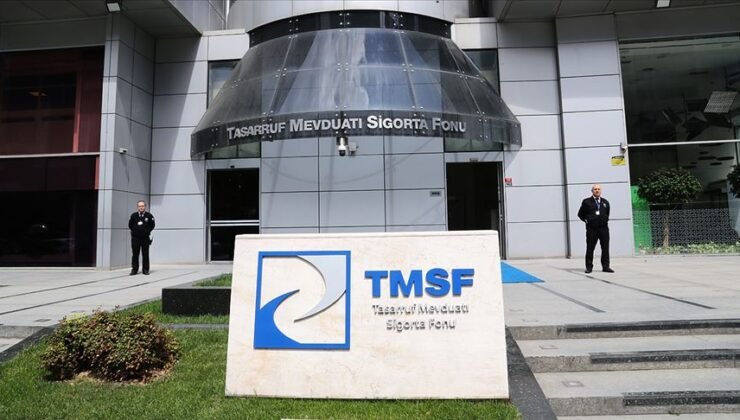
The total assets of private companies placed under the management of Turkey’s state-run Savings Deposit Insurance Fund (TMSF) have surged more than fourfold in one year, reflecting a sharp expansion in the number and scale of businesses brought under court-appointed trusteeship during criminal investigations, the Bold Medya news website reported.
The TMSF managed companies with total assets of 880 billion lira, about $20.4 billion at end-2025 exchange rates, up from 218 billion lira, about $6.2 billion at end-2024 rates, a year earlier, according to figures from the fund’s activity reports. The number of companies under its trusteeship rose from 699 to 949 over the same period, excluding companies in liquidation, while the total reached 1,046 when companies in liquidation are included.
In 2025 the assets of companies under TMSF management rose 303.6 percent, from 218 billion lira, about $6.2 billion at end-2024 exchange rates, to 880 billion lira, about $20.4 billion at end-2025 rates. By employment, TMSF-managed companies are comparable to some of the biggest firms listed on the Borsa Istanbul 30 Index (BIST 30). By asset size, they surpass many of Turkey’s major listed corporations.
The TMSF, originally established to protect bank deposits and resolve failed banks, has become one of Turkey’s most powerful administrators of private companies put under state control by court order. The fund also acts as a trustee over assets belonging to 105 individuals and shares in 65 companies.
Turkish authorities say trustee appointments are legal measures used to protect company assets, preserve jobs and prevent businesses from being used for terrorism financing, money laundering or organized crime. Critics say the practice can still amount to a serious interference with property rights when imposed before final convictions and without effective remedies for owners, shareholders or creditors.
The TMSF’s mandate was expanded through government decrees issued after a 2016 coup attempt and further strengthened by legislative amendments that entered into force on January 31, 2025.
Its role in the economy has expanded particularly through the seizure of businesses over alleged links to the faith-based Gülen movement.
Turkish President Recep Tayyip Erdoğan has targeted followers of the Gülen movement, inspired by the late Muslim cleric Fethullah Gülen, since corruption investigations in December 2013 implicated him as well as some members of his family and inner circle. He dismissed the probes as a Gülenist conspiracy and later designated the movement a terrorist organization in May 2016, intensifying a sweeping crackdown after a coup attempt in July of the same year that he accused Gülen of orchestrating. The movement denies involvement in the coup attempt or any terrorist activity.
Since then, the Erdoğan government has seized schools, universities, media outlets, companies and their buildings and the assets of individuals, corporations and organizations that were allegedly linked to the movement.
According to figures published by Turkey’s state-run Anadolu news agency in July 2025, Turkish authorities have seized 784 companies with a total asset value of TL 42.3 billion at the time of their takeover, an estimated $14 billion in 2016 US dollar terms, as part of the sweeping crackdown on the Gülen movement.
In 2019 Anadolu quoted then-TMSF president Muhiddin Gülal as saying that the fund was managing 932 companies seized over alleged Gülen links. Those companies had 57.9 billion lira, about $10.8 billion at 2019 exchange rates, in assets and employed more than 44,000 people at the time.
Among the major conglomerates the TMSF has taken over are Dumankaya, Boydak Holding, the Koza Ipek Group and Kaynak Holding. The TMSF, which has been managing companies confiscated under post-coup emergency decrees since 2016, has continued liquidating assets belonging to individuals and corporations accused of ties to the Gülen movement.
Critics contend that the planned asset sales represent the culmination of a broad confiscation policy that has stripped thousands of people of their property without judicial oversight or due process. Human rights groups warn that such measures constitute collective punishment and violate international conventions protecting the right to property and prohibiting arbitrary deprivation.