A decade after a failed military coup in Turkey on July 15, 2016, some teachers and education critics accuse the government of using textbooks and school commemorations to promote its political account of the events, BBC Turkish service reported.
The criticism centers on politically charged textbook language, repeated emphasis of President Recep Tayyip Erdoğan’s role and official commemorations that some educators say leave little room for critical discussion. Eğitim-Sen, a teachers’ union critical of the government, says some teachers risk administrative investigations when they refuse to prepare school displays commemorating July 15.
“Students do not want to engage with the subject, quite frankly,” an unnamed private school teacher in Ankara said. “As a teacher, I try not to engage in or become part of political propaganda.”
Kemal Irmak, president of Eğitim-Sen, a teachers’ union critical of the government, accused Erdoğan’s ruling Justice and Development Party (AKP) of turning the coup attempt into political propaganda.
Irmak said some teachers refuse to prepare school displays dedicated to coup despite the possibility of investigations. He also criticized efforts to present the defeat of the attempted coup as comparable to defining events in Turkey’s War of Independence.
“The AKP government turns many things into political propaganda,” Irmak said. “This is one of them.”
Textbooks cited by BBC Turkish use heroic language and prominently feature Erdoğan. A sixth-grade social studies book published in 2025 calls the attempt “traitorous” and its defeat an “epic resistance,” saying people fulfilled their national responsibility after Erdoğan called for them to take to the streets. A high school history book similarly credits those who gathered following his appeal with stopping the attack on Turkish democracy.
Critics say such language presents the government’s interpretation as established history rather than encouraging students to examine the event and its political context.
The Ministry of Education rejected the allegation of propaganda. It said that teaching July 15 was necessary to preserve collective memory and develop civic awareness among the younger generations.
The ministry said teachers could choose how to present the material but were required to cover subjects included in the national curriculum. It described the coup attempt as an attack on Turkey’s democratic legal order, constitutional institutions and the democratic will of the people.
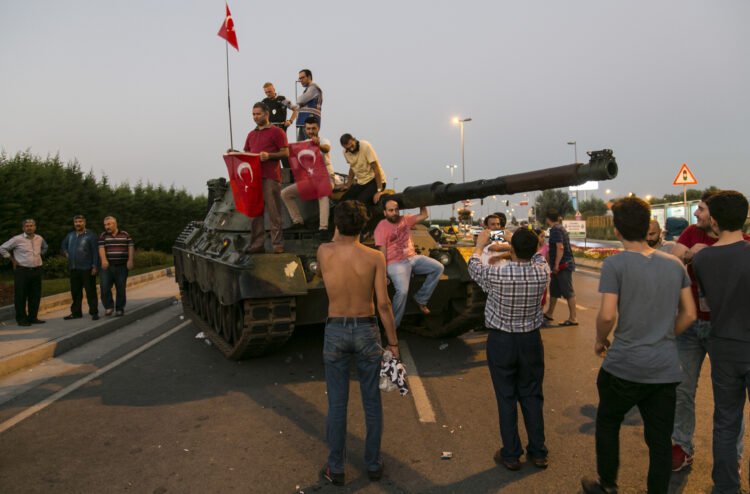
Turkey experienced a controversial military coup attempt on the night of July 15, 2016, which, according to many, was a false flag operation aimed at entrenching the authoritarian rule of President Erdoğan by rooting out dissidents and eliminating powerful actors such as the military in his desire for absolute power.
Following the coup attempt, Erdoğan immediately accused the faith-based Gülen movement, inspired by the late US-based cleric Fethullah Gülen, of orchestrating the plot and significantly expanded an already underway crackdown that began in 2013 on the movement’s supporters. The movement strongly denies involvement in the coup attempt or any terrorist activity.
The government designated July 15 as Democracy and National Unity Day, and the event has appeared in school textbooks since 2017. It is also covered under the government’s new national curriculum, introduced gradually beginning in the 2024-25 school year.
At the preschool level, July 15 is included in a ministry calendar of national commemorations recommended for classroom activities. It also appears in primary school textbooks and is covered more extensively in middle school social studies and high school history classes.
Concerns about political influence are accompanied by questions about whether some material is suitable for young children.
A teacher in the northern province of Bartın said students were repeatedly shown videos about the attempted coup during the first three years after it occurred. Schools also organized visits to families of those killed and invited relatives to speak with students, the teacher said.
“Showing these videos to children is pedagogical abuse,” the teacher said.
Talat Yavuz, secretary-general of Eğitim-Bir-Sen, another education union, said students should learn about the attempted coup so they can understand what happened and help prevent a recurrence.
He said teachers and administrators should avoid bringing their personal political views into the classroom and acknowledged that criticism was justified when the subject was not taught according to appropriate educational standards.
The ministry said the material was designed for students’ cognitive and emotional development and was intended to promote democracy, peace and solidarity rather than fear, trauma or political division.