
Turkey’s mass dismissal of public servants over alleged links to the faith-based Gülen movement after a 2016 coup attempt had punitive effects and violated multiple rights guaranteed by the European Convention on Human Rights (ECHR), five Turkish legal scholars have concluded.
The scholars said the dismissals, although formally classified as administrative measures, had punitive effects, including permanent exclusion from public service, restrictions on private sector employment and social stigmatization affecting families. They found the lifetime ban disproportionate, saying it was imposed without considering individual conduct or the nature of the duties.
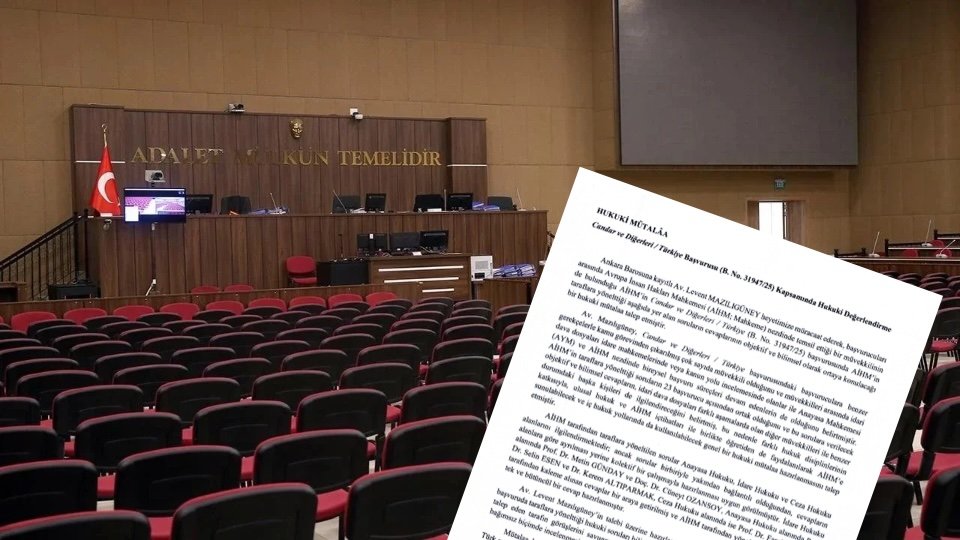
The 105-page legal opinion, made public on Monday, was prepared in response to questions posed by the European Court of Human Rights (ECtHR) in the case of Candar and Others v. Türkiye, concerning 23 people dismissed from public service during the state of emergency declared following the coup attempt.
The scholars concluded that the dismissal practices examined violated the right to respect for private life under Article 8, the right to a fair trial under Article 6 and freedom of association under Article 11 of the ECHR. They also said the measures had not been shown to be strictly required by the exigencies of the situation, as stipulated by Article 15 of the convention.
The court communicated the applications to the Turkish government on June 23 and made its questions public on July 13. The applicants include judges, prosecutors, military personnel, police and gendarmerie personnel and other civil servants.
The opinion was prepared at the request of Levent Mazılıgüney, an Ankara-based lawyer representing one of the applicants, by administrative law experts Metin Günday and Cüneyt Ozansoy, constitutional law experts Selin Esen and Kerem Altıparmak and criminal law expert Faruk Turhan.
The scholars said approximately 82 percent of the dismissals were carried out through lists attached to emergency decrees without warning, an opportunity to present a defense or individualized reasoning, despite the availability of a procedure allowing individual administrative decisions and direct access to the courts.
Turkish President Recep Tayyip Erdoğan has targeted the faith-based Gülen movement, inspired by Muslim cleric Fethullah Gülen, who died in 2024, since corruption investigations in December 2013 implicated Erdoğan as well as some members of his family and inner circle. He dismissed the probes as a Gülenist conspiracy and designated the movement as a terrorist organization in May 2016, intensifying a sweeping crackdown after the coup attempt in July of the same year that he accused Gülen of orchestrating. The movement denies involvement in the attempted coup or any terrorist activity.
The terms “affiliation” and “links” with terrorist organizations, introduced as grounds for dismissal under emergency decrees, lacked clear legal definitions and were applied to activities that were lawful at the time, the scholars said.
Among the activities cited as grounds for dismissal in the cases examined were conducting transactions at a legally operating bank, enrolling a child in a particular school, attending social gatherings and going on trips and even voting for a particular candidate in a university rector election. The scholars said none of these activities indicated professional misconduct.
Turkey’s Constitutional Court first defined the terms “affiliation” and “links” in November 2019, more than three years after their introduction, without establishing legal criteria. Subsequent court rulings broadened the scope of their application, the scholars said.
They said Turkish administrative courts departed from established principles of disciplinary law after the coup attempt, upholding some dismissals based on a spouse’s alleged links to the movement without concrete evidence against the dismissed person and refusing to treat acquittals in criminal cases as binding.
The scholars found that neither proceedings before the State of Emergency Measures Inquiry Commission nor subsequent judicial review remedied the lack of procedural safeguards at the time of dismissal. The commission took up to five years to decide on some applications without giving applicants an opportunity to respond to the allegations or evidence against them.
The commission was established in January 2017 to review dismissals, institutional closures and other measures imposed under the state of emergency. It completed its work in January 2023, having rejected 109,332 of the 127,292 applications it received, nearly 86 percent of the total.
The scholars concluded that the collection, retention, transfer and use of data relied on to establish use of ByLock, an encrypted messaging application that Turkish authorities claim was used as a secret communication tool by Gülen supporters, as well as telephone and internet traffic records, violated the applicants’ right to respect for private life and correspondence.
They said the legislation governing Turkey’s National Intelligence Organization (MİT) lacked a clear legal basis for the use of intelligence data in dismissal proceedings and failed to provide adequate safeguards such as prior judicial authorization and independent oversight. They also found that telephone and internet traffic records had been retained and disclosed beyond statutory time limits.
Even proven use of ByLock was insufficient in itself to establish a breach of the duty of loyalty, the scholars said, contrary to the several key rulings by Turkey’s Constitutional Court in in 2025. They noted that authorities had failed to produce evidence of any specific communications through the application that constituted a violation of that duty.
The scholars criticized the use of evidence from criminal case files to retroactively justify dismissals, restrictions on applicants’ ability to challenge evidence, the lack of access to raw data, the failure to conduct independent expert examinations or hold oral hearings and proceedings lasting nearly nine years.
The scholars said the dismissal of judges and prosecutors without following disciplinary procedures or giving them an opportunity to defend themselves violated constitutional guarantees of judicial independence and protection against removal from office, undermining everyone’s right to a hearing before an independent and impartial tribunal.
They also found that using membership in legally operating associations, foundations and labor unions, holding leadership positions in them or making donations to them as grounds for dismissal, even as supporting evidence, violated freedom of association.
Publishing the names of dismissed public servants in the Official Gazette and on the judicial council’s website in connection with terrorism accusations constituted a separate and unjustified interference with their right to respect for private life, including the protection of their reputation, the scholars said.
The opinion follows the ECtHR’s landmark September 2023 judgment in Yüksel Yalçınkaya v. Türkiye, which identified systemic problems in terrorism-related convictions based on the use of ByLock and found violations of the right to a fair trial, the principle of no punishment without law and freedom of association.
In December 2025 the ECtHR announced special administrative measures to handle an expected influx of applications from people dismissed from public service following the coup attempt, saying it had already received a substantial number of such applications since mid-October 2025.
Following the coup attempt of July 15, 2016, the Turkish government declared a state of emergency that remained in effect until July 19, 2018. During this period, the government carried out a purge of state institutions under the pretext of an anti-coup fight by issuing a number of government decrees. Some 150,000 people were dismissed from public institutions, including judges, prosecutors and members of the Turkish Armed Forces over alleged links to terrorist organizations for alleged membership in or relationships with “terrorist organizations” by emergency decree-laws subject to neither judicial nor parliamentary scrutiny.