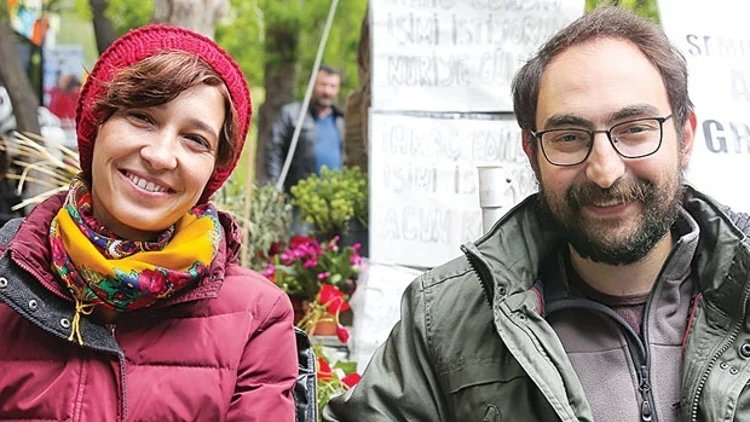
The European Court of Human Rights (ECtHR) ruled on Tuesday that Turkey unlawfully jailed two educators on terrorism charges in 2017 while on a hunger strike to protest their dismissal from public service following a coup attempt in July 2016.
In its unanimous judgment, the Strasbourg-based court found that the pretrial detention of dismissed teacher Semih Özakça and academic Nuriye Gülmen violated Article 5 of the European Convention on Human Rights (ECHR), which protects the right to liberty and security. It also found that the conditions in which Gülmen was held at Ankara’s Numune Hospital amounted to inhuman and degrading treatment, in violation of Article 3 of the convention.
The ECtHR ordered Turkey to pay Özakça €12,500 and Gülmen €16,300 in non-pecuniary damages.
Özakça, a public school teacher in Mardin province, and Gülmen, an academic at Selçuk University in Konya, were dismissed from public service under emergency decrees. Gülmen began a sit-in in Ankara in November 2016 and was later joined by Özakça. The two went on hunger strike on March 9, 2017, demanding reinstatement.
The two were jailed pending trial on May 23, 2017, on charges of membership in the outlawed Revolutionary People’s Liberation Party-Front (DHKP-C), designated as a terrorist organization by Turkey, the EU, the United States and several other countries.
Özakça was released from jail and put under house arrest in October 2017 and acquitted of all charges in December, while Gülmen was sentenced to more than six years in prison and released pending appeal. The two ended their 324-day hunger strike in January 2018 after the State of Emergency Measures Inquiry Commission rejected their requests for reinstatement.
The commission, established in January 2017 to review measures taken under emergency decrees, rejected nearly 86 percent of the 127,292 applications it received before its mandate ended in January 2023.
The ECtHR found that there was no concrete evidence at the time of their pretrial detention that the educators had acted on the instructions of the DHKP/C or that their protests had gone beyond expressing opposition to their dismissal. It also noted that the Turkish trial court ultimately found no evidence proving that the two had conducted their hunger strike under the direction of the DHKP/C.
The court said Turkish courts had failed to demonstrate that their pretrial detention was necessary and proportionate or explain why existing judicial supervision measures, with which both had complied, were no longer sufficient.
It also found no concrete evidence that the two posed a flight risk, might tamper with evidence or threaten public order.
Gülmen and Özakça maintained that the real purpose of their detention was to end their hunger strike and suppress dissent. Although the ECtHR could not establish this with certainty, it found that Turkish courts had failed to dispel concerns about the arbitrariness of their detention.
Turkey’s Constitutional Court dismissed their complaints concerning their detention in September 2021. The ECtHR criticized the Constitutional Court for relying on the severity of the potential sentence without conducting an individualized risk assessment.
During her detention at Numune Hospital between September 26 and December 1, 2017, Gülmen had to use a bedside toilet without adequate privacy, was unable to shower or change her clothes and was not allowed to leave her bed while in intensive care. She was subsequently held in the hospital’s prison ward, where insufficient natural light and fresh air and constant artificial lighting adversely affected her health and disrupted her sleep.
The ECtHR found no violation of the convention in respect of the medical care provided to either educator during their pretrial detention.
The judgment is not yet final. Either party may request that the case be referred to the court’s Grand Chamber within three months.
Gülmen, who has been in prison since August 2020 in a separate case, remains in custody during her retrial on charges of membership in the DHKP/C after Turkey’s Supreme Court of Appeals overturned her 10-year prison sentence.
Following the coup attempt of July 15, 2016, the Turkish government declared a state of emergency that remained in effect until July 19, 2018. During this period the government carried out a purge of state institutions under the pretext of an anti-coup fight by issuing a number of government decrees. Some 150,000 people were dismissed from public institutions, including judges, prosecutors and members of the Turkish Armed Forces over alleged links to terrorist organizations for alleged membership in or relationships with “terrorist organizations” by emergency decree-laws subject to neither judicial nor parliamentary scrutiny.