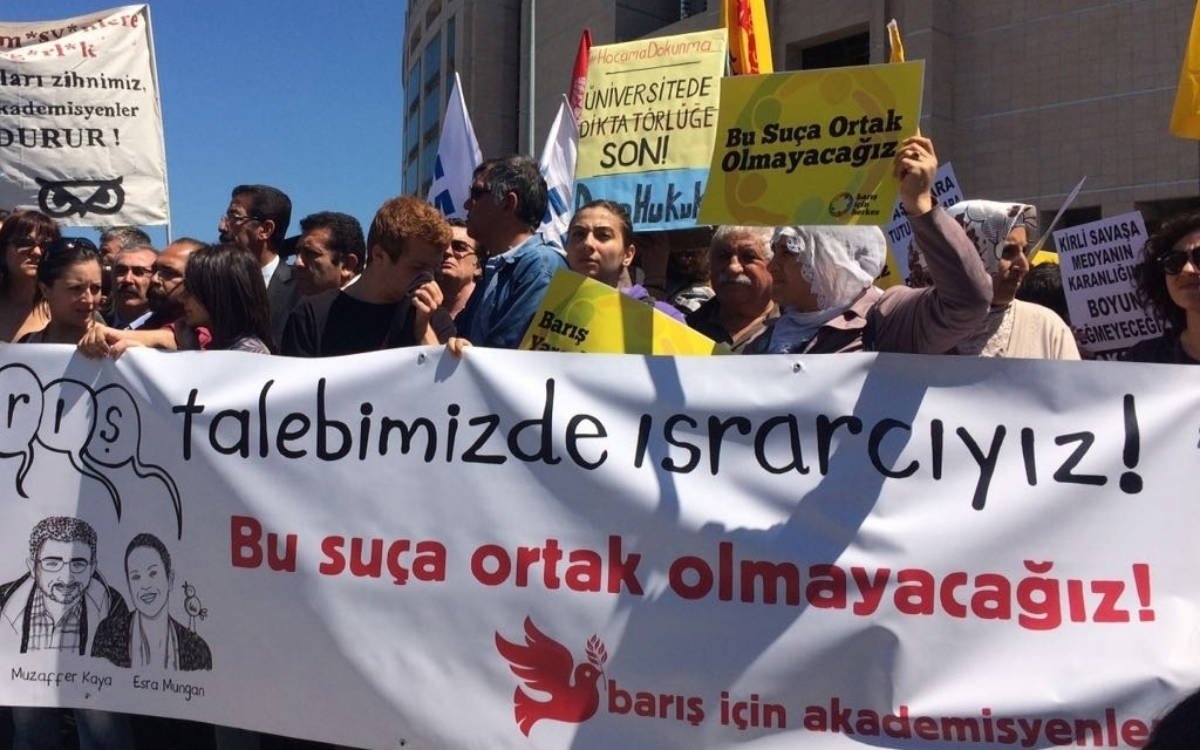
Turkey’s Academics for Peace, a group of 549 scholars dismissed from public universities for signing a peace petition critical of the government in 2016, have renewed their demands for reinstatement 10 years on.
The group marked the 10th anniversary of the petition, first published on January 11, 2016, by sharing an update on their legal struggle and reiterating the appeal contained in the original text.
On the anniversary, several civil society and human rights organizations, including the Turkish Medical Association (TTB), the Education and Science Workers’ Union (Eğitim-Sen) and the Human Rights Association (İHD), issued statements backing the academics’ demands.
The petition, titled “We Will Not Be a Party to This Crime,” was initially signed by 128 academics and called on the government to halt military operations in southeastern Turkey and opt for a negotiated settlement of the Kurdish issue. The petition was later endorsed by 2,213 scholars after President Recep Tayyip Erdoğan accused the signatories of engaging in terrorist propaganda.
The Kurdish issue, a term prevalent in Turkey’s public discourse, refers to the demands by the country’s Kurdish population for equal rights and recognition.
Following President Erdoğan’s accusations, criminal cases were filed against 822 academics on charges of disseminating terrorist propaganda, although all the cases ended in acquittals. However, during a state of emergency declared in the aftermath of a coup attempt in July 2016, the authorities dismissed 406 academics by emergency decrees, alleging links to terrorism. Subsequent administrative pressure increased the number of dismissed academics to 549.
Turkey’s Constitutional Court ruled in July 2019 that the right to freedom of expression of the Academics for Peace convicted for signing the petition had been violated, finding that the declaration fell within the scope of protected expression.
Despite the ruling, the State of Emergency Procedures Investigation Commission (OHAL Commission) rejected the reinstatement applications after a delay of nearly five years. The commission was established in January 2017 for appeals against measures taken by the Turkish government during the two-year state of emergency declared in the aftermath of the coup attempt in 2016.
Only a limited number of academics have been reinstated. Some universities have refused to implement administrative court rulings ordering reinstatement, while appeals courts have overturned reinstatement rulings issued by lower courts.
Courts have so far ruled in favor of 170 academics, while 184 reinstatement requests have been rejected. Legal proceedings remain pending in hundreds of cases, with 160 appeals before regional administrative courts and another 180 awaiting decisions at Turkey’s Council of State, the country’s highest administrative court.
As the anniversary passes, dismissed academics continue to press for full reinstatement, saying their prolonged exclusion from public service reflects broader shortcomings in Turkey’s justice system.
Following the coup attempt, the Turkish government declared a state of emergency that remained in effect until July 19, 2018. During this period, the government carried out a purge of state institutions under the pretext of an anti-coup fight by issuing a number of government decrees. Over 130,000 public servants, were summarily removed from their jobs for alleged membership in or relationships with “terrorist organizations” by emergency decree-laws subject to neither judicial nor parliamentary scrutiny.