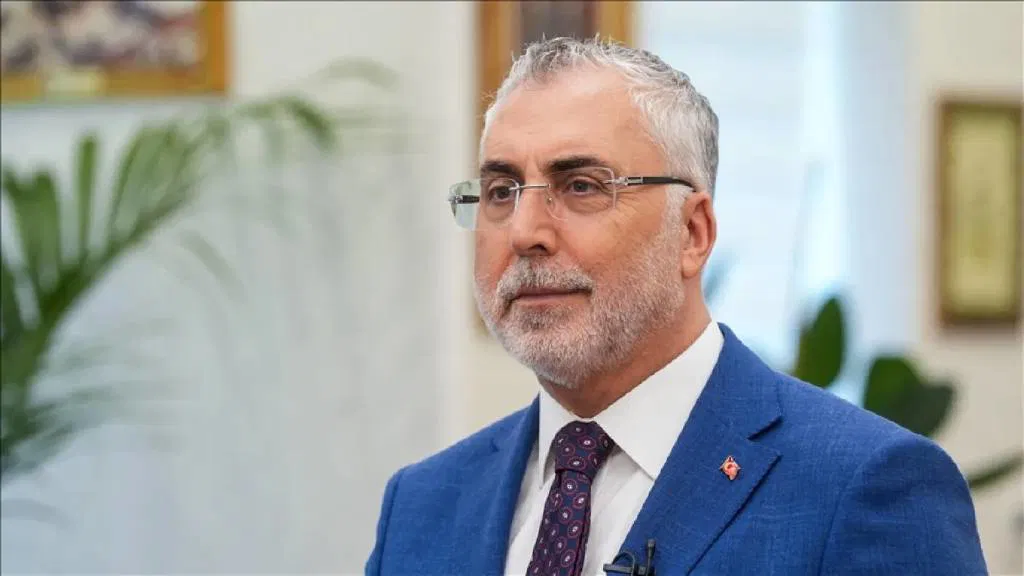
Turkey has raised its monthly minimum wage by 27 percent for 2026, setting net pay at 28,075 lira ($655), Labor Minister Vedat Işıkhan announced on Tuesday, a move widely seen as aimed at containing inflation but criticized as inadequate to address the country’s rising cost of living, Turkish Minute reported.
Işıkhan said the new minimum wage would take effect on January 1, 2026, following the final meeting of the Minimum Wage Determination Commission, which includes representatives from the government, employers and selected labor unions.
The Confederation of Turkish Trade Unions (Türk-İş), which represents the workers, boycotted the talks due to its objections to the commission’s structure.
Işıkhan said the increase was designed to balance the needs of workers and employers and to protect purchasing power, adding that the government remained committed to its pledge to not let workers be crushed by inflation.
The minimum wage set for 2025 at the end of 2024 was 22,104 lira ($521).
The increase falls short of inflation expectations and remains below the hunger line in the country reported by Türk-İş.
Official forecasts put inflation at around 31 percent in 2025, while Wall Street estimates see price growth easing to about 25 percent by the end of 2026, down from 31.1 percent in November. Critics say the gap means workers’ real incomes are likely to keep shrinking.
President Recep Tayyip Erdoğan has welcomed the decision, saying the new minimum wage would benefit both workers and employers.
“I wish the new minimum wage of 28,075 lira for 2026 to be auspicious for our workers and employers,” Erdoğan said as he spoke at a meeting of his party on Wednesday.
He said the net minimum wage had increased by 27 percent compared to the previous year and said the government would continue providing a monthly minimum wage support payment of 1,270 ($30) lira to employers next year.
In previous years Erdoğan’s government raised the minimum wage once and even twice annually, particularly during election periods. However, despite persistent inflation, which currently stands around 31 percent, the government declined to approve midyear increases in both 2024 and 2025, a shift that unions say has deepened the cost-of-living crisis for workers.
Opposition condemnation
Opposition parties reacted angrily to the minimum wage hike and accused the government of condemning millions of workers to poverty.
Turkey is known for its relatively high percentage of the workforce making the minimum wage. Labor unions estimated that roughly half of all workers earn a wage similar to the minimum wage.
Main opposition Republican People’s Party leader Özgür Özel called the wage “a disgrace,” saying it marked the first time in Turkey’s history that the minimum wage had been set below the hunger threshold.
According to data from Türk-İş, the hunger threshold for a family of four stood at 29,828 ($700) lira in November 2025, placing the newly announced minimum wage below the estimated cost of basic food needs. The poverty line, which includes housing and other essentials, was measured at 97,159 lira ($2,263).
“In this country, the state provides revenue guarantees to companies operating bridges, highways and airports, but offers no living guarantee to workers,” Özel said. He blamed President Erdoğan for the decision and said the CHP had proposed a minimum wage of 39,000 lira ($910).
İstanbul Mayor Ekrem İmamoğlu, the CHP’s presidential candidate who has been jailed in what many see as a politically motivated investigation since March, also criticized the decision in a statement shared on X through his lawyers.
“The announced minimum wage does not even come close to the reality of severe cost-of-living pressures,” İmamoğlu said, describing the increase as “a political choice, not an economic necessity.”
He also said setting wages “at a table without workers” showed the government was siding with employers over labor, referring to the absence of Türk-İş at the talks.
Türk-İş President Ergün Atalay also rejected the new minimum wage, saying it failed to meet workers’ demands.
“The announced figure of 28,075 lira does not fulfill any of our demands,” Atalay said. “This is not a figure that minimum-wage earners, the public or we can accept.”
The pro-Kurdish DEM Party described the new wage as a “poverty wage.”
Party Co-chairperson Tuncer Bakırhan said wages determined using what he called politically manipulated official statistics could not be considered fair.
“As the tables of workers shrink day by day, a wage set below the hunger line is unacceptable,” Bakırhan said.
The Turkish Statistical Institute (TurkStat), which calculates official inflation data, faces accusations of failing to capture the economic reality experienced by Turkish citizens by manipulating inflation data.
Many accuse TurkStat and the government of underreporting inflation to downplay economic hardship. The institute’s credibility has been questioned, particularly after ENAG, an independent group of economists, consistently reported rates of inflation that are often double those released by TurkStat.
İYİ (Good) Party leader Müsavat Dervişoğlu also criticized the government’s minimum wage decision, warning that it would provoke a strong public backlash.
“A minimum wage set below the hunger threshold condemns millions of citizens to poverty,” Dervişoğlu said. “How will you explain this to the public? Be prepared for the reaction of people who work for a living.”
Public anger
The announcement sparked widespread anger on social media, where the hashtag #AsgariÜcret (minimum wage) was among the top trending topics on X in Turkey on Tuesday. Many users said the new wage would not cover basic expenses such as rent, food and energy.
Turkey has been grappling with double-digit inflation since 2019, peaking at 85.5 percent in October 2022 and currently standing at about 31 percent, resulting in a prolonged cost-of-living crisis that has made it harder for many households to meet basic needs such as food, housing and healthcare.