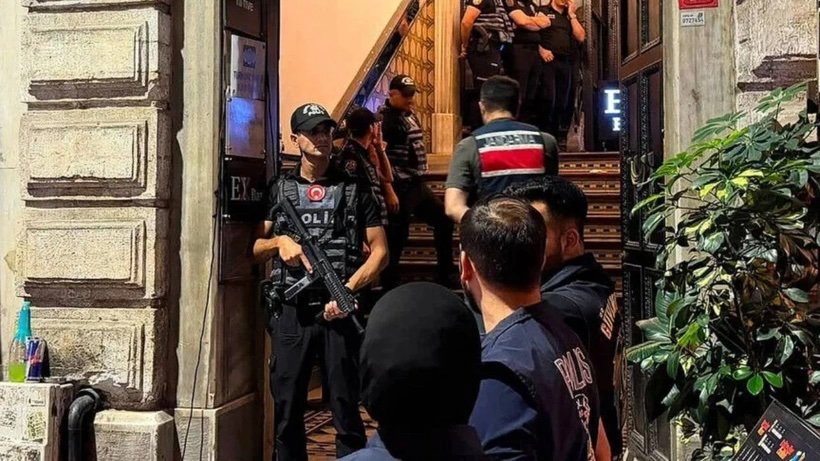
Turkish authorities have begun proceedings aimed at closing two LGBTQ+ rights associations in the southern province of Mersin and also blocked 14 websites and 186 personal social media accounts, expanding a nationwide crackdown that has led to the pretrial detention of at least 62 people.
The action targets the Muamma LGBTİ+ Education, Research and Solidarity Association and the Mersin 7 Renk LGBTİ+ Solidarity Association.
An official information note cited by local media said the “necessary correspondence” for the dissolution of the associations had been initiated. No court or administrative body has issued a final order closing either group, the Mersin Portal reported.
Mersin 7 Renk was founded by seven trans women in 2013 and describes its work as monitoring discrimination and rights violations, providing support and organizing educational and cultural programs.
Muamma, founded in 2018, provides psychosocial support, peer counseling during gender transition and legal assistance to LGBTQ+ people, according to the Rainbow Against Discrimination Association, an umbrella group that lists both organizations as among its members.
The effort to dissolve the associations is the latest development in a series of investigations conducted under an operation called “My Family Is Safe.”
At least 62 jailed nationwide
Police detained 36 people in the Mersin-led investigation: 33 in Mersin and one each in Ankara, Sakarya and Antalya.
A Mersin court jailed 28 of them pending trial, while the other eight were released under judicial supervision. Prosecutors said the investigation concerned alleged obscenity and prostitution-related offenses.
The court decisions do not constitute convictions, and prosecutors have not publicly provided individualized evidence against all those jailed.
The Mersin rulings brought the confirmed number of people jailed in the nationwide operation to at least 62.
In Ankara courts jailed 13 people: five trans women in one case and journalist Tuğba Tekerek and seven regular members of the management and audit boards of the Kaos Gay and Lesbian Cultural Research and Solidarity Association (Kaos GL) in another.
Seven alternate Kaos GL board members were released under judicial supervision. Another person detained in Ankara was released because the individual was already subject to house arrest in a separate case.
In İzmir 16 of 18 detainees were jailed pending trial and two were released under judicial supervision. Prosecutors appealed the release decisions and said efforts were continuing to locate six other people.
A court in Kuşadası, a district of Aydın province, jailed five of six detainees. A prosecutor released the sixth after questioning.
The total of at least 62 comprises 28 people in the Mersin case, 13 in Ankara, 16 in İzmir and five in Kuşadası.
The İstanbul Chief Public Prosecutor’s Office previously announced the detention of 26 people in an investigation covering 12 provinces. No reliable report had disclosed their court status by Wednesday afternoon.
Justice Minister Akın Gürlek announced that the operation involved legal action against 162 people, nine associations and 13 businesses in 15 provinces.
The investigations are being coordinated by prosecutors in İstanbul, Ankara, İzmir, Aydın and Mersin. The allegations vary between files and comprise obscenity, prostitution, drug possession and establishing a criminal organization.
Journalist jailed over one article
Tekerek, a journalist with 24 years of professional experience, was jailed by the Ankara 6th Criminal Court of Peace over allegations of violating Turkey’s Associations Law, assisting in the publication of obscene material and making obscene content visible to children.
Her detention was based on a single article she wrote for Kaos GL in October 2024 about the treatment of LGBTQ+ people during elections in Georgia.
The article examined the Georgian Dream party’s anti-LGBTQ+ campaign, legislation titled “Family Values and the Protection of Minors” and the security concerns of Tbilisi Pride leader Tamar Jakeli.
Tekerek told the court that she had never worked for Kaos GL, had never visited its office and had submitted only one paid article to its news website.
“I have been a journalist for 24 years. I only wrote one article for Kaos GL,” she said.
Tekerek said police apparently identified her as an administrator of Kaos GL’s Instagram account because the organization had shared her article on the platform.
Prosecutors alleged that Kaos GL’s activities and social media posts violated “general morality” and offended public standards of decency. They also claimed that some posts promoted the idea that people can choose their gender and that illustrations depicting children encouraged homosexuality.
The Journalists’ Union of Turkey condemned the use of Tekerek’s reporting as grounds for criminal proceedings and called for her release.
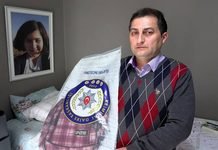
Among the seven Kaos GL members jailed was Nedime Erdoğan, the mother of an LGBTQ+ person. Erdoğan told the court that she became involved in the group after learning more about her child’s sexual orientation and had worked to preserve relationships between LGBTQ+ people and their families.
She said she joined the association in 2025, after some of the social media posts used as evidence had been published.
Protesters detained outside courthouse
Police on Tuesday detained 106 people who attempted to deliver a press statement outside İstanbul’s Çağlayan Courthouse to protest the raids.
The detainees comprised BirGün reporter Sarya Toprak and German broadcaster ARD reporter Şener Azak along with activists, university students and representatives of civil society organizations.
Police surrounded the group after announcing that the reading of the statement would not be permitted. Lawyers said the detainees’ questioning had not begun several hours after they were taken into custody. No subsequent court outcome had been publicly announced by early Wednesday afternoon.
Police also intervened in demonstrations in Ankara and İzmir. Officers used pepper spray in İzmir, prevented participants from displaying rainbow flags and detained two people, along with a lawyer. They were later released.
The Justice Ministry has meanwhile ordered prosecutors across all 81 provinces to examine complaints about material alleged to expose children to obscenity or promote “genderlessness.”
The instructions were sent to 175 chief public prosecutors’ offices serving high criminal courts and called for the preservation of digital evidence and requests for online access restrictions when considered necessary.
Courts have blocked websites and social media accounts belonging to LGBTQ+ organizations, journalists and rights groups, along with the X account of Amnesty International Turkey.
Amnesty said its Turkey branch received an email from X on September 14 informing it that its @aforgutu account had been blocked following a decision communicated by Turkey’s Cyber Security Presidency under Article 8/A of Law No. 5651.
The account can still be accessed outside Turkey. Amnesty said it had requested a copy of the decision from X but had not received one, leaving the organization unable to review the legal grounds for the restriction.
Gürlek said the investigations were intended to protect children, the institution of the family and social order. He also said Turkey’s Financial Crimes Investigation Board (MASAK) was examining funding transferred to some associations by foreign public institutions and other overseas organizations.
International backlash grows
Amnesty International called for an end to the crackdown, the release of activists detained solely for human rights work and an end to what it described as the targeting and stigmatization of LGBTQ+ people and their advocates.
“This sweeping crackdown has nothing to do with protecting families and everything to do with further harming and stigmatizing a community,” said Esther Major, Amnesty International’s deputy regional director for Europe.
Major described the operation as an assault on LGBTQ+ rights and the people who defend them. She also called on the government to allow protests against the operation to proceed without restrictions.
Amnesty said it would join protests outside Turkish embassies in Brussels, Paris, London, Oslo, Washington and other capitals on Friday.
Kate Osborne, the general rapporteur on LGBTQ+ rights for the Parliamentary Assembly of the Council of Europe (PACE), condemned what she described as harassment, intimidation, censorship, raids and mass arrests.
Osborne said freedom of expression and assembly are protected under the European Convention on Human Rights and described the operation as “an attack on fundamental rights and an attempt to silence civil society.”
She said the European Court of Human Rights had rejected the use of “family values” as a justification for repression in a 2017 judgment.
Osborne called on Turkey to release anyone detained for defending LGBTQ rights and to end further restrictions on the civil and political rights of activists and human rights defenders.
The European Commission has expressed concern about the detentions, funding investigations and online restrictions, saying Turkey must respect human dignity regardless of gender identity or sexual orientation.
US Senator Jeanne Shaheen, the ranking Democrat on the Senate Foreign Relations Committee, urged Congress to pass the Global Respect Act in response to the operation. The legislation would authorize visa restrictions against foreign nationals found responsible for human rights abuses against LGBTQ people.
More than 50 international rights organizations, among them ILGA-Europe, Front Line Defenders and Trans Europe and Central Asia, have called the raids a coordinated attack on freedom of association, expression and human rights advocacy.
Labor Party lawmaker Sevda Karaca also brought the raids before the Turkish Parliament, asking Justice Minister Gürlek whether protecting the family could be used to justify hostility toward LGBTQ people.
The prospective Mersin closures follow an İzmir court’s December 2025 decision to dissolve the Genç LGBTİ+ Association over illustrations on its social media accounts that the court considered obscene. The group said it would appeal.
Same-sex relations are legal in Turkey, but President Recep Tayyip Erdoğan and his ruling Justice and Development Party (AKP) have increasingly used anti-LGBTQ rhetoric and restricted LGBTQ events.
İstanbul Pride has been banned every year since 2015, with police repeatedly detaining people who attempt to participate.
The “My Family Is Safe” operation is linked to Erdoğan’s 2026 to 2035 “Decade of Family and Population,” a government program introduced in response to declining birth rates and an aging population.
This article is republished from Turkish Minute.