
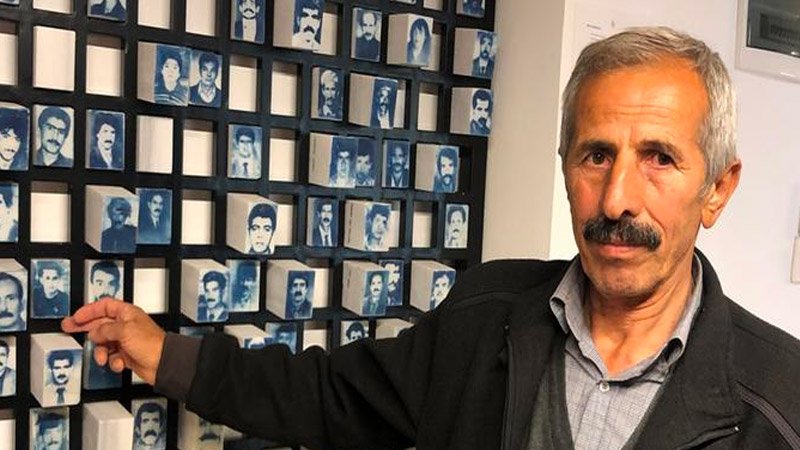
Turkey’s top appeals court has dropped a long-running case concerning the enforced disappearance of eight people, including three children, in the predominantly Kurdish province of Mardin in the 1990s, ruling that the statute of limitations had expired, Turkish Minute reported, citing the Mezopotamya news agency (MA).
The 1st Criminal Chamber of the Supreme Court of Appeals said the 30-year limitation period in the case, publicly known as the “Dargeçit JİTEM case,” expired on March 8, 2026, Mezopotamya said.
The case concerned people who disappeared after being detained in the Dargeçit district of Mardin between October 29, 1995, and March 8, 1996, as well as specialist sergeant Bilal Batırır, who also went missing after reportedly giving information to one of the families about the location of a body.
JİTEM, an alleged intelligence unit within the gendarmerie whose existence has never been officially acknowledged, has long been accused by human rights groups of involvement in extrajudicial killings, enforced disappearances and other abuses in Turkey’s mainly Kurdish Southeast during the 1990s, when the conflict between Turkish security forces and the outlawed Kurdistan Workers’ Party (PKK) was at its height.
The case was one of a number of trials launched in the early 2010s over alleged crimes committed during that period, but many ended in acquittals or dismissals.
The Supreme Court of Appeals overturned an April 18, 2024, ruling by the Gaziantep Regional Court of Appeals that had upheld the acquittal of the defendants. A retrial, however, was not ordered, but rather the case was dropped due to the expiration of the statute of limitations.
The court said the ordinary and extraordinary limitation periods under the former Turkish Penal Code, which it found to be more favorable to the defendants, had expired.
It ruled unanimously that the case be dismissed on grounds of the statute of limitations.
The decision covered 15 defendants, including three who died during the proceedings.
The case was brought to the Supreme Court of Appeals by lawyer Erdal Kuzu, who followed the trial on behalf of the Human Rights Association (İHD), after the appeals court upheld the acquittals.
Kuzu had asked the high court to overturn the lower court rulings.
Bones found years later
The disappearances took place during a period marked by intense military operations, village evacuations, unsolved murders and enforced disappearances in Turkey’s Kurdish-majority provinces.
In Dargeçit, Davut Altınkaynak, 12; Seyhan Doğan, 14; Nedim Akyön, 16; Mehmet Emin Aslan, 19; Abdurrahman Olcay, 20; Abdurrahman Coşkun, 21; Hikmet Kaya, 24; and Süleyman Seyhan, 57, were detained during house raids between October 29, 1995, and March 8, 1996, according to case records.
Their families heard nothing from them afterward.
As the families searched for their missing relatives, specialist sergeant Batırır reportedly told Seyhan’s family where his body had been buried. Seyhan’s body was found on March 6, 1996. Batırır also disappeared shortly afterward.
For years, there was little progress in the investigation. Search efforts began after new information was added to the file in 2012.
That year, bones belonging to Seyhan Doğan and Mehmet Emin Aslan were found at a vineyard building in Dargeçit. In 2013, the remains of Abdurrahman Olcay and Abdurrahman Coşkun were discovered in a well in the village of Tilzerin in Kızıltepe. The bones of Nedim Akyön and Davut Altınkaynak were found in 2015 near the Pekurt ruins on the banks of the Tigris River.
The defendants in the case, including former military officers, were charged with premeditated murder. In July 2022 a court acquitted all the defendants, saying there was not enough definitive evidence linking them to the disappearances.
The Gaziantep Regional Court of Appeals later upheld the acquittals, saying there had been no procedural or substantive legal violations and no deficiencies in the evidence or proceedings.
It also ruled that the case should be dropped for three village guard defendants who had died during the trial.
The Dargeçit case has been closely followed by rights groups and families of the disappeared as part of an ongoing struggle for accountability over the violence of the 1990s.
During that period, enforced disappearances and unsolved killings became associated in public memory with the so-called “white Toros” incidents, named after the white Renault Toros cars allegedly used by security and intelligence units to abduct people who were never seen alive again.
Some victims’ remains were later found in wells, forests, garbage dumps and rural areas, while others were never recovered.
The decision comes as Turkey’s Justice Ministry has recently established a department to examine unsolved killings and disappearances.
Following the creation of the Unsolved Crimes Investigation Department under the ministry’s General Directorate of Criminal Affairs, a deputy chief prosecutor and a prosecutor were assigned in Diyarbakır to review such files. A team in the city has identified 70 files, including cases from districts, the oldest dating back to 2002.
According to initial findings by the ministry, 638 files involving 693 victims in 75 provinces are being analyzed nationwide, including unsolved killings of women and children as well as high-profile disappearance cases such as that of university student Gülistan Doku.