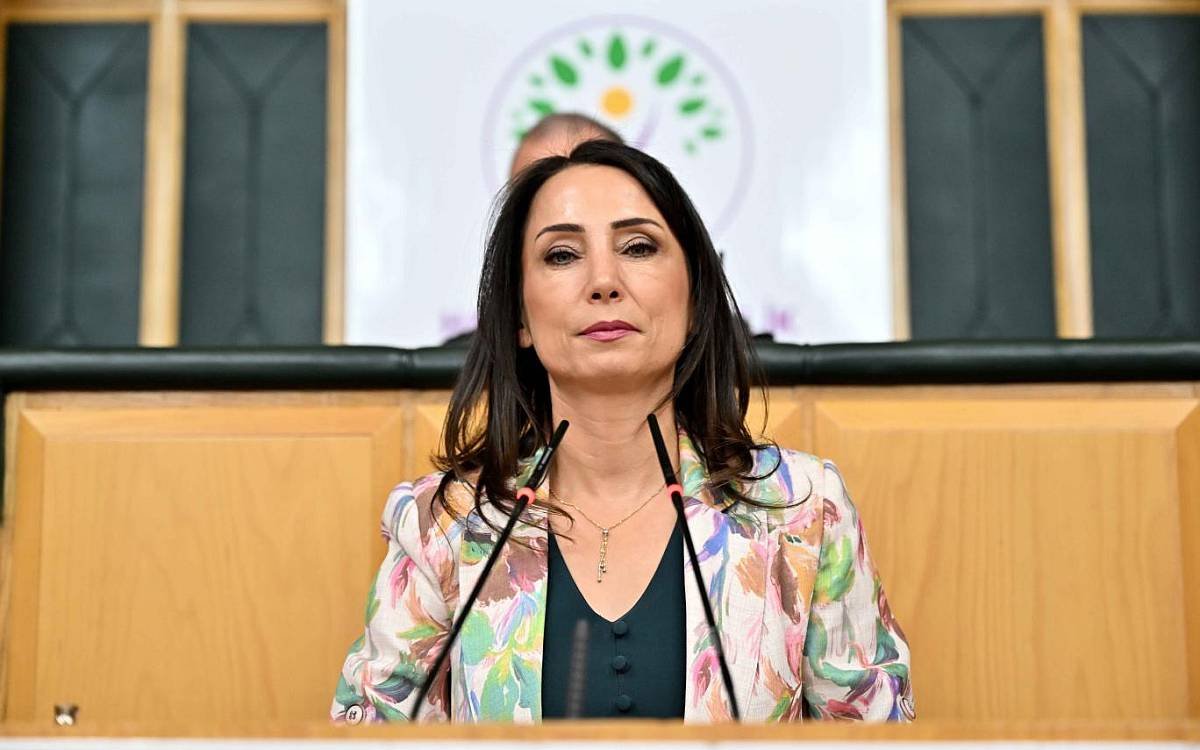
Tülay Hatimoğulları, co-chair of Turkey’s main pro-Kurdish party, has said concrete legal steps, including a “peace law,” the removal of government-appointed trustees and broader democratization measures, must be enacted as the next phase of Turkey’s peace initiative with the outlawed Kurdistan Workers’ Party (PKK), Turkish Minute reported.
In an interview with the Independent’s Turkish service, pro-Kurdish Peoples’ Equality and Democracy Party (DEM Party) co-chair Hatimoğulları said the process that followed the PKK decision to lay down arms and disband had entered a stage where legal guarantees, rather than political statements, would shape the next phase, with parliament expected to take up key legislation after the holiday recess.
“A peace law, the removal of trustees, the lifting of obstacles to democratic politics and prison-related regulations are no longer wishes but concrete demands on the table,” she added.
She said Kurdish political actors had taken steps toward ending armed conflict but that the government had yet to respond with reforms at the same pace, stressing that the process required mutual political will.
She also called for the release of jailed politicians and criticized the continuation of the trustee system under which elected mayors — predominantly in Kurdish-majority municipalities — are replaced by government-appointed administrators. She said these practices contradict both democratic principles and the recommendations of a parliamentary commission established to support the peace initiative.
In a draft report outlining legal reforms linked to the peace process, the commission proposes revisions to counterterrorism legislation, reintegration measures for former PKK militants and an end to the trustee system.

The report does not explicitly address jailed PKK leader Abdullah Öcalan’s possible release and does not use the term “right to hope.” However, it refers to European Court of Human Rights (ECtHR) and Turkish Constitutional Court rulings concerning sentence enforcement. Legal experts note that such language implicitly touches on the “right to hope” principle, which requires that even prisoners serving life sentences have a realistic prospect of release after a certain period.
Hatimoğulları warned that delays in democratic reforms could have negative consequences and said the success of the process depended on reciprocal steps.
“The only way for Turkey to be protected from a regional war is to ensure its social peace and eliminate its most significant vulnerability in defense and security,” she said.
She said the government faced three possible paths: accelerating democratization and the peace process, ending the process or delaying it, adding that only the first option would reduce risks of a regional war.
Hatimoğulları also rejected claims that the Kurdish issue had already been resolved, describing it as a longstanding and complex political question that required a democratic solution based on equality, rights and legal guarantees.
The Kurdish issue, a term prevalent in Turkey’s public discourse, refers to the demand for equal rights by the country’s Kurdish population and their struggle for recognition.
She said the DEM Party aimed to expand its role in Turkish politics despite what she described as the symptomatic effects of “long-standing political isolation, a media blackout and criminalization” targeting the party and its predecessors, adding that it would continue engaging with broader segments of society.
The current initiative follows Öcalan’s February 2025 call for the group to lay down arms, which preceded the group’s decision to dissolve in May 2025, ending a conflict that has killed more than 40,000 people since 1984.
A parliamentary commission later drafted a report outlining potential legal reforms; however, it did not explicitly address key issues such as the release of political prisoners or Öcalan’s legal status, leaving critical questions unresolved.
Public debate over the process has remained polarized. Research published in February indicated distrust among many Kurdish respondents, who called for concrete legal guarantees, while nationalist groups expressed concerns about state unity.