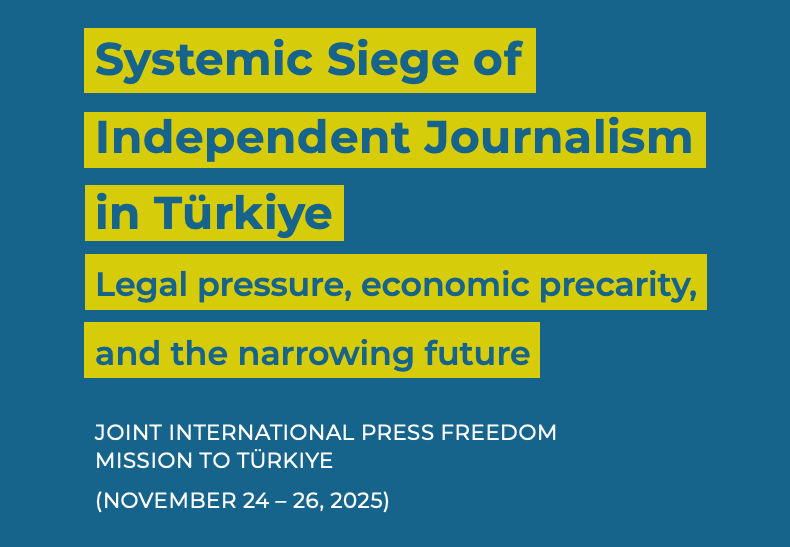
Press freedom in Turkey continued to deteriorate in 2025 amid judicial harassment, censorship, violence and economic pressure, according to a report by leading international press freedom organizations.
The report, which followed a joint mission to Ankara in November 2025 by representatives of eight international press freedom groups, concluded that Turkey’s media environment is marked by “a climate extremely hostile to independent journalism.”
“Critical reporting was routinely framed as a criminal or security concern, reinforcing a pervasive chilling effect across the media ecosystem,” it said.
The report linked the increasing pressure on independent journalism in 2025 to a wider crackdown on political opposition, particularly after protests erupted following the detention of İstanbul Mayor Ekrem İmamoğlu.
İmamoğlu, widely seen as President Recep Tayyip Erdoğan’s strongest political rival, was arrested in March 2025 on corruption charges that critics say are politically motivated and intended to sideline him ahead of the 2028 general election.
Prosecutions under terrorism and disinformation laws continued in 2025, with vague provisions enabling the criminalization of routine journalistic activities. High-profile cases included journalists Fatih Altaylı, Furkan Karabay, Tolga Şardan and Merdan Yanardağ. Courts also increasingly imposed prolonged pretrial detentions and judicial supervision measures.
Physical attacks on journalists reached “alarming levels,” the report said. The murder of Hakan Tosun, the assault on Enver Demirdaş and police inaction during an attack on satirical magazine LeMan reflected what the mission described as a “persistent pattern of violence” enabled by institutional impunity.
Authorities also relied on regulatory mechanisms, including broadcasting bans, fines, seizures and digital censorship, to suppress critical journalism without adequate judicial oversight, according to the report. It cited account blockings, bandwidth throttling, threats of license revocation and the appointment of trustees to opposition TV stations as forms of regulatory pressure.
Economic pressures further compounded the crisis facing independent media. Algorithm changes by major digital platforms reduced the reach of independent outlets by 70 to 90 percent, contributing to closures such as that of Gazete Duvar.
The report also highlighted the challenges faced by Turkish journalists living in exile who continued to contend with financial insecurity, professional isolation and security risks.
The mission called on Turkish authorities to repeal laws criminalizing journalism, ensure institutional independence and adopt policies to support financial sustainability of the media and reform digital governance.
The participating organizations were the International Press Institute (IPI), Amnesty International, ARTICLE 19 Europe, the Committee to Protect Journalists (CPJ), the European Centre for Press and Media Freedom (ECPMF), Osservatorio Balcani Caucaso Transeuropa (OBCT), Reporters Without Borders (RSF) and the South East Europe Media Organisation (SEEMO).
According to Expression Interrupted, a press freedom monitoring group, 27 journalists are currently behind bars in Turkey. The country’s deteriorating media landscape was further pointed out in the 2025 World Press Freedom Index published by Reporters Without Borders (RSF), where it was ranked 159th out of 180 nations.