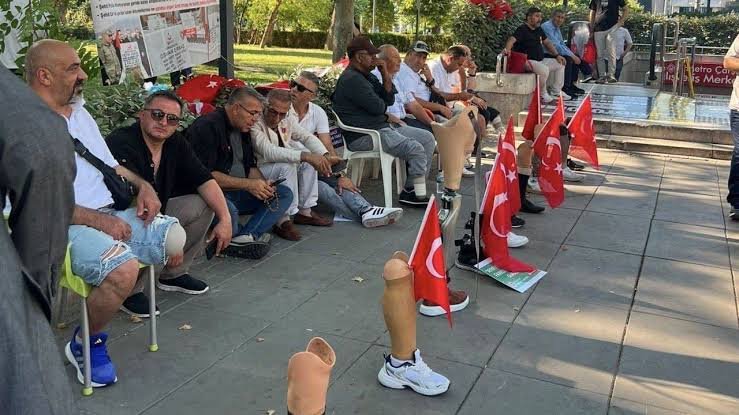
Turkish police early Wednesday removed relatives of conscripts killed in service and veterans who had been conscripted into military service from Ankara’s Güvenpark, ending a 38-day sit-in over unequal pensions and benefits based on military rank and service status.
Police arrived at the park at around 4:45 a.m. and removed the protesters, who had come to Ankara from across Turkey. They were taken by bus to the Bilkent Gazi Uyum Evi, a facility for veterans in Ankara, while police closed Güvenpark with barriers, according to the Karar daily.
The protesters are seeking the same pensions and social benefits granted to wounded career service members and the families of career personnel killed in service. Their demands include equal survivor and disability pensions, health care, prosthetic support, housing aid and access to military social facilities, regardless of rank or whether the service member was a conscript or career soldier.
Veterans say their pensions have lost value because, unlike those of former noncommissioned officers and specialist sergeants, they are not tied to the pay of personnel in equivalent posts.
Erdem Çerçioğlu, head of the Association of Families of Fallen Soldiers and Veterans (ŞAGAD), criticized the police intervention in a video recorded from a police bus after he was removed from the park.
“We encountered heavy police intervention at a quarter to 5. We are in a police vehicle right now. We do not know where we are being taken. The police intervened very harshly,” Çerçioğlu said.
Çerçioğlu later said that protesters were also subjected to physical force, alleging that at least 10 people had attacked him during the intervention.
During a later confrontation with police, one veteran fell ill and another climbed onto a bridge railing and threatened to take his own life. Fellow protesters persuaded him to come down.
The group began its sit-in on July 13 after coming to Ankara from all 81 provinces to demand equal rights regardless of rank. The protesters had said they would remain in Güvenpark until their demands were addressed.
As of Wednesday afternoon, the Ankara Governor’s Office, Ankara Police Directorate and other government bodies had not issued a written statement explaining the intervention. After being taken to the Bilkent Gazi Uyumevi, the protesters sought to march to the Interior Ministry but said police first kept them inside and then blocked their route, prompting another sit-in on the road.
The protest also drew visits from opposition politicians. Ankara Mayor Mansur Yavaş visited the group in July, while Democracy and Progress Party (DEVA Party) leader Ali Babacan visited on the 20th day of the sit-in and called on the government to meet their demands.
Victory Party (ZP) leader Ümit Özdağ criticized the police intervention, asking why the government was preventing the veterans from making a statement in front of the Interior Ministry.
“Why are you so afraid of these veterans? These people put their lives on the line so the state and nation could survive. They gave their legs, their arms, their eyes. Why are you preventing them from making a statement in front of the Interior Ministry?” Özdağ said at a press conference in Ankara.
Özdağ’s comments followed the police removal of the protesters on the 38th day of their sit-in in Güvenpark.
The removal came one day after a law on benefits for families of people killed in service and veterans was published in Turkey’s Official Gazette. The law raises monthly payments for disabled conscripts and other groups, guarantees a minimum pension for parents of those killed in service, raises payments for veterans who need full-time care and grants payments and benefits to some people wounded in counterterrorism operations but not classified as disabled. However, it does not fully equalize conscripts’ pensions and benefits with those of career military personnel, the protesters’ central demand.
This article is republished from Turkish Minute.