Turkey’s parliamentary peace commission has finalized a draft report proposing legal reforms tied to peace efforts with the Kurdistan Workers’ Party (PKK), including a new definition of terrorism, an end to appointing trustees over municipalities and reintegration of former PKK militants into civilian life, while hinting at changes that would pave the way for the release of jailed PKK founder Abdullah Öcalan, Turkish Minute reported.
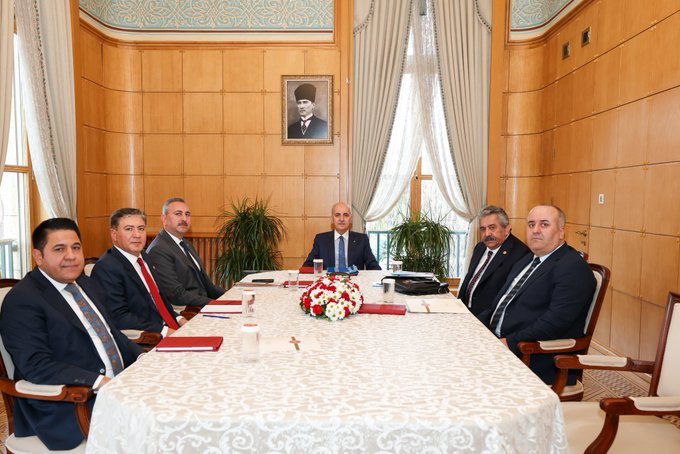
The draft report, seen by the BBC’s Turkish edition on Tuesday, was completed by a five-member writing team representing all parties on the National Solidarity, Brotherhood and Democracy Commission and is scheduled for a vote on Wednesday.
Parliament Speaker Numan Kurtulmuş, who chairs the commission, met with the writing team on Sunday to finalize small revisions to the text, then separately briefed representatives of smaller parties.
The report is organized into seven sections covering the commission’s work, its core objectives, a historical narrative of Turkish-Kurdish coexistence, hearing summaries, the PKK’s decision to disband, proposed legislation and democratization measures.
On terrorism, the report recommends that no non-violent act be prosecuted as a terrorist offense and that expression protected under freedom of speech not be treated as terrorism. It calls for revisions to the Turkish Penal Code and the Counterterrorism Law in line with the principle of legal clarity. On the media, it recommends that press freedom laws be reviewed so that opinion and criticism that do not cross into incitement no longer produce criminal liability.
The report also proposes ending the trustee system, under which the government removes elected mayors, predominantly in Kurdish-majority cities in Turkey’s southeast, and replaces them with government-appointed administrators. Since 2016, dozens of elected mayors have been removed from office, many of them members of Turkey’s main pro-Kurdish party.
The draft proposes that whenever a mayor is removed for any reason, their replacement be chosen by the city council through an election rather than appointed by the government.
On prisoners, the report recommends that sentence enforcement legislation be reviewed in line with rulings from the European Court of Human Rights (ECtHR) and Turkey’s Constitutional Court, and that conditional release conditions be made “fairer, more equitable and more comprehensive.” It calls for consideration of suspended sentences for sick and elderly inmates on the grounds that “the right to life takes precedence over all other rights.” It also recommends that detention be treated as a last resort and that pretrial detention rules be revised to reflect that principle.
For former PKK members, the report says those who laid down arms should be reintegrated into society, that those who did not commit crimes should be helped into civilian life and that their legal situations be handled “fairly and transparently.” However, the report specifies that all former members must still face a formal judicial process and that “legal arrangements must not create a perception of impunity or amnesty.”
On the process itself, the report says a standalone law will be needed once state security services verify that the PKK has fully given up its arms. That law “should be comprehensive enough to entirely resolve the consequences of the process and strengthen the ground for democratic politics,” according to the draft.
Öcalan’s release
The report does not directly address jailed PKK founder Öcalan’s release.
Öcalan, 76, has been imprisoned on İmralı Island in the Marmara Sea since 1999. He is serving an aggravated life sentence — a replacement for the death penalty in Turkey — for leading an armed insurrection. Under current Turkish law, people sentenced to aggravated life for crimes against the state are not eligible for conditional release under any circumstances.
Nationalist Movement Party (MHP) Deputy Chairman Feti Yıldız has previously said that all parties in the commission had agreed to include the term “right to hope,” a concept drawn from ECtHR jurisprudence holding that even people serving life sentences must have a realistic and meaningful possibility of release after a sufficiently long period, in the report.
“We agreed on the right to hope, there is no problem, it will be in the report,” Yıldız said. “ECtHR decisions already mention the right to hope. Our report will recommend compliance with ECtHR decisions. The right to hope is included in that.” The draft’s indirect language appears to be the formulation the ruling coalition settled on to satisfy that commitment without naming Öcalan explicitly.
Hence the term “right to hope” does not appear in the draft. Instead, the report refers more broadly to ECtHR and Constitutional Court case law on sentence enforcement, language that implicitly encompasses the concept without naming it.
Pro-Kurdish Peoples’ Equality and Democracy Party (DEM Party) Co-chair Tuncer Bakırhan has previously said the peace process cannot be separated from Öcalan’s situation. “Let there be peace and let Öcalan remain the same does not fit the logic of this initiative and will not be accepted by a large part of society,” Bakırhan said last week. His party has long demanded that the right to hope be embedded explicitly in Turkish law as a step toward Öcalan’s release.
The commission was established in August following the PKK’s decision to disband in May, which came after Öcalan issued a call from prison in February 2025 urging his followers to lay down their arms and disband. The PKK, which took up arms against the Turkish state in 1984, had waged an insurgency that cost more than 50,000 lives over four decades. Turkey and its Western allies designate the PKK as a terrorist organization.
The initiative traces back to October 2024, when MHP leader Devlet Bahçeli, a longtime hardliner on Kurdish rights, shocked the political establishment by shaking hands with DEM Party lawmakers in parliament and suggesting that Öcalan be allowed to address the DEM Party group in the legislature. Bahçeli is President Recep Tayyip Erdoğan’s most important ally, and his intervention was widely seen as a signal that the government was ready for a new attempt at a settlement, having failed in an earlier peace process that collapsed in 2015.
Critics have noted that the commission has no enforcement power, no independent monitors and that its work remains tied to Erdoğan’s own political calculations including his need for additional parliamentary support to extend his presidency beyond its 2028 constitutional limit.
The main opposition Republican People’s Party (CHP) has participated in commission sessions but refused to join the DEM Party delegation that visited Öcalan on İmralı Island, citing a lack of transparency about the process. A DEM Party delegation visited Öcalan most recently on February 16, the day before the writing team finalized the draft.
Critics have noted that the draft makes no provision for the tens of thousands of people targeted by the government for alleged links to the faith-based Gülen movement.
Erdoğan has been targeting followers of the Gülen movement, inspired by the late Muslim cleric Fethullah Gülen, since corruption investigations in December 2013 implicated him as well as some members of his family and inner circle.
Dismissing the investigations as a Gülenist coup and a conspiracy against his government, Erdoğan began to target the movement’s members. He designated the movement as a terrorist organization in May 2016 and intensified the crackdown on it following an abortive putsch in July of the same year that he accused Gülen of masterminding.
According to the latest figures from the Justice Ministry, more than 126,000 people have been convicted of alleged links to the movement since 2016, with 11,085 still in prison. Legal proceedings are ongoing for over 24,000 individuals, while another 58,000 remain under active investigation nearly a decade later.
In addition to the thousands who were jailed, scores of other Gülen movement followers had to flee Turkey to avoid the government crackdown.
DEVA Party lawmaker İdris Şahin said on Monday that the commission had a constitutional obligation to address those victims along with any legal changes made for former PKK fighters, warning that “you cannot build an atmosphere of peace and stability in this country while leaving new victims behind.”