A special parliamentary body on Thursday received only a four-page summary of a recent meeting between Turkish lawmakers and jailed Kurdistan Workers’ Party (PKK) leader Abdullah Öcalan instead of the full 16-page record, Turkish Minute reported.
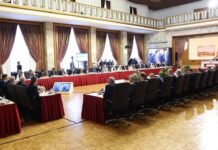
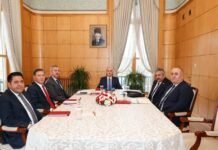
The parliamentary body is called the National Solidarity, Brotherhood and Democracy Commission. It was created in August to guide legal and political steps in Turkey’s attempt to end its four-decade conflict with the PKK, an armed group designated as a terrorist organization by Turkey and its Western allies.
Three lawmakers from the commission, Hüseyin Yayman from the ruling Justice and Development Party (AKP), Gülistan Kılıç Koçyiğit from the pro-Kurdish Peoples’ Equality and Democracy Party (DEM Party) and Feti Yıldız from the Nationalist Movement Party (MHP), visited Öcalan on November 24 at the İmralı High Security Prison in the Sea of Marmara.
Öcalan is serving a life sentence, and all contact with him is monitored by the National Intelligence Organization (MİT).
Koçyiğit later told journalist Cansu Çamlıbel of the T24 news website that none of the three lawmakers had seen or approved the shorter text. She said the deputies sent the full 16-page transcript to the parliament speaker and expected that document to be shared with the commission and the public. A member of the parliamentary commission had read the 4-page summary to the commission members, which then became public, which the pro-Kurdish member of the delegation says is misleading. The insistence of CHP, DEM Party and other opposition parties was to make the full 16-page records public and it seems that won’t happen.
She said the summary did not reflect Öcalan’s full remarks or the tone of the meeting and argued that Öcalan offered detailed comments on many issues and that his direct words should be shared.
In the summary read in parliament, Öcalan is presented as praising President Recep Tayyip Erdoğan and MHP leader Devlet Bahçeli for their roles in the new peace process. He is quoted as calling Bahçeli’s position rare in the history of the republic and as thanking Erdoğan.
The summary also says Öcalan told the delegation that he rejected armed conflict and stood by his earlier calls for the PKK to disband and lay down its weapons. It says he described each Turkish soldier’s death as a personal tragedy and repeated his view that Turks and Kurds cannot live apart.
Commission members told Öcalan that some PKK fighters who left Iraq still carried weapons and that this caused anger among the public. They also said some forces had moved into Syria.
Öcalan is quoted in the summary as saying the organization must give up what he called “mental weapons” as well as guns. He is also presented as supporting a unitary Syrian state with local democracy.
The text says Öcalan warned that if Syria’s government does not choose a democratic system, it will become a new dictatorship that harms all communities. It says he argued that Syrian Democratic Forces commander Mazlum Abdi is loyal to him and would accept his guidance.
Öcalan is also quoted as describing what he called “coup mechanics” that have damaged past peace efforts including indirect talks with former presidents Turgut Özal and Süleyman Demirel and former prime minister Necmettin Erbakan. He is presented as saying that he should have disbanded the PKK in 1993 but that unnamed forces blocked each attempt.
Koçyiğit said this part of the summary changed the meaning of Öcalan’s comments. She said he used the phrase “coup mechanics” to warn about political actors who may try to derail the current process.
She also said the summary downplayed Öcalan’s emphasis on democracy in both Turkey and Syria and his warning that Kurdish groups cannot accept a non-democratic system in Damascus. According to her account, Öcalan said that if Syria becomes democratic, the main questions will no longer be military ones.
Koçyiğit said Öcalan told the delegation that military issues will fade and that questions such as whether Kurdish forces join the Syrian army or work as local security will become second or third-level issues.
Parties lay out peace proposals, AKP signals shift on mayoral trustees
At the same commission meeting, lawmakers began to lay out their written proposals.
Main opposition Republican People’s Party (CHP) deputy group chair Murat Emir briefly summarized a 29-point paper that calls for full implementation of Constitutional Court and European Court of Human Rights rulings, a narrower and clearer counterterrorism law and an end to indictments based on secret-witness statements.
The CHP also calls for the release of people jailed in high-profile political cases, including those linked to the 2013 Gezi Park protests and to the year-long crackdown on CHP that led to the arrest of İstanbul Mayor Ekrem İmamoğlu and other opposition mayors.
Commission member Mustafa Şen from the ruling Justice and Development Party (AKP) focused on two main themes. He outlined his party’s ideas on the legal status of PKK members who lay down their arms, saying, “Membership in [a terrorist] organization is a crime,” but arguing that if the PKK disbands, then “the crime ceases to exist,” which could allow courts to drop cases and free some prisoners, followed by a five-year period of judicial supervision.
Şen then turned to one of the most sensitive issues for Kurds in Turkey, the central government’s longstanding practice of removing elected mayors in the southeast and replacing them with trustees.
Since 2016 Ankara has used terrorism allegations to take control of dozens of city and town municipalities run by pro-Kurdish parties. In many Kurdish-majority provinces, elected mayors from the Peoples’ Democratic Party (HDP) and later the DEM Party were dismissed and replaced by governors or senior civil servants chosen by the interior ministry.
The government has defended this as a security measure, saying municipal resources must not be used to support the PKK.
Kurdish politicians and human rights groups say it strips millions of voters of local representation and turns competitive elections into empty rituals if winners can be removed at will.
Şen told the commission that if the PKK is no longer active, the security argument for trusteeships disappears. He said the AKP’s draft proposals share the view that “if a trustee was appointed to a municipality for that reason, this practice should now be dropped,” signaling for the first time that the ruling party is ready to discuss giving back municipalities taken over on grounds of terrorism.
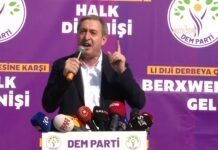
DEM Party deputy Cengiz Çiçek said Turkey must introduce a “right to hope” for prisoners serving aggravated life sentences, in line with a 2013 European Court of Human Rights ruling that says such prisoners should have a real chance of conditional release after 25 years. He said this would require changes to the Turkish Penal Code and to the law that governs prison terms and would directly affect Öcalan’s status.
Çiçek also called for the repeal of the counterterrorism law and a new enforcement law without special exceptions that target political opponents. He said rules used to punish the financing of terrorism are so broad that they criminalize sending money to relatives in prison and should be revised.
Parliament Speaker Numan Kurtulmuş, who chairs the commission, opened the session with a warning that members must be extremely careful with their words and must not turn the peace process into “political fodder.”
He said the commission has heard 134 individuals and organizations and that the hearing phase is now over. The next step is to combine all proposals into a joint report that will guide the drafting of new laws.
The commission aims to finish that report by the end of the year. Any legal changes will then go to other parliamentary committees and to the full assembly.