
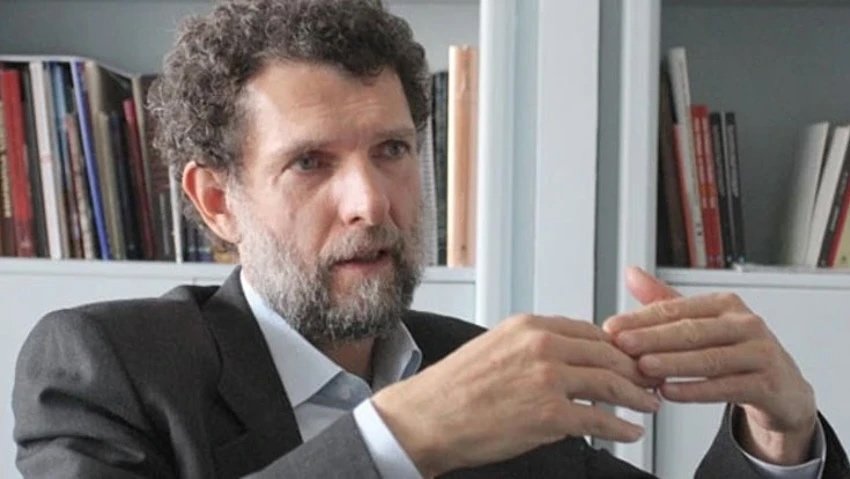
Jailed businessman and philanthropist Osman Kavala said on Thursday that Turkey’s compliance with a recent judgment of the European Court of Human Rights (ECtHR) ordering his immediate release was a basic obligation of a state governed by the rule of law, the Bianet news website reported.
Kavala made the remarks in his first statement since the ECtHR’s 17-judge Grand Chamber ordered Turkey to release him immediately and eliminate all the consequences of his conviction.
Kavala, 68, has been imprisoned since October 2017 and is serving an aggravated life sentence without the possibility of parole for allegedly attempting to overthrow the government by financing the anti-government Gezi Park protests of 2013.
He said the Grand Chamber had examined not only his detention but also the proceedings that led to his conviction.
“As in the ECtHR’s two previous judgments, the latest ruling emphasized that a person cannot be deprived of the right to live freely without convincing, concrete evidence showing that a crime was committed,” Kavala said in a written statement.
He recalled that he was acquitted in the first Gezi Park trial in 2020, saying that ruling had also established that there was no evidence he had committed a crime.
Kavala was acquitted of charges related to the Gezi protests in February 2020 but was immediately rearrested on separate accusations. An İstanbul court convicted him in April 2022, and the verdict was upheld by Turkey’s Supreme Court of Appeals in September 2023.
Kavala said the latest ECtHR judgment rejected the use of broad assessments and speculation about a defendant’s intentions as grounds for a criminal conviction.
“The ECtHR has made clear that courts cannot hand down convictions based on general assessments of events or reasoning that claims to infer the purpose behind a person’s activities,” he said.
Kavala said people who had not committed an act defined as a crime by law could not be deprived of their liberty.
“Protecting this right and ensuring that public institutions strictly observe this principle is an obligation of a state governed by the rule of law toward its citizens,” he said.
“Compliance with ECtHR judgments is necessary for fulfilling that obligation.”
In its final judgment on Tuesday, the Grand Chamber found that Kavala’s prosecution, continued detention and conviction had been intended primarily to punish and silence him over his involvement in the Gezi Park protests and his work as a human rights defender.
The court said Kavala had been convicted for activities protected by the European Convention on Human Rights, including participation in public debate, support for civil society initiatives and advocacy for peaceful protests.
It found that Turkish courts had failed to establish a concrete link between Kavala and acts of violence committed during the protests.
His conviction amounted to a “flagrant denial of justice” and must be regarded as null and void under convention law, the court said.
The judges found violations of Kavala’s rights to liberty, a fair trial, freedom of expression and freedom of assembly and association. They also found that his life sentence without the possibility of review violated the prohibition of inhuman or degrading treatment.
The court awarded Kavala €70,000 ($81,600) in nonpecuniary damages and €43,342.57 for legal costs and expenses.
The ECtHR first ordered Kavala’s release in December 2019, finding that his detention lacked reasonable grounds and pursued the ulterior purpose of silencing him.
After Turkey refused to implement the ruling, the Council of Europe initiated infringement proceedings. The Strasbourg court ruled in July 2022 that Ankara had failed to comply with its obligations.
The latest judgment is final and cannot be appealed. But the Turkish government’s initial response offered little indication that it was prepared to comply.
Presidential legal adviser Mehmet Uçum on Wednesday accused the ECtHR of issuing a politically motivated judgment and suggested that Turkey could reconsider its participation in the European human rights system.
Although Uçum advises President Recep Tayyip Erdoğan on legal policy, his remarks did not constitute an official announcement that Turkey intends to withdraw from the European Convention on Human Rights.
This article is republished from Turkish Minute.