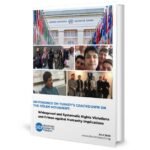
Four international judges associations have called on Turkey to release people imprisoned in violation of fundamental rights during the crackdown that followed a 2016 coup attempt and to restore judicial independence and democratic governance, which have been systematically eroded over the past decade.
In a joint statement released on Wednesday, the associations said the dismissal of more than 4,500 judges and prosecutors after the coup attempt, politically driven recruitment of their replacements and constitutional amendments that introduced an executive presidential system in 2017 had destroyed judicial independence and undermined democratic governance.
The associations said the 2017 constitutional amendments put the Council of Judges and Prosecutors (HSK) under the decisive control of political authorities, prompting the European Network of Councils for the Judiciary to suspend the council’s status over concerns about its independence.
According to the associations, the post-coup measures evolved from an emergency response into a systematic transformation of both the judiciary and the constitutional order.
The statement also pointed to the imprisonment of Murat Arslan, president of Turkey’s now-dissolved Judges and Prosecutors Association (YARSAV), as an example of the elimination of independent judicial voices following the purge.
Citing European Court of Human Rights (ECtHR) rulings including Baş v. Türkiye and Yalçınkaya v. Türkiye, the associations said the court had identified systemic violations of fundamental rights and the rule of law.
In its 2023 Grand Chamber judgment in Yalçınkaya v. Turkey, the court found that the use of digital evidence and association-based criteria to convict people of terrorism-related offenses had violated the applicant’s fair trial rights. According to the latest figures from the justice ministry, more than 127,000 people have been convicted in post-coup prosecutions since 2016, with 10,485 still in prison and legal proceedings ongoing against 83,404 individuals.
The associations also pointed to Turkey’s continued failure to implement ECtHR judgements, including the ruling ordering the release of jailed businessman and philanthropist Osman Kavala, as evidence of its persistent non-compliance with its obligations under the European Convention on Human Rights.
Kavala was arrested in October 2017 and sentenced to life in 2022 on charges of attempting to overthrow the government of President Recep Tayyip Erdoğan. His conviction was upheld by the Supreme Court of Appeals in September 2023.
“Once courts cease to operate independently, rights exist only on paper, constitutional limitations lose practical significance, and law becomes an instrument for exercising power rather than constraining it,” the associations said.
They called on Turkey to fully implement the ECtHR judgements, provide effective remedies for dismissed judges and prosecutors and restore merit-based judicial recruitment.
They also urged European institutions to take concrete action in response to Turkey’s continued non-compliance with its obligations.
The statement was undersigned by President of the Association of European Administrative Judges (AEAJ) Sylvain Mérenne, President of the European Association of Judges (EAJ) Sabine Matejka, President of Judges for Judges Tamara Trotman and President of Magistrats Européens pour la Démocratie et les Libertés (MEDEL) Mariarosaria Guglielmi.
Turkey was ranked 118th out of 142 countries in the World Justice Project’s 2025 Rule of Law Index, reflecting longstanding concerns over judicial independence that have intensified since the 2016 coup attempt.