Human Rights Watch (HRW) on Monday urged Turkish authorities to remove restrictions on lawyers, journalists and the public seeking to follow the trial of jailed İstanbul Mayor Ekrem İmamoğlu, as the proceedings entered their third week, Turkish Minute reported.
The trial, which began on March 9 and involves İmamoğlu and 406 municipal officials and others facing what rights groups describe as politically motivated corruption charges, entered its third week on March 23 amid mounting concerns over transparency and access.
HRW criticized decisions by the İstanbul 40th High Criminal Court to limit who can attend hearings and to confine journalists to a remote corner of the courtroom, saying the measures undermine the principle of open justice.
“The fundamental principle that justice must be seen to be done requires access for journalists, lawyers, and the public, especially when elected officials are on trial and the proceedings are of such public interest,” said Benjamin Ward, deputy Europe and Central Asia director at Human Rights Watch.
“There is a lot of empty space in the huge courtroom that could and should be used to ensure that journalists observing the case are able to effectively follow the proceedings.”
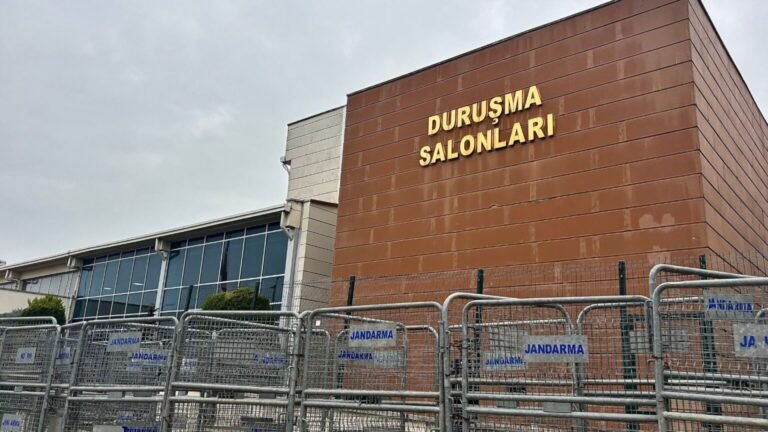
The hearings are being held at the courthouse inside the Marmara Prison complex in Silivri, İstanbul’s most remote district, about 70 kilometers from the city center, under heavy security with gendarmes, barricades and identity checks at multiple entry points.
On March 16 the court issued a written order limiting attendance to defendants, up to three lawyers per defendant, one relative each and media, excluding all others from the courtroom. Lawyers not representing defendants but wanting to observe proceedings were also barred.
Subsequent hearings on March 17 and 18 were held with increased security and a reduced public presence. All defendants’ relatives were seated in the back, while many rows reserved for lawyers remained empty.
Following negotiations, several main opposition Republican People’s Party (CHP) lawmakers were admitted to the back of the courtroom, and on March 18 additional relatives and opposition party officials were allowed in, though broader public access and independent lawyers remained restricted.
The restrictions followed a series of tense sessions marked by disputes over seating arrangements between the court, defense lawyers, journalists and lawmakers from the CHP, from which İmamoğlu was elected.
Earlier in the trial, proceedings were briefly halted after a dispute between CHP lawmaker Turan Taşkın Özer and the presiding judge over seating, highlighting growing tensions inside the courtroom.
Journalists have also protested new rules requiring them to follow proceedings from what they describe as a “blind spot” in the courtroom. From that position, they can hear only amplified testimony and see defendants via video screens, while off-microphone exchanges between judges and defendants remain inaudible.
Following an incident in which a journalist asked İmamoğlu a question as he was leaving the courtroom, reporters are now required to remain in the back corner, prompting written petitions requesting relocation to empty side benches to better observe proceedings.
HRW said such restrictions come amid a broader pattern of pressure on journalists in Turkey over the past year for their reporting on investigations and court cases targeting İmamoğlu, other CHP mayors and legal efforts affecting the party’s leadership.
The indictment accuses İmamoğlu of leading a criminal organization and includes charges such as bribery, bid-rigging, embezzlement and espionage, with prosecutors seeking a combined sentence of up to 2,430 years in prison. Critics say the case criminalizes legitimate political activity and is part of a wider crackdown on the opposition following the CHP’s strong performance in the March 2024 local elections.
Two co-defendants, CHP district mayors Resul Emrah Şahan of Şişli and Mehmet Murat Çalık of Beylikdüzü, are expected to present their defense this week. HRW warned that if current entry restrictions remain in place, the public may not be permitted to attend their hearings.
Under the Turkish Constitution, court hearings are open to the public, with closed sessions allowed only when strictly required by considerations of public morality or security. In 2023 the Constitutional Court reaffirmed that public trials are a constitutional requirement and that restrictions may only be imposed under narrowly defined conditions.
Article 6 of the European Convention on Human Rights also guarantees the right to a fair and public hearing. The European Court of Human Rights has said that while some limitations may be permitted, they must be strictly necessary in the interest of justice.
“Imposing arbitrary restrictions on access to this case undermines confidence in the proceedings and violates the requirement under Turkish and international law to conduct justice in public,” Ward said. “Instead of limiting the public’s right to information about the case, the authorities should allow journalists to report fully on proceedings and ensure public access to the trial.”
The trial is expected to last for 45 days of hearings.