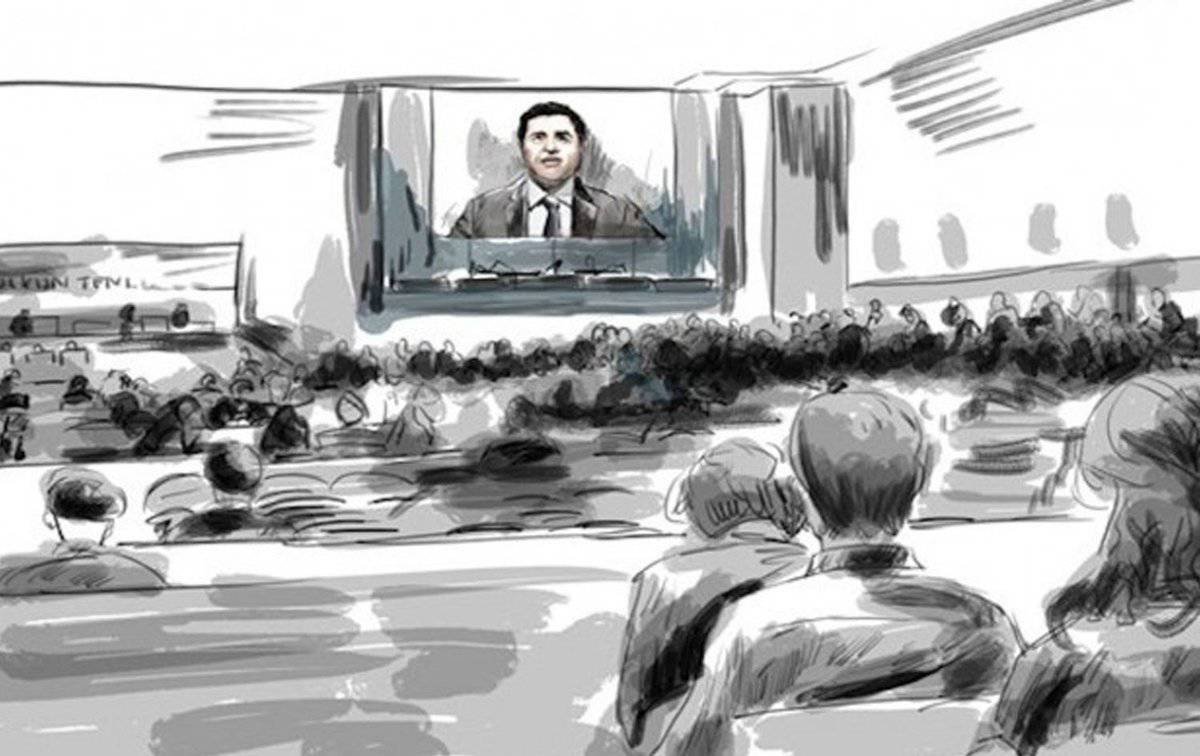
A Turkish court has sentenced seven journalists to 18 days in prison for allegedly recording audio and video during the final hearing of the high-profile Kobani trial, which included prominent Kurdish politicians among 108 defendants, Turkish Minute reported, citing the Media and Law Studies Association.
An Ankara criminal court of peace convicted journalists Damla Kırmızıtaş, Derya Okatan Albayrak, Fatih Polat, Fırat Can Arslan, Handan Ceren Bayar, Hüseyin Hayatsever and Kaan Can Bircan on charges of “recording audio or video during a hearing.”
The court said the police determined that the journalists used mobile phones and tablets to take recordings during the May 16, 2024, final hearing held at the Sincan Prison complex in Ankara and concluded that “the offense was established.”
The case was handled under a summary procedure without a full trial hearing.
The court ruled that the file was not complex and that existing evidence was sufficient. The journalists were initially sentenced to one month in prison under Article 286/1 of the Turkish Penal Code. After applying discretionary and procedural reductions, the sentence was reduced to 18 days.
The court gave a suspended sentence to Kırmızıtaş, while converting short prison terms into a judicial fine of 900 Turkish lira ($20) for some of the other defendants.
In the case of journalist Fatih Polat, the court ruled that a repeat offender procedure would apply due to a previous conviction.
The journalists’ lawyers claimed that their clients were present at the hearing in their professional capacity and did not make any audio or video recordings.
They said the only evidence cited against the journalists was a police report and that no forensic examination had been conducted on the journalists’ devices.
The lawyers argued that there was no concrete proof of any recording and that the police report alone could not justify a conviction.
The defense also claimed that the journalists were fulfilling their duty to inform the public and that the elements of the alleged offense had not been met.
They described the prosecution as a disproportionate interference with freedom of the press and the right to freedom of expression, adding that no clear prohibition had been communicated to journalists during the hearing and that the police report did not contain individualized findings.
Initially, prosecutors launched an investigation into 21 journalists on the same accusation. Some reporters, including correspondents from Hürriyet, the Anka news agency, Ulusal Kanal, SZC TV, Voice of America, Gazete Duvar, Evrensel, Reuters and Medyascope, opted for a prepayment procedure under the summary process.
The investigation into the seven journalists who declined prepayment was later turned into a criminal case.
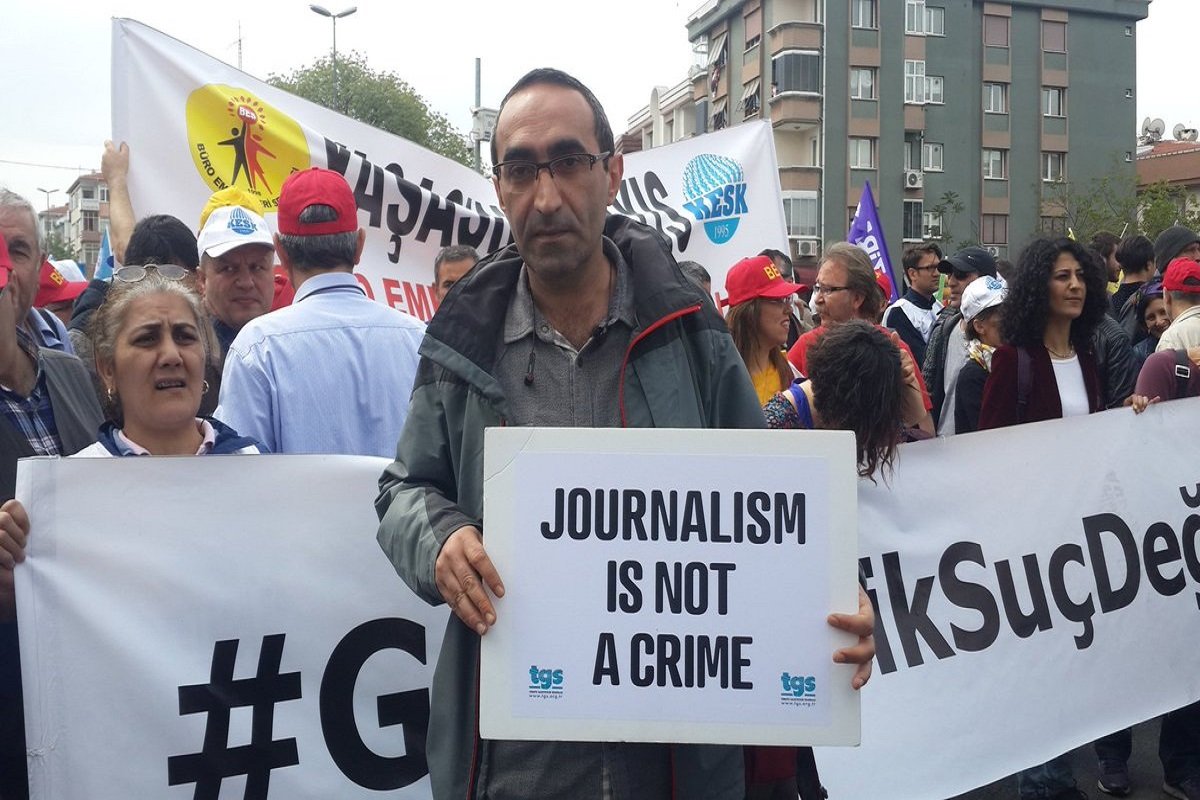
Turkey continues to rank among the world’s worst performers on press freedom. It placed 159th out of 180 countries in the 2025 World Press Freedom Index published by Reporters Without Borders (RSF).
Journalists in Turkey frequently face investigation, prosecution and conviction in connection with their reporting.
The Kobani trial concerns the events of October 6-8, 2014, when the Islamic State in Iraq and the Levant (ISIL) laid siege to the Syrian town of Kobani. Protests erupted across Turkey, particularly in predominantly Kurdish southeastern provinces. The Turkish government accused leaders of the Peoples’ Democratic Party (HDP), the main pro-Kurdish party at the time, of inciting the demonstrations, which left 37 people dead.
Then-HDP-co-chairs Selahattin Demirtaş and Figen Yüksekdağ and other defendants denied the charges, saying their calls for solidarity with Kobani were democratic and protected by freedom of expression.
In May 2024 the court handed down lengthy prison sentences to several defendants in the Kobani case. The verdict sparked criticism from rights groups and opposition figures, who described the trial as politically motivated.
Demirtaş and Yüksekdağ have been jailed since November 2016 on terrorism-related charges and remain behind bars despite rulings from the European Court of Human Rights calling for their release.