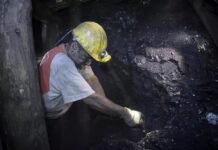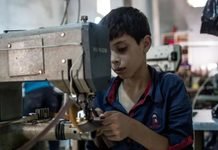

At least 212 people died in work-related incidents across Turkey in May, bringing the death toll for the first five months of 2026 to 835, according to a new report by the Health and Safety Labour Watch Turkey (İSİG).
Agriculture and forestry accounted for the highest number of deaths with 48, followed by construction with 38 and transportation with 33.
The report, compiled from a variety of sources including national and local media, trade unions, workers’ families and colleagues, said the victims included 13 women and 16 refugees or migrants from Egypt, Uzbekistan, Syria and Turkmenistan (three each) and Afghanistan, Iran, Kazakhstan and Senegal (one each).
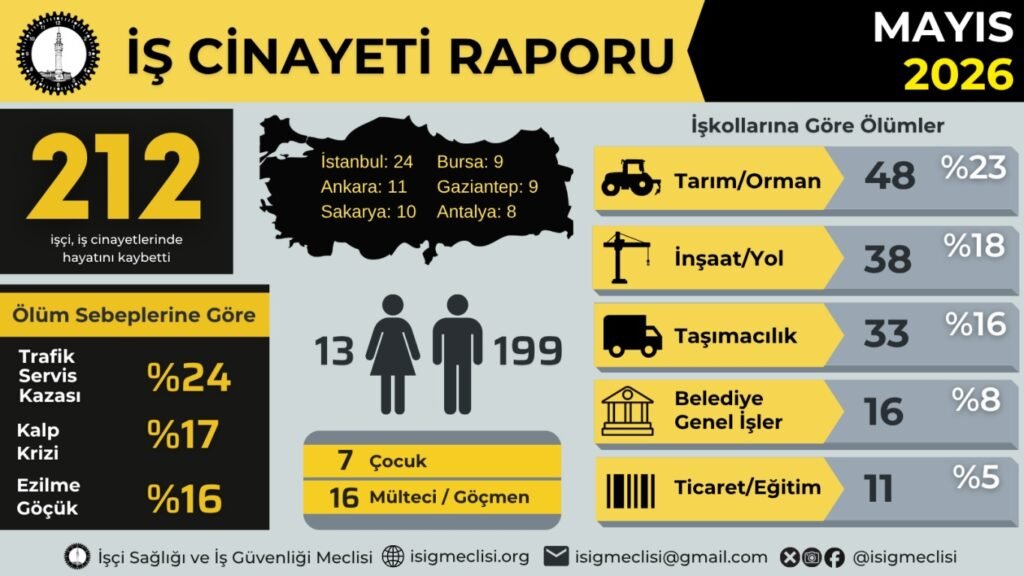
Traffic accidents were the leading cause of death, accounting for 24 percent of all fatalities, İSİG said.
The report also found that 5 percent of the deceased workers were unionized, with 10 identified as union members.
İSİG reported that three workers died from silicosis, a fatal lung disease caused by inhaling crystalline silica dust, despite Turkey’s 2009 ban on the use of the material, which is used in sandblasting operations.
The report also said workplace mobbing has continued to be cited in worker suicides. In Kocaeli a worker who had said he could not work in a heavy-duty section due to multiple sclerosis was nonetheless assigned there and later died by suicide.
In another case 19-year-old Syrian university student Hanaa Ebu Zeyneb was found hanged in the stockroom of a café in Konya where she worked as an unregistered waitress. The report described her death as suspicious.
İstanbul recorded the highest number of fatalities with 24 deaths, followed by Ankara (11) and Sakarya (10).
İSİG documented 2,105 work-related deaths in 2025, the highest annual total in at least a decade, indicating that workplace safety in Turkey is worsening rather than improving.
Workplace accidents remain a chronic problem in the country, where lax enforcement of occupational health and safety standards continues to cost lives.
Turkey made progress in aligning its occupational health and safety legislation with European Union standards after it became an EU candidate country in 1999 and also ratified the relevant International Labour Organization conventions in 2005. However, implementation and enforcement of these standards have been far less effective. In recent years an influx of migrants and growing economic instability have further undermined workplace safety, as investments in safety measures declined and informal employment increased.
Turkey’s poor record on labor rights has also been highlighted internationally. A yearly report produced by the International Trade Union Confederation (ITUC) on labor rights revealed that Turkey is one of the 10 worst countries in the world for workers in industrial sectors. According to the Brussels-based ITUC, workers’ freedoms and rights have been further denied since police crackdowns on protests in Turkey in 2025, while strikes and attempts to unionize were prevented by the authorities.