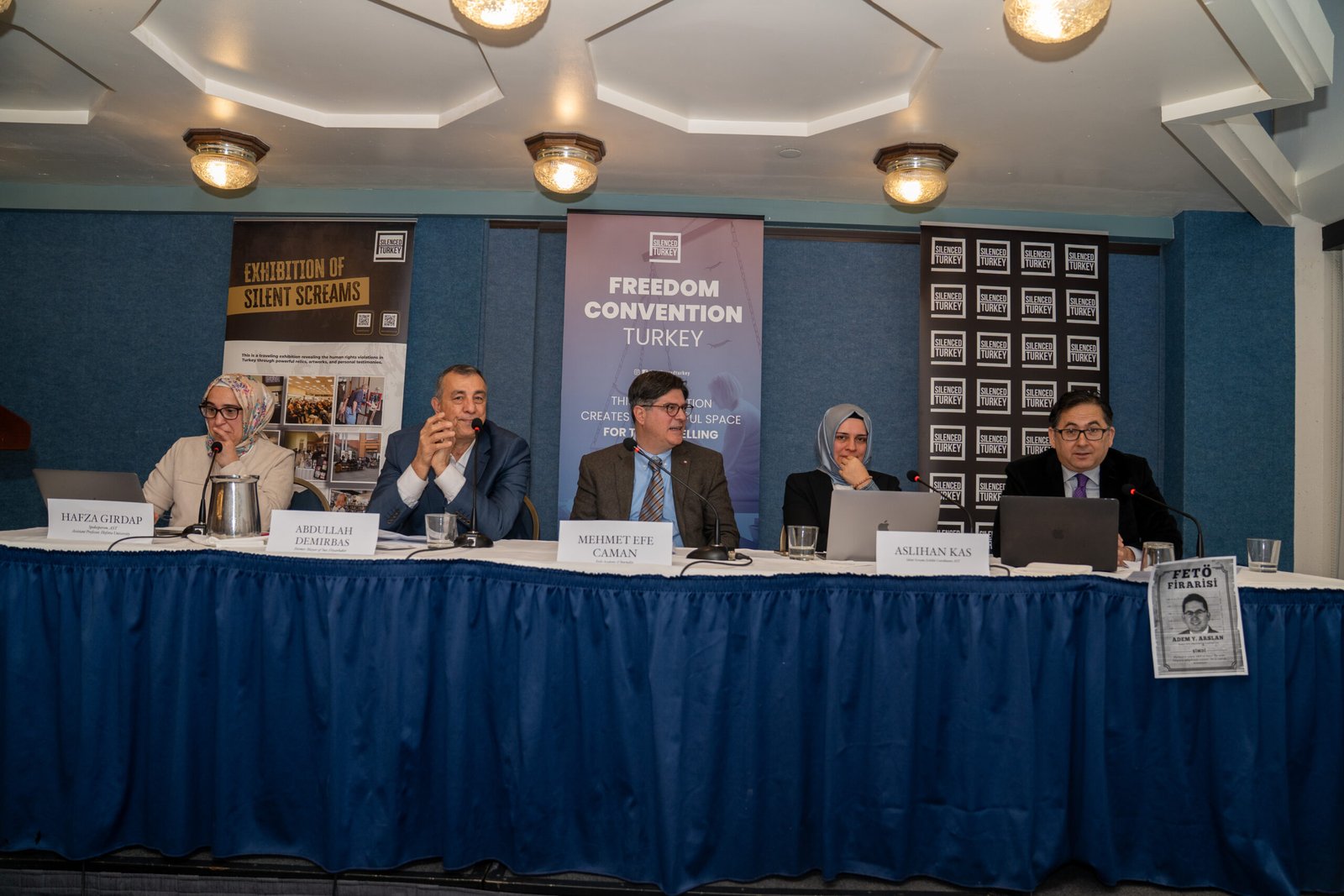
Marking International Human Rights Day, the Freedom Convention Turkey 2025 brought victims of state violence, purged academics, journalists living in exile, human rights defenders and community leaders together at the National Press Club in Washington, D.C., on Wednesday, according to Abdülhamid Bilici’s report published on Turkish Minute.
Turkey has been experiencing a human rights crisis since an abortive putsch in 2016, after which the government started a sweeping crackdown on non-loyalist citizens, jailing tens of thousands on broad terrorism charges while dismissing more than 100,000 from civil service with emergency decrees subject to no judicial scrutiny.
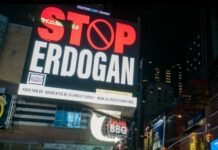
Organized by Advocates of Silenced Turkey (AST), a US-based human rights group, under the theme “Turkey at the Crossroads: Democracy and Justice,” the event highlighted the scale of repression, discrimination and injustice in Turkey over the past decade.
Opening the conference, AST spokesperson Dr. Hafza Girdap warned that freedom of expression, the rule of law and equality before justice are under severe threat in Turkey.
Banned documentary highlights purge
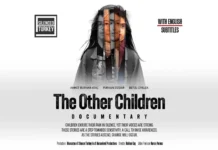
The program opened with the screening of Kanun Hükmü (Decree), directed by Nejla Demirci, which documents the suffering of people fired from public service by emergency decrees.
Speakers recalled that the film was removed from the Antalya Golden Orange Film Festival and blocked from public screenings across Turkey despite focusing on only two individual cases to illustrate the broader devastation caused by mass purges.
Participants also visited the Silent Screams exhibition, which displayed personal belongings of detained, missing or exiled individuals. Organizers said the exhibit aimed to underscore a central message of the day: “Behind every statistic lies a human life.”
Counterterrorism laws as a tool of repression
AST President Osman Dülgeroğlu said Turkey’s counterterrorism legislation has been systematically misused to silence dissent. Between 2014 and 2024 nearly 3 million investigations were launched under counterterrorism provisions, a figure he described as showing “the sheer scale of injustice.”
Testimonies of civil death and fear
Dr. Murat Can, who spent five years in prison and now lives in exile, described the post-2016 crackdown as a form of “civil death.”
“I was interrogated with absurd accusations and sentenced to nine years without even being allowed to defend myself,” he said.
To illustrate the scope of repression, he cited figures including more than 2 million investigations, nearly 400,000 detentions, 120,000 arrests and around 130,000 public sector dismissals.
“Every number represents a life, a child’s cry, a mother’s tears,” Can said. He added that the charges against his family escalated to the point where his wife was targeted simply because the couple had spoken on the phone more than 600 times.
Ordinary life criminalized
Andrea Barron of the Torture Abolition and Survivors Support Coalition (TASSC International) recounted her observations from the “Girls’ Trial” in İstanbul.
“The prosecutor charged 41 women and children with terrorism,” she said. “The judge never asked about weapons or violence, only why they studied math together, went bowling or prayed.”
Children as overlooked victims
University student Azra Polat, whose father has been imprisoned for more than eight years, said children and young people are among the most neglected victims of the crackdown.
“I am my father’s daughter. I will not abandon my beliefs, even if it costs me my life,” she said, asking the audience, “Are you ready to stand tall no matter the cost?”
Media freedom at a breaking point
Se Hoon Kim, senior White House correspondent for Global Strat View, described media restrictions in Turkey as extreme.
“What’s happening in Turkey is complete madness,” he said. “Journalists must ask leaders the questions they don’t want to hear.”
Echoing that view, journalist Adem Yavuz Arslan, who lives in exile in the US, said he faces hundreds of lawsuits, including three aggravated life sentences, for his reporting.
“I watched my father’s funeral on FaceTime,” he said. “To survive, I became an Uber driver.”
Kurdish identity and long-term pressure
Abdullah Demirbaş, former mayor of the Sur district in Turkey’s Kurdish-majority Diyarbakır province, spoke about years of pressure, threats and assassination attempts, saying Kurds have been punished simply for asserting their identity.
“We are the ancient people of these lands,” he said. “We were punished simply for trying to prove that we exist.”
A system built on fear
Political scientist Dr. Mehmet Efe Çaman said emergency decrees enabled authoritarian consolidation after the 2016 coup attempt, pushing Turkey toward a system resembling that of Russia.
“The regime justified everything by saying, ‘We caught the traitors, and they will pay the price,’” he said.
Çaman read from a school assignment written by his daughter, describing the impact of collective punishment on families.
“Losing my passport changed my life overnight,” the text read. “I’d like to think I overcame it, but writing this made me realize I haven’t.”
Making invisible pain visible
Aslıhan Kaş, coordinator of the Silent Screams exhibition, recounted her own imprisonment and years of separation from her family.
“We are trying to make invisible pain visible,” she said, breaking down as she spoke of her late friend Hatice Akçabay, an educator who died along with her three children while trying to cross the Maritsa River into Greece.
‘Silence is not a solution’
Closing the event, Dr. Girdap said authoritarian systems rely on silence.
“Authoritarianism thrives on silence, and today we chose to speak openly and courageously,” she said, adding that journalists, academics and civil society groups would continue to challenge repression despite the risks.