
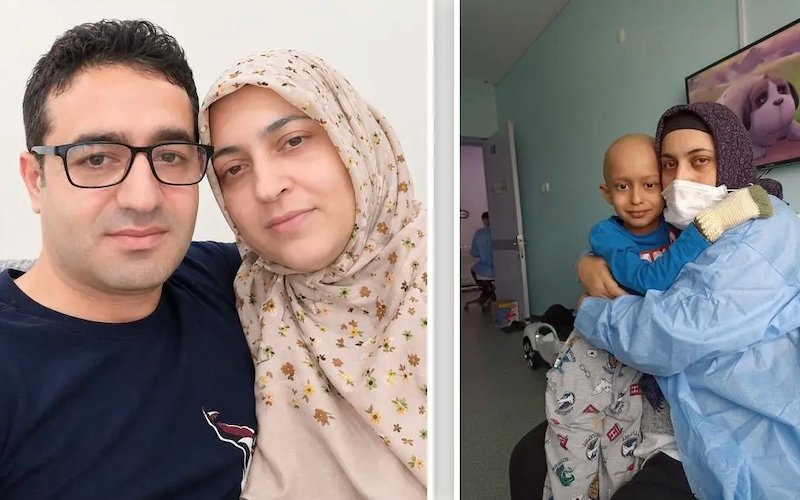
Gülten Sayın, imprisoned over alleged links to the faith-based Gülen movement while her son battled bone cancer, was released Friday pending retrial after the Constitutional Court found a rights violation, more than three years after the boy’s death.
The Bilecik 1st High Criminal Court suspended enforcement of her prison sentence of more than six years and ordered a retrial after the Constitutional Court ruled on September 22 that her right to a reasoned judgment, part of the right to a fair trial, had been violated. The lower court also imposed an international travel ban. Her husband, Süleyman Sayın, announced her release on X on November 20.
Sayın was briefly detained in February 2017, when her son Yusuf Kerim was just two-and-a-half months old. A Bilecik court sentenced her to more than six years in prison on March 30, 2018. Prosecutors cited her work as director of a student dormitory later closed by the government, deposits at Bank Asya, which was shut down in 2016, and her alleged use of ByLock, an encrypted messaging app once widely available on Apple’s App Store and Google Play that Turkish authorities claim Gülen supporters used as a secret communication tool.
Turkish President Recep Tayyip Erdoğan has targeted the faith-based Gülen movement, inspired by Muslim cleric Fethullah Gülen, who died in 2024, since corruption investigations in December 2013 implicated Erdoğan as well as some members of his family and inner circle. He dismissed the probes as a Gülenist conspiracy and designated the movement as a terrorist organization in May 2016, intensifying a sweeping crackdown after a coup attempt in July of the same year that he accused Gülen of orchestrating. The movement denies involvement in the attempted coup or any terrorist activity.
The Supreme Court of Appeals upheld her conviction on December 15, 2022, and she began serving her sentence at Sakarya Ferizli Prison the next day, while her 6-year-old son was undergoing treatment for Ewing sarcoma, a rare form of bone cancer. Her family’s request to postpone her sentence because of his illness was denied, prompting calls from human rights advocates for her release.
Videos of Yusuf Kerim crying and asking for his mother while receiving treatment in a hospital drew support from opposition politicians, rights advocates and public figures. Prison authorities initially allowed Sayın to visit her son in the hospital for eight hours in December 2022 and 12 hours in January 2023.
The campaign helped bring about legislation that took effect in April 2023, allowing prosecutors to postpone prison sentences of 10 years or less for women whose children under 18 are seriously ill or require care because of a disability. The provision became widely known as the “Yusuf Kerim law.”
Sayın was temporarily released on April 18, 2023, allowing her to remain with her son during his treatment. Yusuf Kerim died on October 2, 2023, at age six. Eight days later, authorities revoked the postponement of her sentence, saying the circumstances justifying it no longer existed and sent her back to prison.
In an interview after her release, Sayın said her prison ward housed 27 women, sometimes as many as 38, forcing some to sleep in common areas. She also described children living in prison with their mothers, including a 4-year-old who had spent 17 months there before the child’s mother arranged for the child to live outside the prison.
According to figures released by Justice Minister Akın Gürlek in July 2026, more than 127,000 people have been convicted of alleged links to the movement since 2016, with 10,485 still in prison and legal proceedings ongoing against 83,404 individuals.