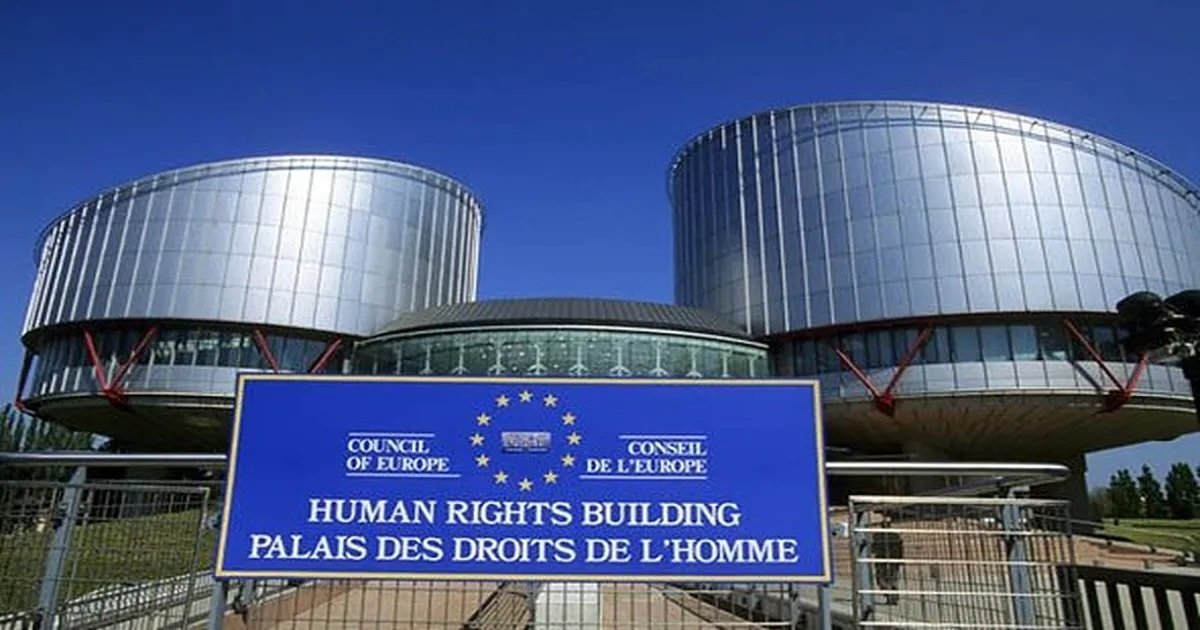
The European Court of Human Rights (ECtHR) found 1,004 violations of the right to a fair trial in cases against Turkey between 2003 and 2025, according to official statistics published by Turkey’s Justice Ministry.
The figures, published by the ministry’s human rights fepartment in its annual breakdown of Article 6 violations, concern the provision of the European Convention on Human Rights (ECHR) that guarantees the right to a fair trial. The highest annual total was recorded in 2009, when the Strasbourg-based court identified 126 violations in that category.
The court recorded 24 such violations in 2025, up from 13 in 2024, according to the ministry’s data.
The figures show 415 violations between 2003 and 2007, followed by 299 between 2008 and 2012, 123 between 2013 and 2017 and 113 between 2018 and 2022. Another 54 violations were recorded between 2023 and 2025.
The statistics reflect the years in which the European court issued its findings, rather than necessarily when the underlying violations occurred.
Article 6 of the ECHR guarantees the right to a fair and public hearing before an independent and impartial court within a reasonable period of time. It also protects the presumption of innocence and defendants’ rights to legal assistance and to challenge evidence presented against them.
The ministry separately classifies violations involving excessive delays in judicial proceedings and failures to enforce court judgments, which are also covered by Article 6. In 2025 the court recorded eight violations concerning excessive delays and one involving the failure to enforce a judgment, in addition to the 24 findings in the fair-trial category.
The fair-trial findings form part of a larger record of ECtHR judgments against Turkey, including cases involving unlawful detention, restrictions on political freedoms and other fundamental rights. Turkey has also faced repeated criticism from the Council of Europe (CoE) for failing to implement some of the court’s binding judgments.
Recent rulings illustrate the continuing scope of those concerns. On September 29, 2026, the European court issued three judgments involving 947 applications concerning terrorism convictions over alleged links to the faith-based Gülen movement.
In Ünal and Others, the court found fair-trial violations in 591 applications, while Parun and Others concerned 345 applications in which it found violations of both the right to a fair trial and the prohibition on punishment without law. A third judgment, Korkmaz and Others, found violations of the latter protection in 11 applications.
Turkish President Recep Tayyip Erdoğan has targeted the faith-based Gülen movement, inspired by Muslim cleric Fethullah Gülen, who died in 2024, since corruption investigations in December 2013 implicated him as well as some members of his family and inner circle. He dismissed the probes as a Gülenist conspiracy and designated the movement as a terrorist organization in May 2016, intensifying a sweeping crackdown after a coup attempt in July of the same year that he accused Gülen of orchestrating. The movement denies involvement in the coup attempt or any terrorist activity.
The rulings followed a landmark judgment in September 2023 involving former teacher Yüksel Yalçınkaya, whose conviction was based largely on his alleged use of ByLock, an encrypted messaging application.
Turkish authorities have considered ByLock to be a secret tool of communication among supporters of the Gülen movement since a coup attempt on July 15, 2016, despite a lack of evidence that ByLock messages were related to the abortive putsch.
The court found that Turkish courts had failed to provide sufficient safeguards for challenging digital evidence and had effectively treated ByLock use as proof of terrorist organization membership without adequately establishing individual criminal responsibility.
The European court has also found violations involving prominent government critics. In an August 25, 2026, ruling, it found that Turkey had violated several rights of jailed philanthropist Osman Kavala, including his right to a fair trial, freedom of expression, freedom of peaceful assembly and protection against arbitrary detention.
Kavala is serving an aggravated life sentence over his alleged role in the 2013 anti-government Gezi Park protests. The European court found that his prosecution and conviction were politically motivated and said his conviction should be regarded as null and void under the convention. It again called for his release.
The Council of Europe’s Committee of Ministers, which supervises the implementation of ECtHR judgments, said on September 16 that Kavala remained imprisoned despite three judgments from the European court and repeated calls for his release. The committee urged Turkey to provide information by October 14 on measures taken or planned to secure his release.
Similar concerns over compliance have arisen in cases involving Kurdish opposition politicians. At the same September meeting, the committee renewed its call for the immediate release of Selahattin Demirtaş and Figen Yüksekdağ Şenoğlu, former co-chairs of the pro-Kurdish Peoples’ Democratic Party (HDP), who have been imprisoned since November 2016.
Turkey, a member of the Council of Europe and a party to the European Convention on Human Rights since 1954, is legally obligated to implement the court’s final judgments.