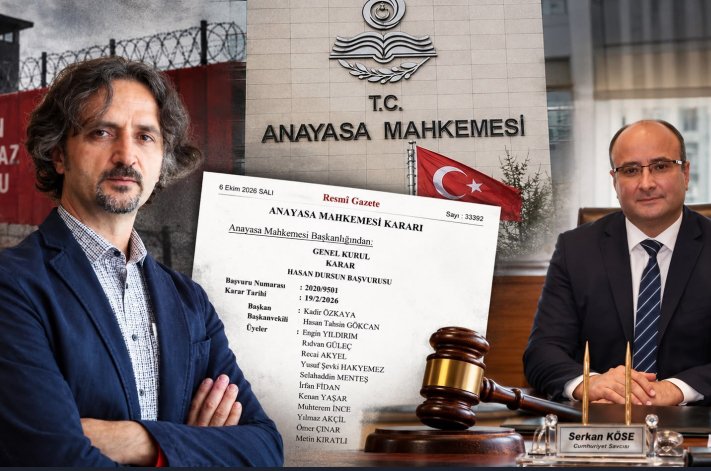
Turkey’s Constitutional Court has ruled that prison officials subjected dismissed prosecutor Hasan Dursun to treatment incompatible with human dignity by using force that authorities failed to show was necessary during an attempt to cut his hair and that prosecutors failed to effectively investigate the incident, the TR724 news website reported.
The Constitutional Court issued the ruling on February 19, with its reasoned decision published in the Official Gazette on October 6. The court found violations of Article 17 of the Turkish Constitution, which protects a person’s physical and psychological integrity and prohibits torture and treatment incompatible with human dignity, both through the treatment itself and through authorities’ failure to conduct an effective investigation.
The case stems from an incident on May 24, 2018, at Sincan Prison in Ankara, where Dursun had been transferred to attend a court hearing. Prison officials told him his hair had to be cut, a demand he refused to agree to.
Prison officials said Dursun’s hair was unusually long and that he wore it in a bun, which they said posed cleanliness and security concerns. Dursun said eight or nine prison personnel, including a deputy prison director, then attempted to cut his hair by force and that he was injured as he resisted. A medical examination following the incident documented injuries to his leg, arm and finger.
The Constitutional Court said the prison administration had failed to provide concrete evidence showing that Dursun’s hair created a health or security risk. It noted that prison records did not indicate that he had lice, a fungal infection or another hygiene problem that would have required his hair be cut.
The court also said there was no clear legal provision authorizing prison officials to forcibly cut a prisoner’s hair for failing to comply with rules governing appearance.
It concluded that authorities had not demonstrated that the force used against Dursun was necessary and classified his treatment as incompatible with human dignity, a form of prohibited ill-treatment under the Turkish Constitution.
Dursun filed a criminal complaint against the prison personnel after the incident. Prosecutors in Ankara decided in November 2019 not to bring charges against the officers over allegations including ill-treatment, intentional injury, threats, abuse of office and falsification of an official document. A court subsequently rejected Dursun’s challenge to that decision.
The Constitutional Court found that the investigation into Dursun’s allegations was ineffective. Among other shortcomings, it said prosecutors failed to question a prisoner Dursun had identified as a witness and did not adequately examine whether the use of force had been necessary.
Dursun was himself prosecuted in December 2019 on allegations of resisting public officials during the same confrontation. He said that case remains pending.
The Constitutional Court ordered prosecutors in Ankara to conduct a new investigation aimed at remedying the rights violations and awarded Dursun 100,000 Turkish lira ($2,033) in damages.
Dursun said the finding that authorities had failed to effectively investigate his complaint was particularly significant because he was prosecuted over the confrontation while the prison personnel he accused of mistreating him were not.
Dursun, a former prosecutor, was detained after a failed coup on July 15, 2016, and jailed pending trial over alleged links to the faith-based Gülen movement. He was also dismissed from the judiciary under an emergency decree issued during a state of emergency imposed after the coup attempt.
Before the Sincan incident, Dursun had been held in prisons in Sivas and Silivri. He said officials at Silivri Prison had also sought to make him cut his hair and imposed a disciplinary penalty after he refused. The penalty was later overturned because it lacked a legal basis.
Turkish President Recep Tayyip Erdoğan has targeted the faith-based Gülen movement, inspired by Muslim cleric Fethullah Gülen, who died in 2024, since corruption investigations in December 2013 implicated him as well as some members of his family and inner circle. He dismissed the probes as a Gülenist conspiracy and designated the movement as a terrorist organization in May 2016, intensifying a sweeping crackdown after a coup attempt in July of the same year that he accused Gülen of orchestrating. The movement denies involvement in the coup attempt or any terrorist activity.
Following the coup attempt, the Turkish government declared a state of emergency (OHAL) that remained in effect until July 19, 2018. During this period, the government carried out a purge of state institutions under the pretext of an anti-coup fight by issuing a number of government decrees, known as KHKs. A total of 113,290 civil servants and 4,006 judges and prosecutors were dismissed over alleged links to terrorist organizations, while more than 26,206 members of the armed forces were expelled from the military for alleged membership in or relationships with “terrorist organizations” by emergency decree-laws subject to neither judicial nor parliamentary scrutiny.