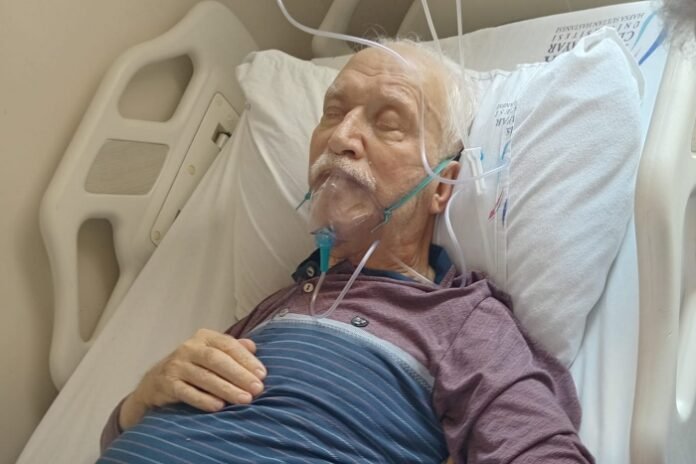
Halil Karakoç, an 86-year-old retired imam who spent more than five years in prison over alleged links to the faith-based Gülen movement and was freed last year after authorities delayed his release on probation despite his serious health problems, has been hospitalized in critical condition, the TR724 news website reported.
Karakoç was admitted to a hospital in Manisa about 20 days ago, where doctors detected a fluid buildup in his brain and a cancerous tumor in his intestines. He also underwent gallbladder surgery.
Karakoç was released on May 1, 2025, nearly a year after becoming eligible for release on probation, following repeated delays by a prison board. He suffers from diabetes as well as heart and stomach problems and has difficulty walking and tending to his basic needs without assistance.
He was sentenced to more than seven years in prison on charges of membership in a terrorist organization. His conviction was based on his account at the now-closed Bank Asya and attendance at events organized by people allegedly affiliated with the Gülen movement. Karakoç was rearrested and sent to prison on January 6, 2021, after his conviction was upheld by the Supreme Court of Appeals.
Turkish President Recep Tayyip Erdoğan has targeted the Gülen movement, a worldwide civic initiative inspired by the ideas of Muslim cleric Fethullah Gülen, who died in 2024, since corruption investigations in December 2013 implicated him as well as some members of his family and inner circle. He dismissed the probes as a Gülenist conspiracy and designated the movement as a terrorist organization in May 2016, intensifying a sweeping crackdown after a coup attempt in July of the same year that he accused Gülen of orchestrating. The movement denies involvement in the coup attempt or any terrorist activity.
Karakoç was first detained 10 days after the 2016 attempted coup while recovering from a broken hip. He spent 30 days in police custody followed by 18 months in pretrial detention. His condition deteriorated after a fall in prison. He was subsequently released pending appeal on health grounds after which he underwent surgery and remained bedridden for months.
Despite his advanced age, chronic illnesses and inability to meet his basic needs without assistance, Turkey’s Council of Forensic Medicine (ATK) found him fit to remain in prison, and requests to suspend his sentence were rejected.
Turkey’s Law on the Execution of Sentences and Security Measures allows the suspension of a sentence when a seriously ill or disabled prisoner cannot manage prison life independently and does not pose a serious and concrete danger to society. Rights groups say the provision is frequently not applied in practice.
According to the latest figures from the justice ministry, more than 127,000 people have been convicted of alleged links to the movement since 2016, with 10,485 still in prison and legal proceedings ongoing against 83,404 individuals.