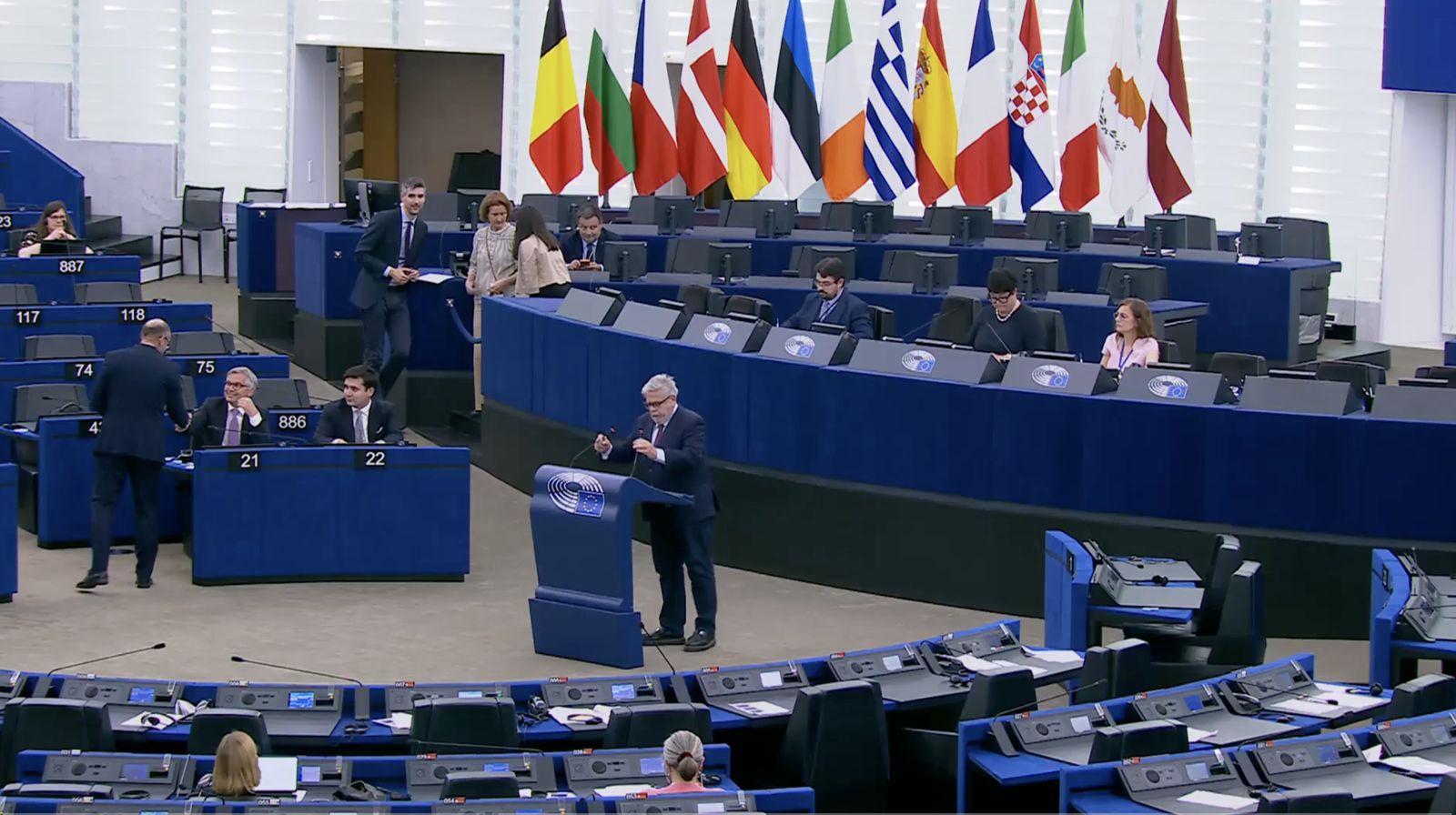
Turkey’s European Union membership talks cannot resume without concrete democratic progress, the European Parliament’s rapporteur on Turkey said at a Wednesday press conference.
Nacho Sánchez Amor, the Spanish lawmaker who leads the European Parliament’s reporting on Turkey, said the EU faces a difficult balance: Turkey remains an important neighbor and partner, but its democratic backsliding makes accession talks impossible under current conditions.
He made the remarks after European lawmakers adopted their 2025 report on Turkey, whose formal EU membership negotiations began in 2005 but have been effectively frozen for years over concerns about the rule of law, judicial independence, fundamental rights and press freedom.
“It’s very frustrating to be the rapporteur on Turkey, because we have had no good news for many, many years,” Sánchez Amor told reporters.
He said the report had to repeat concerns about democratic backsliding and “consequently the impossibility to resume the accession process.”
Sánchez Amor said he had received input from prominent Turkish opposition figures asking the EU to think about reviving the membership process, including jailed Istanbul Mayor Ekrem İmamoğlu, jailed former pro-Kurdish party leader Selahattin Demirtaş and main opposition leader Özgür Özel.
But he said there were “no objective conditions” to restart the talks.
Turkey’s accession process is one of the longest-running and most troubled in the EU’s enlargement policy. The negotiations have stalled as European institutions have accused Ankara of moving away from EU democratic standards.
Amor criticized what he described as weak statements and silence from the European Commission and the EU’s foreign policy service over Turkey’s domestic situation. He said the EU had spoken more forcefully in support of civil society in Serbia and Georgia than in Turkey, calling that a double standard.
“We are losing the pro-European civil society in Turkey,” he said. “They feel abandoned, they feel orphaned.”
Sánchez Amor said pro-European groups in Turkey were beginning to suspect that the EU was no longer a project based on principles and values, but one driven mainly by interests.
He also raised alarm over pressure on Turkey’s main opposition Republican People’s Party (CHP). The party dealt President Recep Tayyip Erdoğan’s ruling party its worst election defeat in more than two decades in the 2024 local elections, retaining Istanbul and Ankara and winning control of other major municipalities.
Sánchez Amor said the CHP was being “carefully dismantled” after those election victories and said the pressure represented “a great loss for plurality in Turkey.”
İmamoğlu, Istanbul’s mayor, has become one of Erdoğan’s most prominent political rivals and a potential opposition challenger in a future presidential race. He was jailed pending trial in March 2025 on corruption charges that he denies, a move that triggered Turkey’s largest street protests in more than a decade.
Sánchez Amor accused Turkish authorities of using the judiciary to weaken the opposition, pointing to cases against İmamoğlu and other municipal officials. He said the case against İmamoğlu and more than 100 others was “fabricated” and part of a wider effort to “dismantle the opposition.”
Sánchez Amor also criticized the appointment of Akın Gürlek as justice minister. Gürlek, a former Istanbul chief prosecutor, has been criticized by opposition figures over his role in politically sensitive cases against government critics.
“This is still a club of democracies,” Sánchez Amor said. “We want the European Union to stay as a club of democracies.”