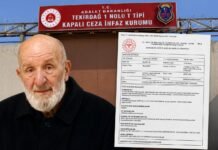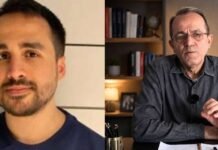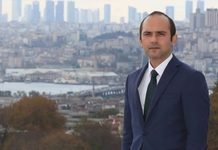
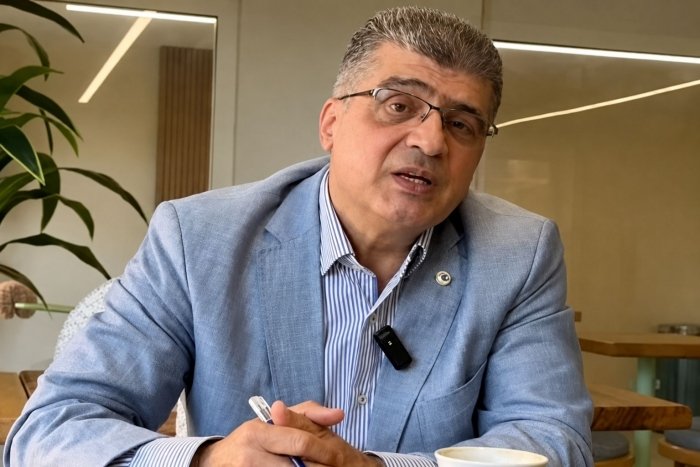
A former judge at Turkey’s Supreme Court of Appeals who spent nearly eight years in prison has alleged that prison guards beat him in a room outside camera view and that his rights complaint over the incident has remained unaddressed for six years, the TR724 news website reported.
Hüsamettin Uğur, a former member of the country’s top appeals court, said in an interview with KHK TV, a YouTube-based Turkish media outlet that focuses on people dismissed from public service under emergency decrees issued after a 2016 coup attempt, that he was assaulted at a prison in the western province of Afyonkarahisar after repeatedly raising complaints about the alleged mistreatment of other inmates.
Uğur said he had tried to report allegations that prisoners held on ordinary criminal charges were being beaten in areas not covered by security cameras. He said some inmates had marks on their feet from falaka, a form of torture in which the soles of the feet are beaten, and had difficulty walking.
He said many prisoners were afraid to file complaints because they feared disciplinary punishment. When he continued to raise the allegations, Uğur said prison officials opened four disciplinary investigations into him.
He said sentence-enforcement judges, who review prison disciplinary measures and complaints related to the execution of prison sentences, later overturned all four investigations.
Despite those rulings, Uğur said prison authorities did not grant his requests to meet with a prison prosecutor. He claimed that after one such request he was taken to a room with no camera coverage and beaten by prison officers.
“My complaint about being beaten has been waiting before the Constitutional Court for six years,” Uğur said.
Turkey’s Constitutional Court allows people to file individual complaints over alleged violations of fundamental rights after other domestic legal remedies have been exhausted. Uğur said allegations of torture and ill-treatment should be examined urgently but that his application has still not been ruled on.
Uğur also described harsh conditions during his imprisonment. He said that after his arrest he and other detained judges were first taken to Sincan Prison in Ankara, where overcrowding was severe. He said as many as 31 people were held in cells designed for 12.
He said conditions worsened after he and other dismissed judges were transferred to other prisons and put in single-person cells. Keskin Prison in the central province of Kırıkkale was not completely ready for prisoners, he said, adding that prisoners faced shortages of water and cleaning supplies.
Uğur said prison authorities did not explain why he was being held alone. He said he was not given a table or chair for an extended period, forcing him to write legal petitions and defense statements on his bed.
He also described what he called psychological pressure, stating that for weeks a nationalist song titled “Ölürüm Türkiye,” meaning “I would die for Turkey,” was played loudly during morning roll calls.
Uğur compared the practice to accounts of prisoners being forced to listen to patriotic songs and anthems after Turkey’s 1980 military coup.
He said that at Keskin Prison he heard repeated accounts of guards in riot gear entering cells and beating inmates. He said prisoners who wanted to complain often stayed silent because disciplinary penalties could affect their prison conditions, sentence reductions or eligibility for early release.
Uğur said the disciplinary investigations opened into him had consequences even after they were overturned. He said he was denied supervised release, a system that allows eligible prisoners to serve the final part of their sentence outside prison under monitoring, causing him to spend about one additional year behind bars.
Uğur said he served 23 years in the judiciary, including 18 years at the Supreme Court of Appeals, before learning from television reports on the night of the coup attempt that he was under investigation. He was detained on July 18, 2016, three days after the failed coup.
He alleged that during questioning prosecutors did not present concrete accusations against him.
He said his pretrial detention appeared to be predetermined. According to Uğur, the judge who ordered his arrest did not look at the defendants while announcing the decision and said the court had decided in advance to detain them.
Uğur was later convicted of membership in the faith-based Gülen movement and sentenced to 10-and-a-half years in prison. He was released on May 29, 2024, after serving nearly eight years.
Turkish President Recep Tayyip Erdoğan has targeted followers of the Gülen movement, inspired by the late Muslim cleric Fethullah Gülen, since corruption investigations in December 2013 implicated him as well as some members of his family and inner circle. He dismissed the probes as a Gülenist conspiracy and later designated the movement a terrorist organization in May 2016, intensifying a sweeping crackdown after the coup attempt in July of the same year that he accused Gülen of orchestrating. The movement denies involvement in the attempted coup or any terrorist activity.
Uǧur criticized his trial, saying prosecutors treated ordinary professional and social contacts, including meetings with colleagues, shared meals and picnics, as evidence of membership in a terrorist organization.
Uğur said five of his 10 siblings were also dismissed from public service after the coup attempt, including one who, according to him, faced no criminal investigation or trial. He said allegations involving his relatives were also cited against him during his own detention.
Uğur was among thousands of judges and prosecutors dismissed, detained or prosecuted after the failed coup of July 15, 2016.
Following the coup attempt, the Turkish government declared a state of emergency (OHAL) that remained in effect until July 19, 2018. During this period, the government carried out a purge of state institutions under the pretext of an anti-coup fight by issuing a number of government decrees, known as KHKs. Over 130,000 public servants, including 4,156 judges and prosecutors, as well as more than 24,000 members of the armed forces were summarily removed from their jobs for alleged membership in or relationships with “terrorist organizations” by emergency decree-laws subject to neither judicial nor parliamentary scrutiny.