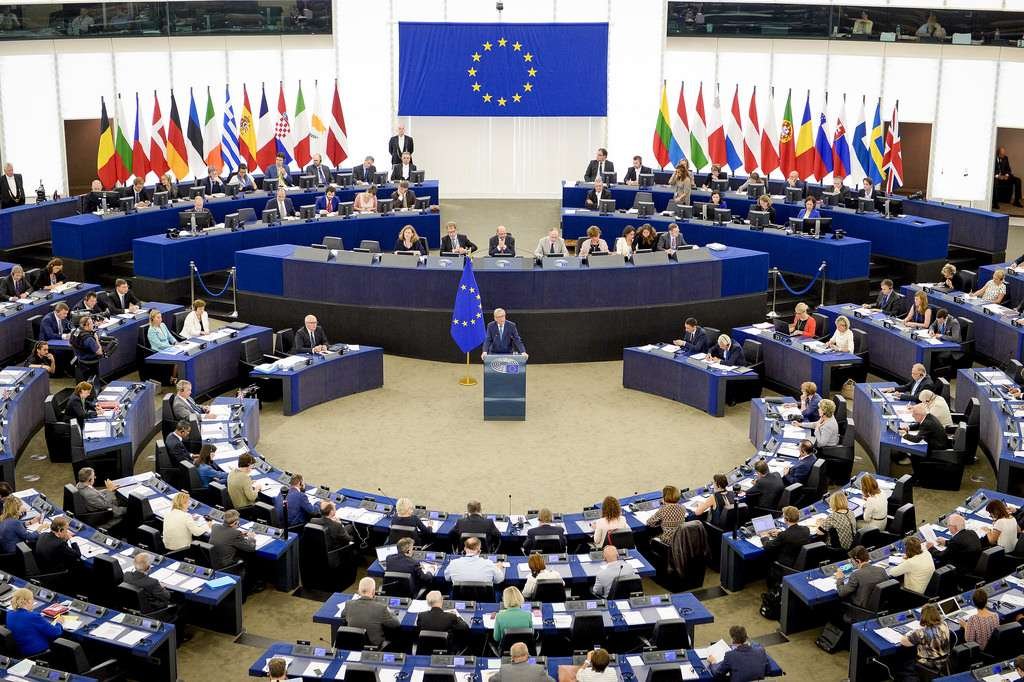
European Parliament (EP) lawmakers from several political groups are seeking sharper criticism of Turkey’s rule-of-law and human rights record before a vote this week on an EP report expected to say Ankara’s European Union accession path remains blocked by democratic backsliding, judicial interference and pressure on the opposition.
According to the Bianet news website, the proposed amendments would toughen the report’s language on prosecutions of opposition figures, the removal of elected mayors, media freedom and Turkey’s ties with Hamas.
They also show that criticism of Ankara comes from different political directions: liberal, socialist and green lawmakers focus heavily on democratic backsliding and judicial pressure, while right-wing groups emphasize issues including EU funding, migration, Hamas, Cyprus and ending accession talks.
The push comes before Wednesday’s vote on the European Parliament’s “Report on the 2025 Commission report on Türkiye,” a nonbinding text prepared by the parliament’s Foreign Affairs Committee in response to the European Commission’s annual assessment of Turkey. However, the report carries political weight because it sets out the EP’s position on Turkey’s long-stalled EU membership bid and on whether closer EU-Turkey cooperation should remain tied to democratic reforms.
Turkey rejected the European Commission’s underlying 2025 report as biased, saying its criticism of the judiciary, fundamental rights and domestic political developments was prejudiced and unfounded. Turkish officials have also criticized parts of the European Parliament process, including proposed sanctions language targeting senior officials.
The core report says Turkey’s accession process cannot move forward under current conditions, citing continued deterioration in the rule of law, fundamental rights and judicial independence. Several amendments seek to sharpen that language, arguing that EU-Turkey relations cannot be normalized outside a framework based on democracy, rights and the rule of law.
Amendments from Renew Europe and the Socialists and Democrats criticize what they describe as state interference in the internal affairs of Turkey’s main opposition Republican People’s Party (CHP). They cite a May 21 ruling by an Ankara regional appeals court that removed the party’s current leadership, annulled its 2023 congress and restored former party leader Kemal Kılıçdaroğlu’s previous leadership.
The amendments also refer to a May 24 police raid on CHP headquarters and warn that such actions could mark a shift from already limited political competition toward full authoritarian rule.
The draft report and proposed amendments also focus on jailed Istanbul Mayor Ekrem İmamoğlu, a leading opposition figure and the strongest presidential challenger. Lawmakers cite a roughly 4,000-page indictment prepared under former Istanbul chief public prosecutor Akın Gürlek, which seeks up to 2,430 years in prison for İmamoğlu on 142 charges.
The text also condemns the annulment of İmamoğlu’s university diploma and a separate indictment accusing him of “political espionage.” The case has become one of the main examples cited by European lawmakers who accuse Turkish authorities of using the judiciary to weaken the opposition.
One proposed amendment calls for targeted sanctions on Gürlek, who was later appointed justice minister. The amendment describes him as responsible for the indictment against İmamoğlu and refers to him as “notorious.”
Local democracy is another central issue. The amendments say 39 mayors have been removed since March 2024, including 29 from the CHP and 10 from the pro-Kurdish Peoples’ Equality and Democracy Party (DEM Party). They also cite the appointment of state trustees to 13 municipalities and a requirement for presidential approval of municipal companies as signs of the erosion of local autonomy.
Turkey has previously defended trustee appointments by citing terrorism-related investigations, particularly in municipalities won by pro-Kurdish parties. Rights groups and opposition parties say the practice overrides voters’ choices and undermines local democracy.
Media freedom and freedom of expression also feature prominently. The transfer of broadcaster TELE1 to a trustee is described in the amendments as an attack on media freedom. The detention of Deutsche Welle reporter Alican Uludağ, the arrest of journalist Merdan Yanardağ on espionage charges and the arrest of BirGün reporter İsmail Arı on disinformation charges are cited as examples of pressure on the press.
Several amendments also address religious freedom. Lawmakers criticize the deportation or denial of re-entry of hundreds of Christian pastors, missionaries and their families who were labeled national security threats under N-82 and G-87 codes.
Amendments from the European Conservatives and Reformists group also refer to what they call the genocide of 3.5 million Christians in the last century.
The report welcomes steps toward the possible reopening of the Halki seminary, an Orthodox Christian theological school near Istanbul that has been closed since 1971, and calls for the remaining obstacles to be removed.
Foreign policy disputes remain another major part of the debate. Conservative amendments describe killings, rapes, enforced disappearances and mass displacement during Turkey’s 1974 military intervention in Cyprus as war crimes.
The amendments also refer to allegations that Turkish forces harassed an aircraft carrying Greek, French and Dutch ministers to EU meetings in Cyprus. Turkey has previously denied similar allegations involving its military activity around Cyprus and the eastern Mediterranean.
The text also criticizes Turkey’s warning that any Greek move to extend its territorial waters to 12 nautical miles would be considered a cause for war, calling such a threat unacceptable between allies.
Turkey’s “Blue Homeland” doctrine is also criticized. The doctrine refers to Turkey’s maritime claims in the Aegean, Mediterranean and Black Sea, a policy Greece and Cyprus view as expansionist.
EU funding is another target for right-wing groups. The Europe of Sovereign Nations group says Turkey will have received more than 24 billion euros in EU support through pre-accession and migration funds by 2027. It calls for accession talks to be formally closed and replaced with a strategic partnership. The far-right Patriots for Europe group also calls for cuts to pre-accession funding.
The Europe of Sovereign Nations group also accuses Turkey’s Directorate of Religious Affairs, known as the Diyanet, of building a religious, educational and social influence network in Europe by training Turkish youths in Turkey for activities in EU countries.
Turkey’s relations with Hamas and Muslim Brotherhood-linked networks are also cited. Amendments from Renew, the European Conservatives and Reformists and Patriots for Europe accuse Turkey of active support for Hamas, which is on the EU’s terrorist list, and of providing financial, media and logistical support for Muslim Brotherhood networks.
But the amendments also show that criticism of Ankara does not come from one shared ideological position.
The Europe of Sovereign Nations group proposes removing several criticisms of Turkey’s record on women’s rights and LGBTI+ rights. The group argues that Turkey is a culturally and socially conservative country and says the EU should respect its national identity. It also wants the report to treat bans on Istanbul Pride and restrictions on gender-transition treatment as domestic matters.
Renew Europe proposes that the European Commission work with the Organization for Security and Cooperation in Europe’s Office for Democratic Institutions and Human Rights and the Council of Europe to establish a stronger monitoring mechanism for Turkey’s 2028 general election.
The group says the findings should be used to assess whether Turkey’s formally frozen accession process can continue or whether it has effectively come to an end.
The Left group, meanwhile, opposes treating Turkey as a safe country of origin for asylum purposes, arguing that widespread human rights violations, political repression and arbitrary arrests mean Turkey does not meet the required criteria.
Such a designation could make asylum claims by Turkish citizens subject to accelerated procedures and a presumption that claims are unfounded, though cases must still be individually assessed.
The report also recognizes Turkey’s growing role in European defense. It notes that Turkey is one of the world’s leading drone producers and that Turkish drone companies have expanded industrial and technological cooperation with firms across the EU.
The vote comes as EU institutions continue to seek cooperation with Turkey on migration, security, trade and regional conflicts, while the EP remains one of the bloc’s sharpest critics of Ankara’s domestic rights record.
For Turkey, the report is unlikely to change the legal status of accession talks. But it is expected to reinforce a political message that has become increasingly dominant in Brussels: Ankara’s path toward EU accession remains blocked as long as democratic backsliding, judicial interference and pressure on opposition politics continue.