Turkish police on Friday raided an İstanbul dormitory run by a religious group known as “Süleymancılar” and who identify themselves as “Süleymanlılar,” which has been targeted for months by politicians and media figures close to the government, a day after the launch of an Ankara-based investigation into the same group that led to the detention of 37 people.
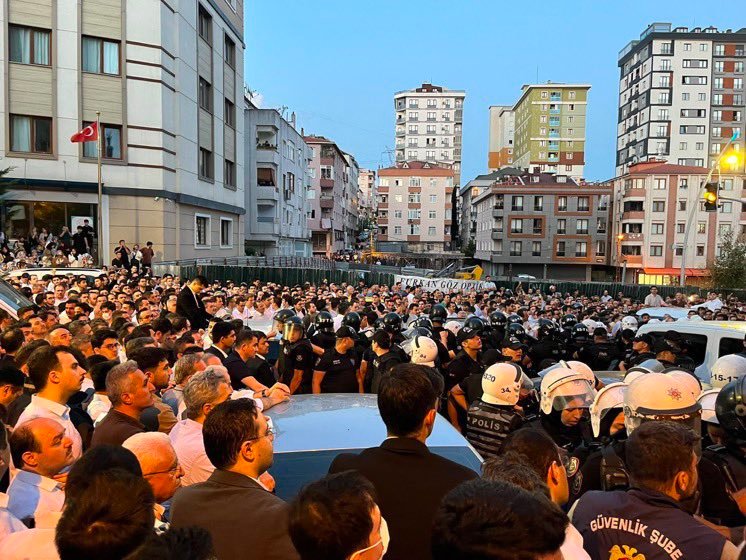
A 12-second video filmed inside the dormitory shows plainclothes officers trying to force their way through glass doors. Dormitory administrators and group members gathered at the entrance to block their advance, while the crowd chanted “Allahu Akbar.”
Other videos showed hundreds of members gathering outside the dormitory and the nearby Hisar Intercontinental Hospital as riot police deployed in the area. Senior figures in the group appealed for calm, telling the crowd that police were conducting a search and asking members not to resist. Many remained outside through the night and into Saturday, keeping watch while praying.
Police also searched the hospital, which is linked to the group. Videos showed members continuing their vigil outside the building as police maintained a presence in the area.
Group members also held a vigil in front of the presidential palace in Ankara on Saturday. The gathering followed messages circulated through the group’s dormitories and WhatsApp channels calling on followers to travel to the capital in support of group leader Alihan Kuriş. Participants prayed as police took security measures around the gathering.
The İstanbul raid showed that the operation against the religious group, whose activities center on student dormitories, Quran courses, foundations and companies across Turkey and Europe, had extended to its educational institutions.
The Ankara Chief Public Prosecutor’s Office issued detention warrants on Thursday for 49 people, including Kuriş.
Operations across 17 provinces, including İstanbul, Ankara and Antalya, involved searches and seizures at 43 locations linked to the individuals and 80 used by 33 companies. The initial number of detainees rose from 30 to 37.
Nine people who were the subject of detention warrants were found to be abroad, while efforts continued to locate four others.
Kuriş and the others face charges of establishing, leading, or belonging to a criminal organization, money laundering, fraud, and tax evasion. Trustees were appointed to some of the companies and related assets.
The investigation is based on a report prepared by the Financial Crimes Investigation Board (MASAK). According to the prosecutor’s statement, the companies’ transaction volumes increased after 2020, unexplained cash inflows were used for capital increases and more than 100 billion lira — approximately $2.1 billion — was transferred abroad through group-linked individuals and companies.
Justice Minister Akın Gürlek argued that the operation targeted the group’s financial structure rather than its religious activities.
Interior Minister Mustafa Çiftçi claimed the group had built a $70 million headquarters in Cologne, Germany, and planned to run its operations from that building. Çiftçi said the investigation had been prepared over a long period of time but did not specify the criminal element in the activities he enumerated as grounds for the operation.
The operation followed a period in which the group had been targeted by figures and media outlets close to the government.
The Süleymanlılar group, founded by followers of Islamic scholar Süleyman Hilmi Tunahan, is one of the religious organizations in Turkey that operates through Quranic schools and student dormitories. Kuriş, among the detainees of Thursday’s operation, took over leadership of the group in 2016. The group’s main body has not endorsed the ruling Justice and Development Party (AKP). Kuriş was reported to have supported nationalist opposition İYİ (Good) Party’s then-leader Meral Akşener in 2018, and the group was said to have voted for the main opposition Republican People’s Party (CHP) in some local elections.
The group also carries out activities outside Turkey, particularly through associations and educational institutions in Germany.
The operation came following longstanding calls for the Turkish government to take legal action against the group. Fatih Süleyman Denizolgun, the grandson of Süleyman Hilmi Tunahan and a former AKP lawmaker, had called on the government in 2024 to carry out a “financial operation” against companies, foundations, and associations linked to the group.
Denizolgun later claimed that Ali Erbaş, then-president of the Directorate of Religious Affairs, told him that President Recep Tayyip Erdoğan had issued an order to conduct an operation against the Süleymanlılar group. The Directorate of Religious Affairs denied the allegation.
Denizolgun’s claim that the judiciary is taking orders from Erdoğan is in tandem with concerns about judicial independence in Turkey. In its 2025 report, the European Commission stated that the judiciary remains “under the control of the executive” and selectively targets the opposition, journalists, civil society and human rights defenders.
In May 2025, after Erdoğan spoke of a “shadowy organization” that he said extended into the bureaucracy, the business world, the media and “certain religious communities,” pro-government writer Fuat Uğur wrote that “it’s the Süleymancılar’s turn” following the faith-based Gülen movement, which has been the target of a government crackdown that saw tens of thousands jailed over more than a decade. Shortly after Uğur’s remarks were published, four individuals alleged to be linked to the group were taken into custody.
This article is republished from Turkish Minute.