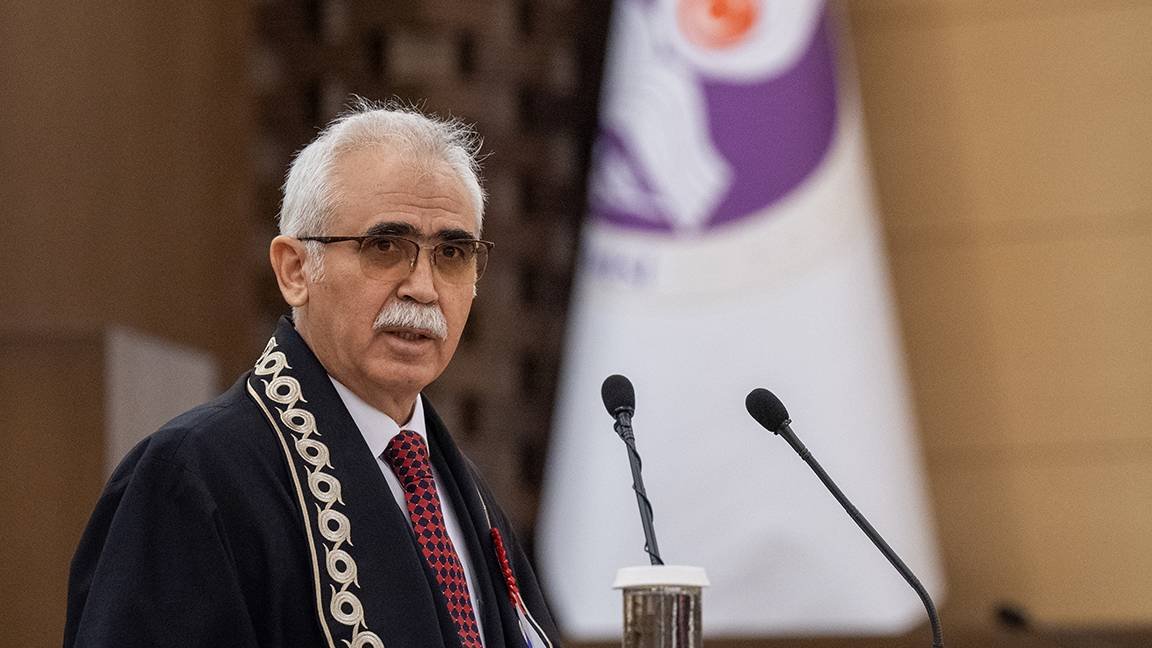
The Turkish Constitutional Court has received more than 739,000 individual rights complaints since 2012, the court’s president said Monday, warning that constitutional protections have real meaning only when court rulings are effectively implemented by judges and public authorities, the Bold Medya news website reported.
Of those, 637,274 have been resolved, while 102,143 remain pending.
Constitutional Court President Kadir Özkaya said the court has issued approximately 87,000 findings of rights violations, including cases involving the right to a trial within a reasonable time.
“The true strength of the rule of law stems not only from the existence of norms but from their effective implementation,” Özkaya said on Monday at a conference in the southern province of Adana. He added that the ultimate goal of constitutional review was not merely to identify rights violations but to create a legal culture that prevents similar violations from recurring.
The issue of implementing Constitutional Court judgments has become increasingly significant in Turkey in recent years, with some lower courts resisting or delaying compliance with rulings in politically sensitive cases, raising questions about the authority of the country’s highest court for constitutional review.
The Constitutional Court’s rulings in the case of jailed opposition lawmaker Can Atalay, for example, triggered an unprecedented dispute within Turkey’s judiciary after lower courts declined to implement decisions finding violations of his rights.
The remarks came during the closing ceremony of a joint European Union-Council of Europe project aimed at improving the implementation of Constitutional Court judgments concerning fundamental rights.
Turkey introduced individual applications to the Constitutional Court in 2012, allowing people who claim their constitutional rights have been violated to seek redress after exhausting ordinary legal remedies. The mechanism was designed to strengthen domestic protections for fundamental rights and provide an effective remedy before cases reach the European Court of Human Rights (ECtHR).
Individual applications have since generated thousands of rulings on issues ranging from freedom of expression and fair-trial rights to property disputes, detention cases and freedom of assembly.
The court has also handled tens of thousands of applications stemming from measures adopted after a failed coup in Turkey in July 2016.
Following the coup attempt, the Turkish government declared a state of emergency (OHAL) that remained in effect until July 19, 2018. During this period, the government carried out a purge of state institutions under the pretext of an anti-coup fight by issuing a number of government decrees, known as KHKs. Over 130,000 public servants, including 4,156 judges and prosecutors, as well as more than 24,000 members of the armed forces were summarily removed from their jobs for alleged membership in or relationships with “terrorist organizations” by emergency decree-laws subject to neither judicial nor parliamentary scrutiny.
Özkaya said the success of the individual application system should not be measured solely by the number of judgments issued but by whether those decisions are reflected in judicial practice, public administration and daily life.
“The real meaning of constitutional guarantees emerges not only in court decisions but in their reflection in social life, judicial practice and the functioning of public authorities,” he said.
Many of those dismissed were accused of alleged links to the faith-based Gülen movement.
Turkish President Recep Tayyip Erdoğan has targeted followers of the Gülen movement, inspired by the late Muslim cleric Fethullah Gülen, since corruption investigations in December 2013 implicated him as well as some members of his family and inner circle. He dismissed the probes as a Gülenist conspiracy and later designated the movement as a terrorist organization in May 2016, intensifying a sweeping crackdown after the coup attempt in July of the same year that he accused Gülen of orchestrating. The movement denies involvement in the coup attempt or any terrorist activity.