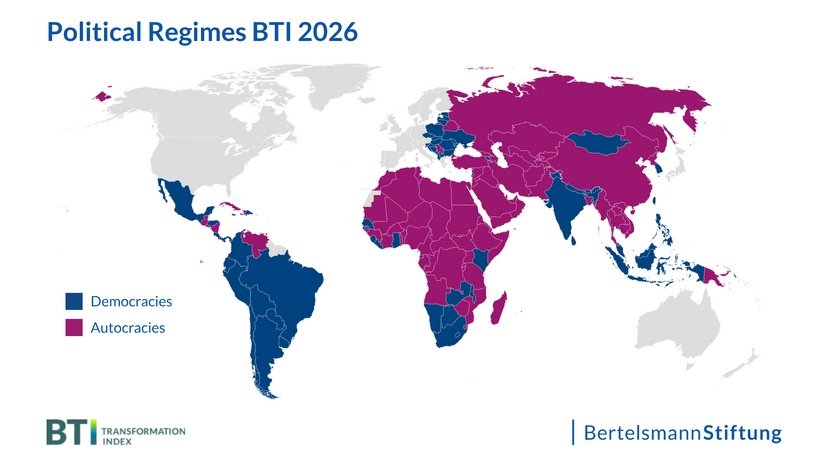
Democracy and human rights in Turkey are deteriorating as the government of President Recep Tayyip Erdoğan operates without effective checks, with press freedom shrinking and pressure on the opposition growing, according to a recent report by the German Bertelsmann Stiftung.
The report traces the acceleration of Turkey’s shift toward autocracy after a coup attempt in July 2016, while the transition to a presidential system in 2018 weakened institutions and deepened an economic crisis that cost the ruling Justice and Development Party (AKP) significant public support.
Already under political and economic pressure, the government mounted “a harsh response” after the opposition scored key victories in the 2024 local elections, arresting many newly elected opposition mayors throughout 2024 and 2025.
The report examined 137 countries and found that 77, including Turkey, are governed by autocratic regimes. It ranks Turkey 110th in the governance index, which measures rule of law and judicial independence, and 131st in political transformation. In the 2016 report, Turkey ranked 29th and 33rd, respectively, in the same categories among 129 countries, pointing to the scale of decline.
Among the most serious concerns about Turkey is “the systemic lack of judicial independence,” reflected in the continued imprisonment of Selahattin Demirtaş, the imprisoned former leader of the pro-Kurdish Peoples’ Democratic Party (HDP), and Osman Kavala, a prominent philanthropist and rights advocate, despite rulings by the European Court of Human Rights ordering their release. The report says courts effectively act as an arm of the executive, serving to silence opposition, with judicial decisions “effectively dictated by President Erdoğan.”
The report also points to several other serious problems. Counterterrorism laws are used to strip away basic legal protections, while Kurdish political and cultural life faces growing restrictions. The Alevi community continues to face discrimination, especially in public institutions, and corruption has become deeply entrenched in Turkey’s political system.
The freedoms of expression, assembly and association have been significantly curtailed, while civil society groups operate under severe restrictions. The media is largely controlled by pro-government outlets, leaving little room for independent reporting. Violence and hate speech targeting Kurds, followers of the Gülen movement, Alevis, Armenians, Christians, Jews, LGBTIQ+ individuals and other minorities remain persistent.
The report suggests that the government’s recent initiative to end terrorism is not a genuine step toward greater rights or democracy but rather a political strategy ahead of the 2028 elections aimed at drawing Kurdish political movements away from the broader opposition.
Public confidence in security has declined due to mass purges following the 2016 coup attempt, which significantly weakened the operational capacity of the security forces, while selective law enforcement has contributed to this sense of declining security, the report says. It adds that organized crime networks operate under political protection.
The quality of public administration has also deteriorated due to political appointments, a lack of merit-based recruitment and tight executive control. The government’s inadequate response to the earthquakes in Turkey’s Southeast in February 2023 exposed the consequences of the weakened institutional capacity following the post-coup purges.
The Bertelsmann Transformation Index has been published since 2006. The latest edition covers the period from February 1, 2023, to January 31, 2025.