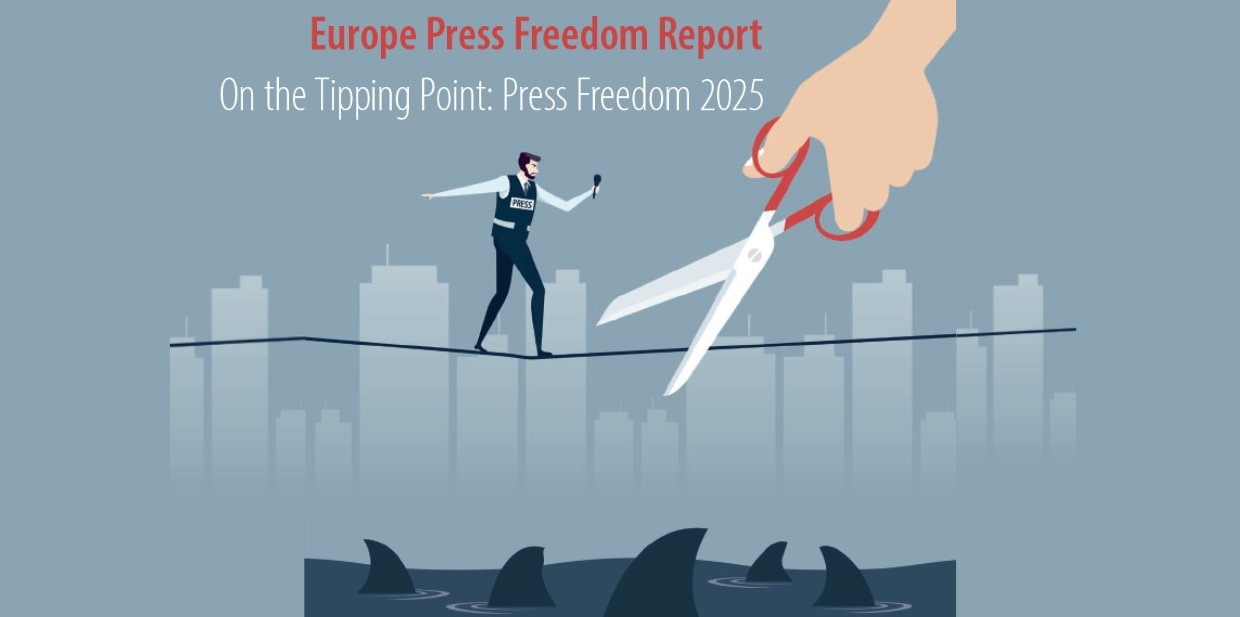
Turkey has become one of Europe’s most hostile environments for independent journalism, with a high number of jailed journalists, widespread legal harassment, intimidation and censorship, according to a new report by the Council of Europe’s Platform to Promote the Protection of Journalism and Safety of Journalists.
The report puts Turkey among the countries with the highest number of jailed journalists, 24 in total. The country is also among those generating the most alerts on the platform, which tracks press freedom violations across Council of Europe member states. These alerts are driven by detentions, physical attacks on journalists, prosecutions and broadcast bans that signal a sharp erosion of press freedom and media pluralism.
The report describes 2025 as a year in which “President Recep Tayyip Erdoğan made clear his desire to silence all critical voices,” linking mounting pressure on journalism to a broader crackdown on the opposition that intensified after the arrest of İstanbul Mayor Ekrem İmamoğlu.
İmamoğlu, widely seen as President Erdoğan’s strongest political rival, was arrested in March 2025 on corruption charges that critics say are politically motivated and intended to sideline him ahead of the 2028 general election.
Large-scale protests that erupted after İmamoğlu’s arrest were met with detentions and restrictions on media coverage. At least 11 journalists were detained in early-morning raids, and at least 12 others were assaulted by police while covering the protests on March 23, 2025.
The country’s broadcasting regulator, the Radio and Television Supreme Council (RTÜK), played a key role in restricting coverage. It banned broadcasters from airing protest footage and threatened networks with license cancellation. In the first half of 2025 alone, RTÜK imposed fines totaling nearly 100 million lira (around $2.2 million), along with broadcasting suspensions and bans, including a 10-day blackout of Sözcü TV and a five-day ban on Tele1 TV.
Physical attacks were among the most serious violations documented in the report. Environmental journalist Hakan Tosun was fatally assaulted, with the investigation ongoing. Other journalists, including Ayşemden Akın, İsmail Arı, Alican Uludağ, Rabia Önver, Şule Aydın and Murat Ağırel, faced assaults, death threats and harassment in what the report calls “a broader pattern of intimidation against the press.”
Judicial pressure on journalists continued through investigations and prosecutions leading to detentions and arrests. Journalist Furkan Karabay was held in pretrial detention for more than 100 days over social media posts authorities said insulted public officials and the president. Prominent journalist Fatih Altaylı was also jailed after prosecutors alleged that remarks he made about historical events threatened the president.
Foreign journalists were also affected. Swedish journalist Joakim Medin was arrested in İstanbul while travelling to cover İmamoğlu protests and charged with “membership in a terrorist organization” and “insulting the president.” He was held for over a month before being released. BBC correspondent Mark Lowen was detained for 17 hours and later deported after authorities said he “posed a threat to public order.”
Six staff members of satirical magazine LeMan were prosecuted over a cartoon. Five were put in pretrial detention before later being released under judicial supervision.
The report also cited the arrest of Merdan Yanardağ, editor-in-chief of the pro-opposition TELE1 TV station, on espionage charges and the appointment of a trustee to the outlet as developments that have heightened concerns about a pending “agents of influence” bill. The proposed legislation could allow authorities to label individuals receiving foreign support as acting on behalf of foreign interests.
The report raised concerns over political interference in public media, citing the 2025 Media Pluralism Monitor, which ranked Turkey third among countries most at risk of political interference in public broadcasting. Public broadcaster TRT’s editorial independence has been gradually weakened since 2018 through legal changes placing its governance and appointments under direct presidential control.
The Council of Europe’s Platform to Promote the Protection of Journalism and Safety of Journalists was established in 2015 and brings together 15 press freedom and journalist organizations. It monitors threats to media freedom across Council of Europe member states and publishes alerts on violations.