
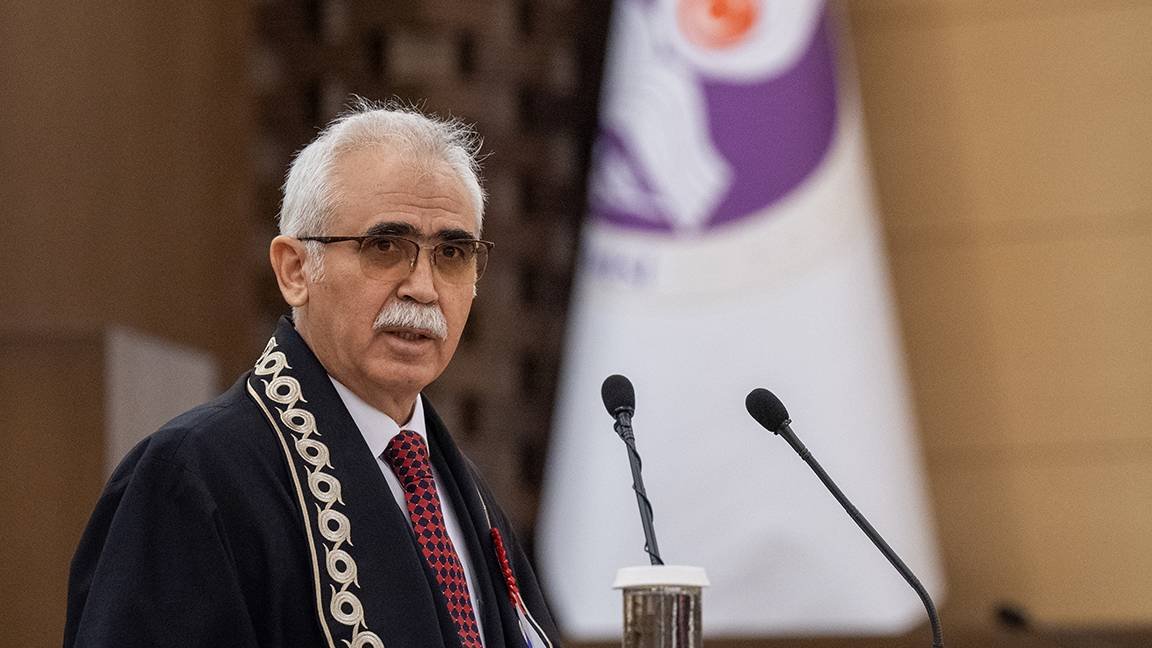
Turkey’s Constitutional Court does not have the authority to ensure the implementation of rulings by the European Court of Human Rights (ECtHR), the court’s president said, addressing ongoing controversy over high-profile cases including that of a jailed Kurdish politician, Turkish Minute reported.
Chief Justice Kadir Özkaya made the remarks during a fast-breaking gathering with journalists in Ankara on Wednesday evening, where he responded to questions about the implementation of both domestic and European human rights rulings.
“We do not have the authority to ensure the fulfillment of violation judgments issued by the European Court of Human Rights,” Özkaya said, adding that responsibility for executing such decisions lies outside the Constitutional Court’s mandate.
His comments come as Turkey faces continued criticism from the Council of Europe over its failure to implement ECtHR rulings, including judgments calling for the release of former Peoples’ Democratic Party (HDP) co-chair Selahattin Demirtaş.
Demirtaş, 52, was arrested on November 4, 2016, on “terrorism-related” charges as part of a government crackdown on opposition figures. Once one of Turkey’s most prominent political voices, he remains widely regarded in Western capitals as a political prisoner.
In its 2020 ruling on Demirtaş, the ECtHR said his “unjustified” detention pursued the ulterior motive of stifling pluralism and limiting freedom of political debate in Turkey and called for his immediate release.
Last summer the ECtHR also ruled that Turkey once again violated Article 5 of the European Convention on Human Rights, which guarantees the right to liberty and security, and criticized Turkey’s Constitutional Court for taking nearly four years to process Demirtaş’s individual appeal.
It was the third ECtHR decision condemning Turkey’s handling of Demirtaş’s detention.
Turkish courts have so far failed to comply with the ECtHR rulings on Demirtaş.
Özkaya also dismissed concerns about a broader structural problem in the execution of ECtHR rulings, saying that aside from 83 violation judgments whose enforcement has not yet been completed, many others had been implemented.
He said procedures in most of the remaining cases were ongoing or delayed due to what he described as technical reasons.
Another high-profile case in which Turkish courts have refused to comply concern jailed businessman Osman Kavala.
Jailed since 2017, Kavala is serving a life sentence despite a 2019 ECtHR judgment ordering his release. He was acquitted in 2020 but rearrested the same day and sentenced in 2022, with Turkish courts upholding the verdict. The CoE launched infringement proceedings in 2022, but they have yet to produce concrete results.
Özkaya’s remarks come amid renewed scrutiny of Turkey’s compliance record following remarks by Petra Bayr, the newly elected president of the Parliamentary Assembly of the Council of Europe (PACE).
Bayr warned in January that Turkey suffers from a lack of coordination among its high courts and described the situation as a “blockade that should not be there,” stressing that the problem ultimately requires action by parliament.
A majority of the ECtHR applications from Turkey were linked to detentions, arrests and trials tied to measures introduced after a coup attempt in 2016, affecting groups across the military, police, judiciary and public sector, with many cases involving alleged links to the faith-based Gülen movement.
Followers of the movement have faced a sweeping crackdown for the past decade after the Turkish government accused the group of orchestrating the coup attempt, an allegation it strongly denies.
According to ECtHR data, the court had about 53,450 pending applications at the end of 2025, with 18,464 of those applications filed against Turkey, which remained the country with the largest caseload before the court.