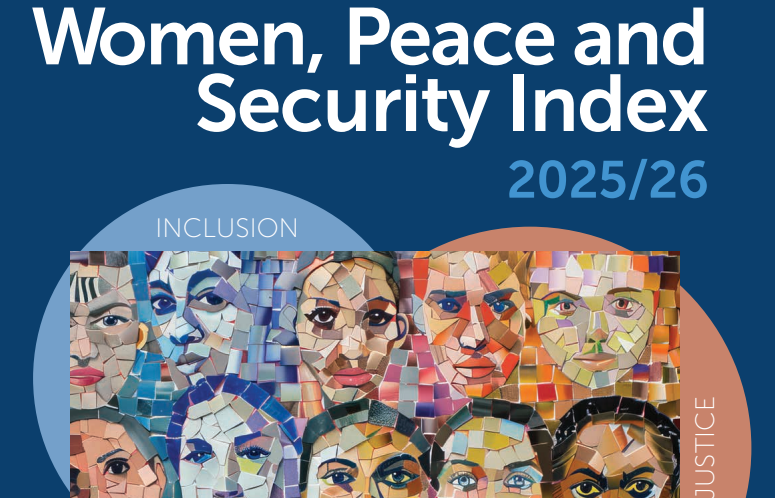
Turkey was ranked 106th out of 183 countries in the 2025/26 Global Women Peace and Security Index (WPS Index), down from 99th in the previous edition, according to a biennial report released by the Georgetown Institute for Women, Peace and Security (GIWPS) and the Peace Research Institute Oslo (PRIO).
Turkey’s overall score of 0.664 was well below both the developed-country average of 0.847 and the 0.715 average for its regional peer group of Central and Eastern Europe and Central Asia.
Published biennially since 2017, the WPS Index measures women’s status across 13 indicators covering three dimensions: inclusion, justice, and security. The inclusion dimension measures women’s achievements in education, employment, parliamentary representation and access to financial services. The justice dimension covers legal discrimination, access to justice and maternal mortality. The security dimension examines community safety as well as violence by intimate partners and during political conflict.
Within its regional group, Turkey was ranked last in women’s average years of schooling, at 7.9 years, and in perception of community safety, with only 44 percent of women reporting they feel safe walking alone at night. It also ranked near the bottom in women’s representation in the parliament at 19.9 percent and in the prevalence of intimate partner violence, recorded at 12.1 percent.
In the fifth edition of the index, Denmark led the rankings with a score of 0.939, followed by Iceland and Norway, while Afghanistan ranked last with 0.279, preceded by Yemen and the Central African Republic in the bottom three.
The report warned that progress on women’s rights and security is stalling or reversing in many parts of the world, with some countries and regions that previously performed better are now experiencing backsliding.
The report also cited Turkey’s 2021 withdrawal from the Istanbul Convention as part of a broader rollback in legal protections for gender equality, highlighting concerns over weakening safeguards against domestic violence.
The Council of Europe Convention on Preventing and Combating Violence against Women and Domestic Violence, known as the Istanbul Convention, is an international accord designed to protect women’s rights and prevent domestic violence in societies and was opened to the signature of Council of Europe member states in 2011.
Since the withdrawal from the Istanbul Convention, rights groups have reported growing concern over gender-based violence in Turkey, while some political allies of President Recep Tayyip Erdoğan have called for further amendments to domestic legislation providing protection mechanisms for women at risk of violence.