Members of a parliamentary commission advancing a peace initiative with the outlawed Kurdistan Workers’ Party (PKK) have agreed on legal changes that could open the way for conditional release for some prisoners serving aggravated life sentences, a senior politician from Turkey’s far-right Nationalist Movement Party (MHP) has said, Turkish Minute reported.
The move is generally linked to the case of jailed PKK leader Abdullah Öcalan.
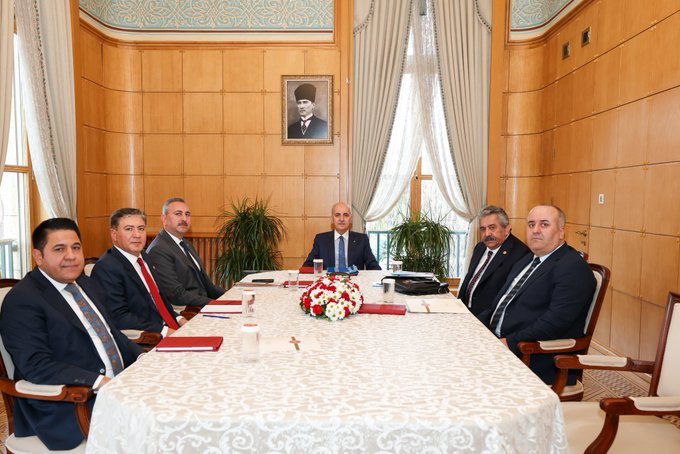
Feti Yıldız, deputy chairman of the MHP, told reporters on Wednesday after a parliamentary commission meeting that there was agreement on the issue known in Turkey as the “right to hope.”
“We have agreed on the right to hope,” Yıldız said, referring to a principle drawn from European human rights standards requiring that life prisoners have a meaningful chance of sentence review and potential release.
The 48-member cross-party commission was formed in parliament in August to outline legal steps related to Turkey’s renewed peace initiative aimed at ending the decades-long armed conflict with the PKK.

Its work has now entered the report-writing stage, according to a statement from the parliament speaker’s office.
Turkish media reported that rather than introducing a separate “right to hope” law, lawmakers are expected to amend existing legislation so that inmates sentenced to aggravated life can benefit from conditional release, bringing Turkish practice in line with rulings from the European Court of Human Rights (ECtHR).
Yıldız said legal obstacles remain in Turkey’s penal and counterterrorism laws, which currently prohibit parole for people sentenced to aggravated life or previously sentenced to death.
Changes would need to be made to the sentence enforcement law, the counterterrorism law and the Turkish Penal Code, he said.
“If these provisions are amended, then the European court’s decisions on the right to hope will be applicable,” Yıldız told Halk TV.
The principle was shaped by a 2013 ECtHR ruling in Vinter and Others v. the United Kingdom, which found that life sentences must be subject to review within 25 years, ensuring prisoners have a genuine possibility of release.
The ruling has since guided human rights standards across Europe. Turkey’s penal code, however, does not allow parole or sentence review for those serving aggravated life terms, effectively denying them any prospect of release.
The Council of Europe’s Committee of Ministers, in a session held in mid-September, once again urged Turkey to bring its laws in line with an ECtHR judgment on the “right to hope.”
The Committee of Ministers in an interim resolution said Turkey should introduce legal reforms to ensure prisoners sentenced to life have a chance of release after serving a minimum period based on the relevant ECtHR ruling.
The comments come a day after MHP leader Devlet Bahçeli, a political ally of President Recep Tayyip Erdoğan, again signaled that Öcalan could be included in such a framework, repeating a message he first delivered in October 2024, when he suggested Öcalan could benefit from the “right to hope” if he called on the PKK to disband.
Bahçeli ended his weekly speech Tuesday with a line that quickly circulated across Turkish media: “Until Anatolia reaches peace, Öcalan reaches hope, the Ahmets return to office and Demirtaş returns home… We are resolute in this.”
Bahçeli’s remarks were widely interpreted as support not only for a legal path affecting Öcalan but also for the possible release of jailed Kurdish politician Selahattin Demirtaş.
They were also read as an endorsement of reinstating elected Kurdish mayors removed from office, including former Mardin Mayor Ahmet Türk and former Esenyurt Mayor Ahmet Özer, who were replaced by government-appointed trustees.
Öcalan, the PKK’s founding leader, has been held on İmralı Island since 1999. Any shift that gives him a clearer legal route toward release will mark one of the most politically sensitive steps in Turkey’s peace process.
The government’s latest initiative follows Öcalan’s February 2025 call for the PKK to lay down its arms and dissolve. The group later announced it would disband, ending a conflict that began in 1984 and has killed more than 40,000 people.
Turkey and its Western allies designate the PKK as a terrorist organization.
Demirtaş, a former leader of the pro-Kurdish political movement, has been imprisoned since 2016 despite European court rulings calling for his release.
The parliamentary commission is expected to finalize its report in the coming days and submit it to Parliament Speaker Numan Kurtulmuş.