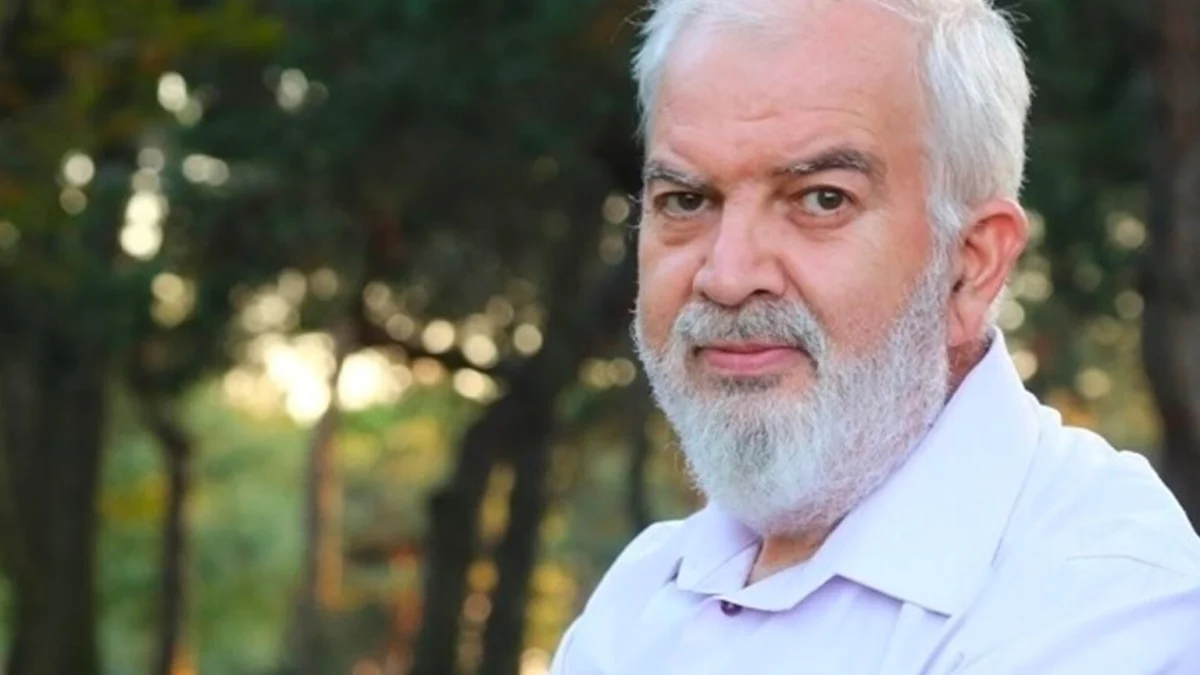
A fellow journalist says Turkish columnist Ahmet Turan Alkan was offered a way to avoid returning to prison by publishing an apology to President Recep Tayyip Erdoğan and his far-right ally Devlet Bahçeli, an account followed by an uncommon reversal by Turkey’s top appeals court, Turkish Minute reported.
Veteran Turkish columnist and political scientist Alkan, who spent nearly two years in prison over his writings during a post-coup crackdown on the media in Turkey, died on January 21 at the age of 72 in Bursa province.
Alkan was among dozens of journalists targeted in the aftermath of a July 15, 2016, coup attempt, as Turkish authorities launched a sweeping crackdown on the media. He was detained and subsequently arrested after the coup on terrorism-related charges, with his published columns in the now-shuttered Zaman daily treated as evidence. The newspaper had been put under state trusteeship and was later shut down by an emergency decree over its alleged affiliation with the faith-based Gülen movement.
President Recep Tayyip Erdoğan has been targeting followers of the Gülen movement, inspired by the late Muslim cleric Fethullah Gülen, since corruption investigations in December 2013 implicated him as well as some members of his family and inner circle.
Dismissing the investigations as a Gülenist coup and a conspiracy against his government, Erdoğan began to target the movement’s members. He designated the movement as a terrorist organization in May 2016 and intensified the crackdown on it following an abortive putsch in July of the same year that he accused Gülen of masterminding. The movement strongly denies involvement in the coup attempt or any terrorist activity.
Alkan remained behind bars for 709 days before his first verdict, a period during which he repeatedly denied the charges and argued that his prosecution criminalized dissenting opinion rather than any act of violence.
On July 6, 2018, after spending 23 months in prison, the İstanbul 13th High Criminal Court sentenced Alkan to almost nine years in prison on charges of “membership in a terrorist organization.” He was acquitted of charges related to involvement in the coup attempt and released pending appeal.
The conviction was upheld by an appeals court in 2019 but overturned two years later by the Supreme Court of Appeals, which ruled that the case had not been sufficiently examined.
According to Professor Mümtaz’er Türköne, who said he was a friend of Alkan’s for 50 years, that reversal was the result of a public apology by Alkan.
In an interview published on YouTube on January 29, Türköne said that after the Supreme Court of Appeals’ 16th Criminal Chamber unanimously upheld Alkan’s eight-year, nine-month prison sentence for “membership in a terrorist organization” in September 2020, unnamed individuals approached Alkan with an offer: Publish an apology and avoid returning to prison.
“He asked me for advice, saying ‘What can I do, that’s what they’re telling me,’” Türköne said. “I told him if it’s guaranteed, it’s not worth going back to prison.”
The apology and its aftermath
Twelve days after the earlier appeals court decision upholding his sentence was formally served on December 24, 2020, Alkan published an article titled “Highlights of an Inevitable Self-Criticism” on January 5, 2021.
In the article Alkan wrote that during his career he had been caught up in a “lust for words” and “the urge to make witty remarks” and that he had “hurt people, damaged personalities, and unfortunately, among them are our President and Mr. Devlet Bahçeli.” He concluded: “Regret? Yes! Apology? Of course!”
Within weeks, judicial authorities reversed course.
On February 12, 2021, the top appeals court’s chief prosecutor, who had previously requested that the conviction be upheld, filed a motion requesting the verdict be overturned, saying there was no concrete evidence linking Alkan to the organization’s hierarchy.
On March 18, 2021, the same 16th Criminal Chamber that had upheld the conviction months earlier reversed its decision. The chamber ruled that Alkan was “a well-known opposition journalist” whose defense was “logical” and that there was “no evidence of a hierarchical link between the defendant and the organization.”
According to the rulings and Türköne’s account, no new evidence was added to the case file between the two decisions.
‘He became disillusioned with himself’
Türköne said the process pushed Alkan to stop writing and withdraw from public life.
“After this incident, he became disillusioned with himself, stopped writing and distanced himself from people,” Türköne said. “He tried his hand at leatherwork and carpentry, but nothing could replace writing.”
Despite the reversal, Alkan’s legal case continued. In a retrial concluded in November 2022, Alkan was sentenced to two-and-a-half years in prison on reduced charges of aiding an armed terrorist organization of which he was not a member and was released due to time served.
The apology contrasted with Alkan’s earlier comments.
In his final court appearance Alkan delivered a defiant defense, rejecting the accusations as politically motivated, telling judges that his prosecution was based solely on his writing and amounted to punishment for dissent rather than any involvement in violence.
“Everyone knows that the claims are just pretexts,” Alkan told the court at the time. “The reason why I am here is what I wrote on the December 17-25 [corruption investigations]. There is no evidence for the charges against me.”
He described his detention as an act of political revenge and said he would not apologize for his views, declaring, “I cannot lick the knife that cuts my throat … do not expect an apology from me.”
Born in Sivas in 1954, Alkan entered Ankara University’s faculty of political science in 1972 and graduated in 1977. He began his academic career at Cumhuriyet University in 1985, where he completed his master’s degree and doctorate and became a faculty member in the public administration department, continuing his academic work until 2008.
He began his journalism career in 1974 and wrote regular columns from 1989 on. For more than two decades he contributed to the Zaman newspaper, establishing himself as a prominent and influential voice in the Turkish media.
After a state of emergency was declared on July 20, 2016, some 200 media outlets were shut down by emergency decrees. The main targets of the media closures have been media outlets affiliated with the Gülen movement as well as pro-Kurdish and far-left outlets.
According to Expression Interrupted, a press freedom monitoring group, 28 journalists are currently behind bars in Turkey. The country’s deteriorating media landscape was further pointed out in the 2025 World Press Freedom Index published by Reporters Without Borders (RSF), where it was ranked 159th out of 180 nations.