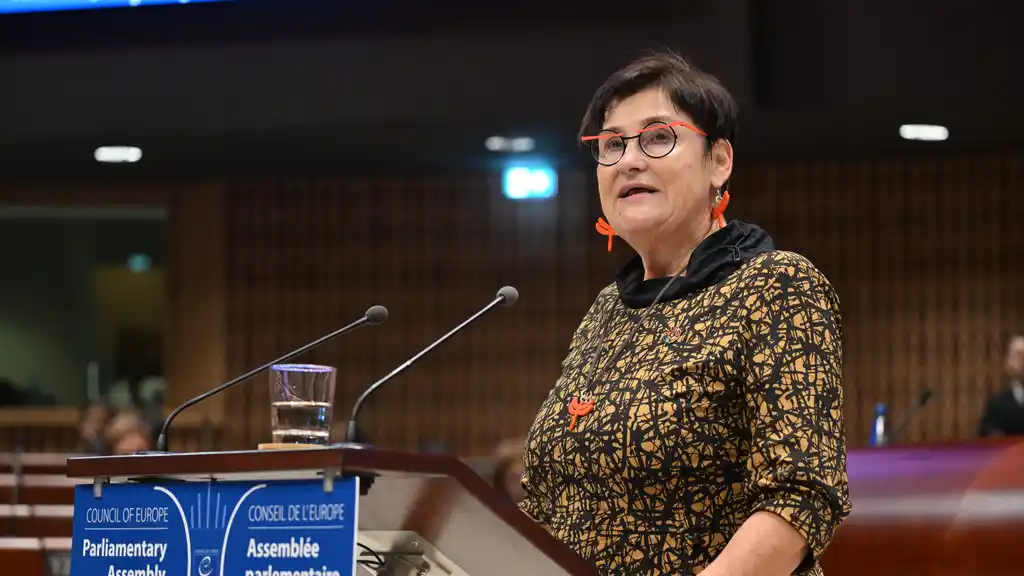
Petra Bayr, the newly elected president of the Parliamentary Assembly of the Council of Europe (PACE), has said Turkey faces a serious problem of synchronization within its high courts, as concerns persist over Ankara’s refusal to implement binding European Court of Human Rights (ECtHR) judgments, Turkish Minute reported.
Bayr, the fifth woman to serve as PACE president and the third Austrian to hold the position since 1949, spoke to journalists in Strasbourg on her second day in office. Bayr told the TR724 news website that ensuring the full execution of ECtHR rulings would be among her top priorities, with Turkey-related cases high on her agenda.
When asked about the Turkish government’s continued refusal to enforce certain ECtHR judgments and what steps she planned to take as PACE president, Bayr referred to her previous role as rapporteur on the implementation of the court’s ruling in the case of Turkish philanthropist and businessman Osman Kavala.
“I was the rapporteur on the implementation of the Osman Kavala verdict of the court,” Bayr said, recalling that in October 2023 PACE warned that measures would be taken if Kavala was not released by January 2024.
“The measures never followed,” she added, saying this showed how much work remained on implementation, not only in Kavala’s case but across thousands of others.
The long-running case of Kavala has become emblematic of Turkey’s failure to comply with ECtHR judgments.
Jailed since 2017, Kavala is serving a life sentence despite a 2019 ECtHR judgment ordering his release. He was acquitted in 2020 but rearrested the same day and sentenced in 2022, with Turkish courts upholding the verdict. The Council of Europe launched infringement proceedings in 2022, but they have yet to produce concrete results.
In written comments to Deutsche Welle in October 2025, Kavala said the Committee of Ministers had a responsibility to ensure the execution of ECtHR judgments but argued that it had avoided decisive action in recent years, “apparently out of concern that it could strain relations with Turkey.”
Bayr said she could not yet spell out specific actions but confirmed that she had already discussed with her office how Turkey-related files would be followed up on, noting that they would be placed “very high on the agenda.”
She also expressed regret that Tuğrul Türkeş, an economist and head of the Turkish delegation to PACE, was unable to attend the session for reasons of health, saying she had hoped to meet him and looked forward to doing so soon.
Türkeş is a nationalist-leaning lawmaker from the ruling Justice and Development Party (AKP). As a member of PACE, he paid a visit Kavala and four other defendants in August 2024 in the Gezi Park trial who are behind bars in İstanbul.
The Gezi Park trial defendants were convicted of attempting to overthrow the Turkish government for their alleged role in anti-government protests in the summer of 2013, which began over an urban development plan in central İstanbul and spread to other cities in Turkey.
Türkeş is one of the few pro-government figures who have criticized the ongoing imprisonment of Kavala despite the ECtHR ruling, calling on the judiciary to act in line with the law.
At the same time Bayr said there was a need to find ways for Turkey’s high courts to work in better synchronization than they currently do. “Because I think that’s really one of the issues, that there is a blockade that shouldn’t be there,” Bayr said.
She added that resolving the situation ultimately required action by Turkey’s parliament, saying it was “in their hands” to address a problem that was widely acknowledged but had yet to be tackled.
Rights groups point to systemic non-compliance
A group of international rights organizations warned in a briefing published last year that Kavala’s case was part of a broader and deepening pattern of non-compliance with ECtHR rulings in Turkey, saying the issue had reached a crisis point that threatened the European human rights system and demanding a principled and strategic EU response.
The joint briefing, published on June and submitted to EU institutions by Human Rights Watch, the International Commission of Jurists and the Turkey Human Rights Litigation Support Project, accused Turkish authorities of systematic noncompliance with legally binding rulings from the Strasbourg-based court.
The report noted that Turkey had 22,450 pending applications before the court as of November 2024, accounting for 36.7 percent of the ECtHR’s total caseload. It added that as of June 2024, 156 leading judgments and 375 repetitive cases remained unimplemented, making Turkey the worst performer among Council of Europe states in terms of compliance.
According to the authors, the situation deteriorated further in 2025, particularly in the aftermath Turkey’s March 2024 local elections, when Turkish authorities intensified politically motivated prosecutions and crackdowns on dissent.
The report pointed to the arrest of opposition mayors, including İstanbul Mayor Ekrem İmamoğlu, as well as police violence against protesters, the arrest of hundreds of young demonstrators and criminal proceedings against lawyers and journalists.