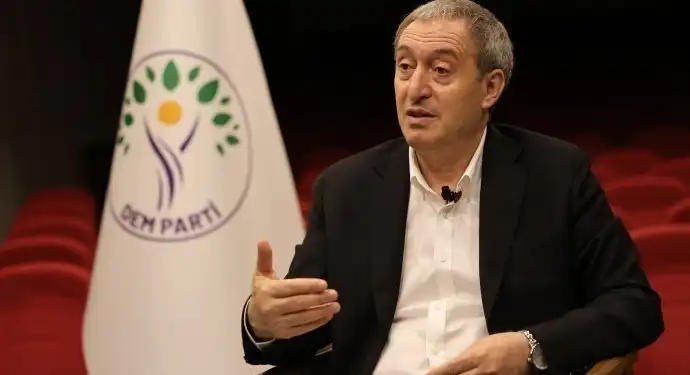
The pro-Kurdish Peoples’ Equality and Democracy Party (DEM Party) has accused Turkey’s government of prioritizing its military and political agenda in Syria over domestic peace efforts with the Kurdistan Workers’ Party (PKK), warning that the shift has triggered a growing crisis of trust in the renewed reconciliation process, Turkish Minute reported.
Tuncer Bakırhan, co-chair of the DEM Party, said in an interview with the pro-Kurdish Yeni Yaşam newspaper that Ankara has failed to take concrete steps toward peace beyond establishing a parliamentary commission while devoting most of its energy to developments in northern Syria.
“The process is continuing, but there is a rupture and a crisis of confidence,” Bakırhan said. “Since it began, the government has not taken a single practical step other than the commission.”
A new peace initiative began after nationalist leader Devlet Bahçeli urged jailed PKK leader Abdullah Öcalan in October 2024 to call for an end to violence. Öcalan did so in February, and the PKK later announced it would dissolve.
Turkey set up a cross-party parliamentary committee in August to lay the groundwork for the peace process and prepare a legal framework for the political integration of the PKK and its militants. However, the commission has yet to produce any concrete proposals that meet the expectations of Öcalan, the DEM Party or Kurds.
Bakırhan said the government’s focus on Syria including intensified operations and tensions around Kurdish-held areas has weakened the prospects for dialogue inside Turkey.
His remarks come amid heightened regional tensions linked to developments in Syria, where the Syrian Democratic Forces (SDF), a Kurdish-led group that partnered with the US military in the fight against the Islamic State group and controlled much of northeastern Syria as recently as November, lost most of that territory to Syrian government forces earlier this month.
Turkey views the SDF as tied to the PKK through its leading faction, the People’s Protection Units (YPG), and has carried out repeated cross-border military operations in Syria over what it describes as threats to Turkish security.
Bakırhan said the government’s approach risks derailing the peace efforts, branded as the “Terrorism-Free Turkey” initiative, with the PKK, which is designated a terrorist organization by Turkey and its Western allies.
“All of its energy has been spent on northern and eastern Syria,” Bakırhan said. “If even a fraction of that effort had been directed here, we would not be facing this situation today.”
Ankara has backed moves by Syria’s new authorities to expand control in areas that had been under Kurdish-led rule and has repeatedly called for the SDF to disband and for its fighters to be removed from the Turkish border region.
Bakırhan warned that treating Syria as the priority has allowed violence across the border to spill into Turkey’s peace track, deepening public distrust.
He claimed recent attacks around Aleppo and increased pressure on Kurdish-led regions in Syria amounted to “sabotage” of the process.
Bakırhan also called for the government to shift from political declarations to concrete legal and democratic reforms, including more regular communication with imprisoned PKK leader Öcalan.
“We don’t have the luxury of losing time,” Bakırhan said.
Following the tensions in Syria, which led to pro-Kurdish protests in Turkey, Nationalist Movement Party (MHP) leader Bahçeli also sharpened his stance and raised suspicions about the future of the peace talks.
He warned last week that rising tensions linked to the developments in Syria could derail Turkey’s peace process with the PKK following an incident in which a Turkish flag was taken down during protests near the Turkey-Syria border.
“Exhausting patience and provoking nerves will bring no benefit to anyone,” Bahçeli said. “The extended hand could easily be replaced by a raised fist,” he added, in a warning that restraint could give way to confrontation.
It marked Bahçeli’s strongest warning to date since the launch of the peace process, raising questions about its future.
Tensions escalated further after ruling Justice and Development Party (AKP) spokesperson Ömer Çelik this week condemned DEM Party leaders for criticizing Turkish President Recep Tayyip Erdoğan and Bahçeli over Syria policy.
Çelik called the remarks “immoral” and said the protection of Erdoğan and Bahçeli was the ruling party’s “red line.”
DEM Party spokesperson Ayşegül Doğan responded by accusing the government of using hostile rhetoric instead of addressing what she described as a humanitarian crisis in the Syrian Kurdish town of Kobani.
“Kobani is under siege. Children are freezing to death,” Doğan said in a statement on Wednesday, adding that “easy condemnations and insistence on red lines are incompatible with peace.”
Local monitors reported that the Kurdish town of Kobani in Syria has taken in large numbers of displaced families in recent weeks, straining already limited resources.
The exchange of words between the DEM Party, the AKP government and its political ally, Bahçeli, adds to mounting uncertainty over whether Ankara’s renewed peace effort can survive escalating regional tensions.
Another peace attempt launched in 2013 collapsed two years later, sparking renewed clashes between the PKK and the Turkish armed forces.