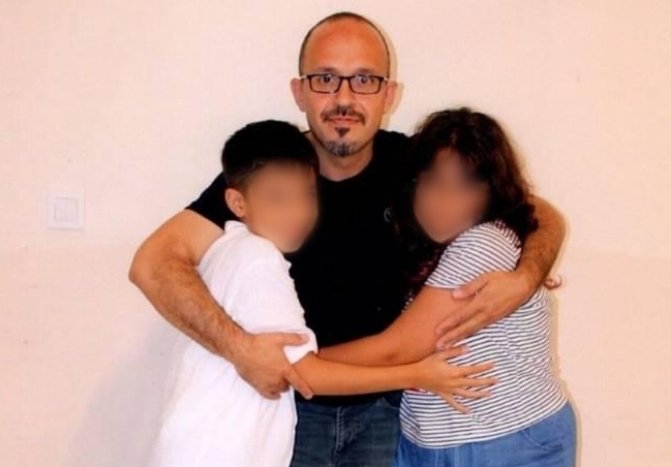
A Turkish academic imprisoned over alleged links to the faith-based Gülen movement has described severe psychological distress in a letter from prison, prompting renewed calls for his release.
According to the TR724 news website Emre Uysal, in his most recent letter to his wife, described a deterioration of his psychological condition, saying he was urgently referred to a psychiatrist amid concerns that he might harm himself or others. Uysal, who suffers from severe depression and epilepsy and has twice attempted suicide in prison, expressed fear that he may not survive his incarceration.
Uysal was dismissed from Anadolu University’s faculty of fine arts by an emergency decree as part of Turkey’s post-coup purge following a coup attempt in July 2016 and was arrested on December 13, 2017. He was later sentenced to 10 years in prison for allegedly using payphones to communicate with his contacts within the Gülen movement.
Following the failed coup, President Recep Tayyip Erdoğan immediately accused the Gülen movement, inspired by the late US-based cleric Fethullah Gülen, of orchestrating the plot and significantly expanded a crackdown on the movement’s supporters that was already underway.
Erdoğan’s campaign against the movement began after corruption investigations in December 2013 implicated him as well as members of his family and inner circle, which he dismissed as a conspiracy, and formally designated it as a terrorist organization in May 2016. The movement strongly denies involvement in the coup attempt or any terrorist activity.
Prosecutors base many Gülen-linked cases on the alleged use of public payphones, assuming that consecutive calls made from the same device indicate an organizational link between the callers. Authorities do not have access to the content of the calls used as evidence.
During eight months of pretrial detention, Uysal reportedly suffered epileptic seizures and loss of consciousness after being denied regular access to his medication. Since he appealed the sentence, the court released him under judicial supervision, taking his health into account in accordance with the Turkish Code of Criminal Procedure (CMK). However, after his sentence was upheld by the appeals court, he was returned to prison on September 9, 2022.
Human rights defender and Peoples’ Equality and Democracy Party (DEM Party) lawmaker Ömer Faruk Gergerlioğlu publicly criticized authorities for ignoring Uysal’s petitions despite his psychiatric referral and ineffective medication. Gergerlioğlu questioned whether authorities were waiting for Uysal to take his own life before considering his release.
Turkey’s Institute of Forensic Medicine (ATK) issued a report in 2024 saying Uysal was fit to remain in prison. However, the prison prosecutor recently requested a reassessment of the report, but no updated decision has yet been issued.
The ATK frequently comes under criticism over its questionable reports that find ailing inmates fit to remain in prison. Rights advocates slam the agency over its lack of independence from political influence and its role in compounding the persecution of political prisoners.
Under Turkey’s Law on the Execution of Sentences and Security Measures, courts may suspend the sentence of a prisoner who, due to a serious illness or disability, cannot sustain life in prison conditions and who is not considered a serious or concrete danger to society. Rights groups say the provision is very rarely applied in practice.
The Human Rights Association (İHD) says more than 1,400 sick prisoners are currently held in Turkey, including hundreds in critical condition. Complaints include delays in taking inmates to hospitals, inadequate treatment in prison infirmaries and forensic reports that allow seriously ill detainees to remain incarcerated.
Following the coup attempt, the Turkish government declared a state of emergency that remained in effect until July 19, 2018. During this period, the government carried out a purge of state institutions under the pretext of an anti-coup fight by issuing a number of government decrees. Over 130,000 public servants were summarily removed from their jobs for alleged membership in or relationships with “terrorist organizations” by emergency decree-laws subject to neither judicial nor parliamentary scrutiny.