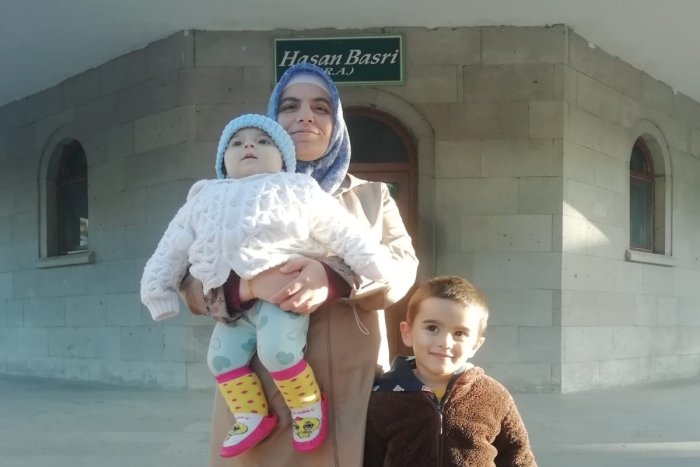
A Turkish social studies teacher was jailed with her 20-month-old child after the Supreme Court of Appeals upheld a prison sentence of over six years due to alleged ties to the faith-based Gülen movement, the TR724 news website reported on Monday.
Emine Sarıoğlu, 34, was taken into custody on October 27 and transferred to Sincan Women’s Prison near Ankara, according to her family. The imprisonment came after a court-approved delay that allowed Sarıoğlu to give birth and care for her child during infancy.
President Recep Tayyip Erdoğan has been targeting followers of the Gülen movement, inspired by the late Muslim cleric Fethullah Gülen, since corruption investigations in December 2013 implicated him as well as some members of his family and inner circle.
Dismissing the investigations as a Gülenist coup and a conspiracy against his government, Erdoğan began to target the movement’s members. He designated the movement as a terrorist organization in May 2016 and intensified the crackdown on it following an abortive putsch in July of the same year that he accused Gülen of masterminding. The movement strongly denies involvement in the coup attempt or any terrorist activity.
According to court rulings, Sarıoğlu was convicted on the basis of activities that included working for 18 months at a now-closed private tutoring center, making deposits at Bank Asya, an institution shuttered for alleged Gülen ties, and participating in religious and community activities that prosecutors said demonstrated affiliation with the movement. Her conviction was handed down by the Malatya 1st High Criminal Court.
Since the coup attempt, the Turkish government has accepted such activities as having an account at Bank Asya, one of Turkey’s largest commercial banks at the time; using the ByLock messaging application; and subscribing to the Zaman daily or other publications affiliated with members of the movement as benchmarks for identifying and arresting alleged followers of the Gülen movement on charges of membership in a terrorist organization.
Her husband, Mustafa Sarıoğlu, said the case against his wife began before their marriage and was already ongoing when they wed in 2020. The couple has two children, a 4-year-old son and a daughter born in April 2024. He said he is caring for both children while continuing to work as an accountant.
Mustafa Sarıoğlu also alleged that prison authorities have recently imposed new restrictions on contact between incarcerated mothers and their children during visits, preventing physical contact and warning that objections could lead to disciplinary penalties.
Sarıoğlu sought a retrial following a 2023 ruling by the European Court of Human Rights (ECtHR) in the case of Yüksel Yalçınkaya, a former teacher whose terrorism conviction was found to violate multiple provisions of the European Convention on Human Rights (ECHR). In that landmark judgment, delivered by the court’s Grand Chamber, judges ruled that Turkish courts had violated the right to a fair trial and the principle of legality, which bars criminal punishment for conduct that was not clearly criminal at the time it occurred, by relying on activities such as bank transactions and association membership as decisive proof of terrorist affiliation without an individualized assessment of criminal intent.
Turkey has not implemented the Yalçınkaya ruling in a way that broadly affects past convictions. Sarıoğlu’s request was rejected in October 2024 by the Malatya court.
European human rights bodies have urged Ankara to align domestic court practices with the judgment.
According to the latest figures from the justice ministry, more than 126,000 people have been convicted for alleged links to the movement since 2016, with 11,085 still in prison. Legal proceedings are ongoing for over 24,000 individuals, while another 58,000 remain under active investigation nearly a decade later.