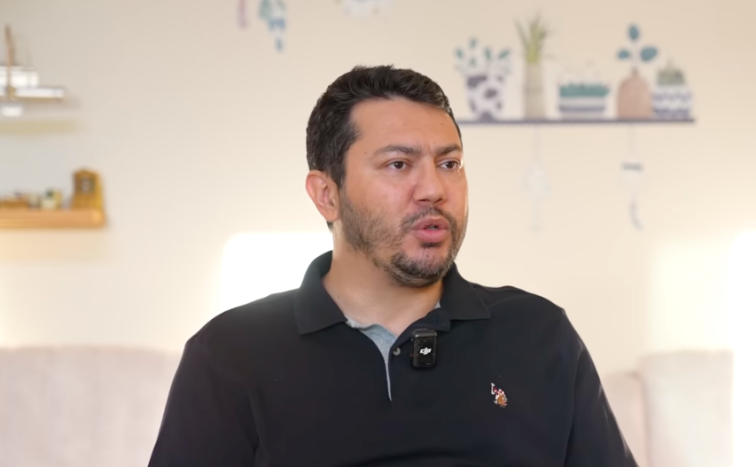
Turkish-American NASA scientist Serkan Gölge on Saturday recounted the nearly three years he spent in prison in Turkey following a coup attempt in 2016 on accusations of ties to the faith-based Gülen movement, with prosecutors citing a one-dollar bill found in a relative’s home as evidence.
Gölge discussed his life, his scientific career at NASA and his imprisonment in Turkey in an interview broadcast on Tutunanlar, a YouTube channel sharing the stories of people who were compelled to flee Turkey in the aftermath of the attempted coup and rebuild their lives abroad.
Gölge, a physicist who had worked as a senior researcher at NASA on radiation studies related to future human space missions, was detained while on a family vacation in Turkey in July 2016, days after the abortive coup, and later sentenced to prison despite the absence of material evidence linking him to any criminal activity.
Prosecutors accused Gölge of ties to the faith-based Gülen movement and of acting as a CIA operative, initially seeking aggravated life imprisonment and citing as evidence an anonymous informant’s statement, a Bank Asya account in his name and a one-dollar bill found in his brother’s room, which Turkish authorities have treated as a sign of affiliation with the movement.
President Recep Tayyip Erdoğan has been targeting followers of the Gülen movement, inspired by the late Muslim cleric Fethullah Gülen, since corruption investigations in December 2013 implicated him as well as some members of his family and inner circle.
Dismissing the investigations as a Gülenist coup and a conspiracy against his government, Erdoğan began to target the movement’s members. He designated the movement as a terrorist organization in May 2016 and intensified the crackdown on it following the abortive putsch in July of the same year that he accused Gülen of masterminding. The movement strongly denies involvement in the coup attempt or any terrorist activity.
Gölge moved to the United States in 2003 to pursue a Ph.D. in physics and settled there. While on a family vacation in the southern province of Hatay, Gölge was detained on July 21, 2016, just days after the failed coup, on his way to the airport.
In February 2018 a court in Hatay sentenced Gölge to seven-and-a-half years in prison on charges of membership in a terrorist organization. In September Turkey’s Supreme Court of Appeals reduced the prison sentence to five years.
He described his confinement — three years spent in a 5–6 square meter cell for 23 hours a day — as a “small death.” During his incarceration, he said he received letters of solidarity from colleagues in the United States and even from people he had never met, many of whom struggled to understand how someone could be imprisoned over a one dollar bill found in a relative’s home.
Despite having served the required portion of his sentence, Gölge was not released when he became eligible. He said intervention by the White House eventually led to his release on probation in 2019. Even then, he was barred from leaving Turkey until he was finally able to return to the United States in June 2020, following a phone call between US President Donald Trump and Turkish President Recep Tayyip Erdoğan.
Gölge criticized the Turkish government for sidelining many successful Turkish scientists whose views do not align with its ideology. In contrast, he said, the United States evaluates people based on what they produce, a key reason why it continues to attract talent from around the world.
Following the coup attempt, the Turkish government declared a state of emergency that remained in effect until July 19, 2018, and carried out a massive purge under the pretext of an anti-coup fight. According to the latest figures from the justice ministry, more than 126,000 people have been convicted of alleged links to the movement since 2016, with 11,085 still in prison. Legal proceedings are ongoing for over 24,000 individuals, while another 58,000 remain under active investigation nearly a decade later.
In addition to the thousands who were jailed, scores of other Gülen movement followers had to flee Turkey to avoid the government crackdown.
Reflecting on the broader impact of the post-coup purges, Gölge said many innocent people like himself were unjustly imprisoned. He urged them not to lose hope, saying he believes “the darkest days will pass and that the truth will eventually come to light.”
After returning to the US, Gölge faced another loss. Nearly 20 relatives, including his parents and three nephews, perished in earthquakes that struck Turkey on February 6, 2023, a loss he said he is still trying to come to terms with.
Gölge noted that NASA’s Artemis program, which aims to return humans to the moon, is expected to begin its first crewed missions in mid-2026, with further flights planned for around 2028. The first human missions to Mars, he added, are envisioned for 2035 and beyond.
With a touch of irony, Gölge joked that after years spent confined to a small prison cell, he once suggested in an interview that NASA should consider him for its astronaut program, having already proven his ability to endure the extreme confinement required on long Mars missions.