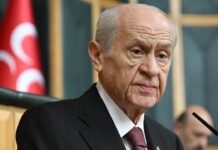

Devlet Bahçeli, the leader of Turkey’s Nationalist Movement Party (MHP) and a key political ally of President Recep Tayyip Erdoğan, has sharply criticized parts of Pope Leo XIV’s visit to Turkey, accusing the pontiff of disseminating “hidden propaganda” through religious ceremonies that he said had unsettled segments of the Turkish public, Turkish Minute reported.
In an interview with the pro-MHP Türkgün daily published on Thursday, Bahçeli said his party did not object to the pope’s official, state-level meetings, including talks with Erdoğan in Ankara, but drew a strict line at what he called “show-driven religious and historical rituals” performed in the pope’s role as spiritual head of the Catholic Church.
The pope visited Turkey from November 27-30 on his first overseas trip, meeting with President Erdoğan in Ankara before traveling to İznik in western Turkey to commemorate the 1,700th anniversary of the Council of Nicaea and later saying Mass for 4,000 people in İstanbul.

These events, he argued, carried symbolic weight that went far beyond commemoration.
The pope and Ecumenical Patriarch Bartholomew I on November 28 marked the 1,700th anniversary of the First Council of Nicaea with a ceremony in İznik, historically known as Nicaea, where hundreds of bishops met in AD 325 to adopt the Nicene Creed.
During the event, leaders prayed in several languages as a choir sang hymns in English, French, Greek, Latin and Turkish, and the pope called for Christian unity, a message echoed by the patriarch.
The pope had also drawn a large crowd in İstanbul, where he said a multilingual Mass at the Volkswagen Arena on November 29. The high-profile ceremony was marked by prayers, hymns and calls for “unity.”
For Bahçeli, these gestures were not benign.
“We cannot remain spectators to attempts to resurrect the memory of a council held 1,700 years ago … or to replace İznik with Nicaea,” he said, claiming the ceremonies amounted to “concealed propaganda” and efforts to reshape religious authority under the guise of commemoration.
He accused the Vatican of advancing “hidden propaganda” and sending “coded messages” through ceremonies that, he said, had unsettled segments of the Turkish public.
“He said there was ‘no point in selling snails in a Muslim neighborhood,’ using a well-known Turkish idiom to suggest that the rituals were out of place and at odds with Muslim sensitivities.
Criticism of US ambassador over seminary remarks
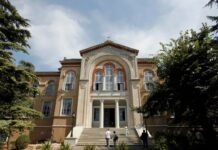
The nationalist leader also broadened his criticism to include recent comments by US Ambassador to Turkey Tom Barrack, who publicly suggested 2026 as a target date for reopening the Halki Theological Seminary on İstanbul’s Heybeliada Island.
Closed since 1971 following a Constitutional Court ruling, the seminary — part of the Holy Trinity Monastery complex — has been the subject of renewed diplomatic discussion, and its restoration is expected to be completed by 2026.
Bahçeli said the ambassador had “overstepped his authority,” arguing that decisions regarding the seminary rest solely with Turkey. “Such intrusive and imposing proposals disregard our national honor,” he said.
Barrack told the Greek Kathimerini newspaper this week that Washington was signaling the possibility of an opening “in September of 2026.”
The issue has resurfaced in political and diplomatic talks in recent years. President Erdoğan discussed the matter with US President Donald Trump at the White House in September, expressing willingness to consider “necessary steps” toward reopening.
Education Minister Yusuf Tekin also visited the site in May, saying he personally supported its reopening and that his ministry had submitted legal recommendations to the government.
Turkey is home to a small Christian population of about 100,000 in a country of 86 million.