Turkey’s labor unions are stepping up pressure for a substantial increase in the 2026 minimum wage as negotiations are expected to begin this week, arguing that the current 22,104 lira ($521) floor wage has been eroded by inflation and no longer covers basic needs for millions of households, Turkish Minute reported.
Presenting its 2026 Minimum Wage Research Report at a press conference earlier this week, the Confederation of Progressive Trade Unions (DİSK) said workers began 2025 already about 15 inflation points behind official price increases and have seen their purchasing power erode even further throughout the year.
The group described the situation with the slogan “Not a bare-minimum wage, but a wage for a humane life,” noting that a family of four now faces a hunger line approaching 30,000 lira ($707) and a poverty line well beyond 90,000 lira ($2,121), while the minimum wage remains at 22,104 lira ($521).
DİSK said that unlike in 2022 and 2023, when the minimum wage was adjusted twice a year, the government refused midyear increases in both 2024 and 2025 despite persistent inflation.
President Recep Tayyip Erdoğan’s government has previously relied on steep minimum wage hikes, sometimes twice a year, to ease public frustration during election periods, a pattern critics say is not repeated in non-election years. The upcoming talks are expected to test how far the government is willing to go without elections on the horizon.
According to calculations by its research unit, DİSK-AR, the minimum wage lost 6,322 lira ($149) of value in the first 10 months of 2025; if year-end inflation reaches the officially projected 33.8 percent, total losses will rise to 7,471 lira ($176).
Over the full year, a minimum-wage earner will have lost more than 50,000 lira ($1,178) in purchasing power, meaning “the 2026 minimum wage is being discussed on the basis of an income whose real value has fallen to around 14,000 lira ($330),” the confederation said.
Union officials said the minimum wage in Turkey is no longer an exceptional floor but has effectively become the average wage. Citing their own data, they said roughly half of private-sector employees earn at or only slightly above the legal minimum, with low pay especially common among women.
DİSK argued that the minimum wage should be updated at least twice a year until inflation returns to single digits and should be set not only in relation to inflation but also to per-capita national income, economic growth and international labor standards that take dependents into account.
Based on calculations using 2022 data, an estimated 11.2 million people in Turkey were earning the minimum wage in 2024, only slightly fewer than the 12.8 million minimum-wage workers across 21 EU countries, according to Eurostat’s reference figures. Turkey also ranks far above European peers in the share of minimum-wage earners. DİSK data show that 37.5 percent of workers in Turkey earned the minimum wage or less in 2022, more than three times the EU average.
Public expectations for a substantial increase are also high. A survey by the Gündemar research company, conducted between November 23 and 29 in 60 provinces with 2,230 respondents, found that 53 percent of people believe the 2026 minimum wage should be 35,001 lira ($825) or higher. Another 20 percent said it should be between 31,001 ($730) and 35,000 lira, while 16 percent favored 28,001 ($660) to 31,000 lira; only 4 percent said it should remain below 25,000 lira ($589).
But when asked what they think the government will actually do, respondents were more cautious. Forty-seven percent predicted the new minimum wage would be set between 25,000 and 28,000 lira, while only 10 percent expected an increase above 35,001 lira.
The same survey found strong support for an additional increase for pensioners, with 42 percent saying pensions should rise by more than 50 percent, though 53 percent said they do not believe the government will grant an extra hike in January.
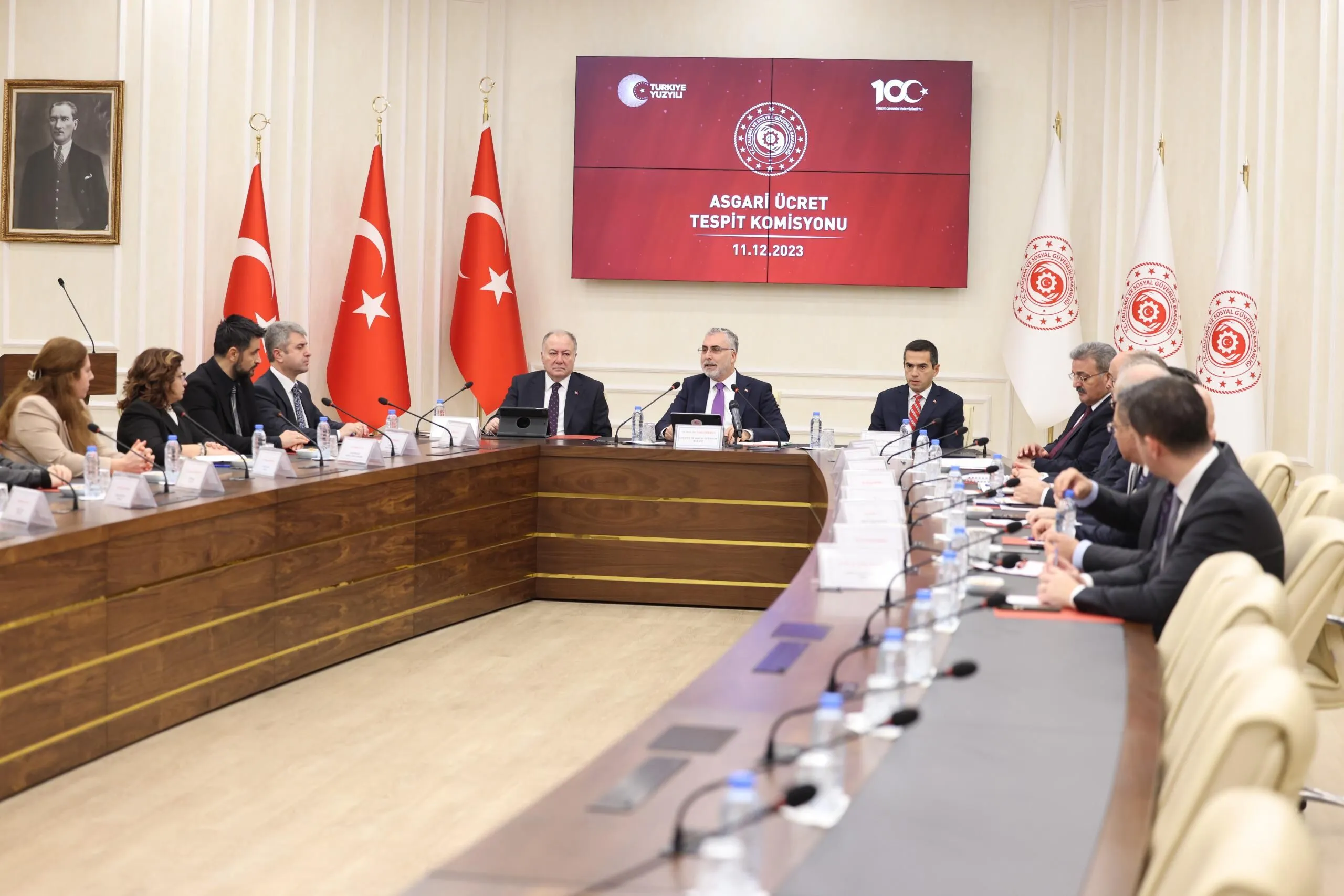
The debate over the level of the minimum wage is tied to a dispute over the structure of the Minimum Wage Determination Commission. The 15-member body consists of five representatives each from the government, employers and workers.
The Confederation of Turkish Trade Unions (Türk-İş), which represents workers on the commission, announced in late 2024 that it would not participate in the 2026 talks unless “a fair adjustment” is made, calling the current structure unfair and saying that for “50 years” workers have been outvoted in a commission that does not adequately reflect their interests.
Labor and Social Security Minister Vedat Işıkhan met with Türk-İş President Ergün Atalay on Tuesday and proposed reducing the number of government representatives on the commission from five to one.
Türk-İş’s decision-making council is expected to evaluate the proposal. If accepted, government representation on the commission will be sharply reduced; if rejected and Türk-İş maintains its boycott, the table would be left to employer and government representatives, and decisions could still be taken as long as at least 10 members are present.
Speaking after a cabinet meeting on Tuesday, Işıkhan said the commission would convene “soon” to start work on the 2026 wage, adding, “We want to see all parties at the table.”