

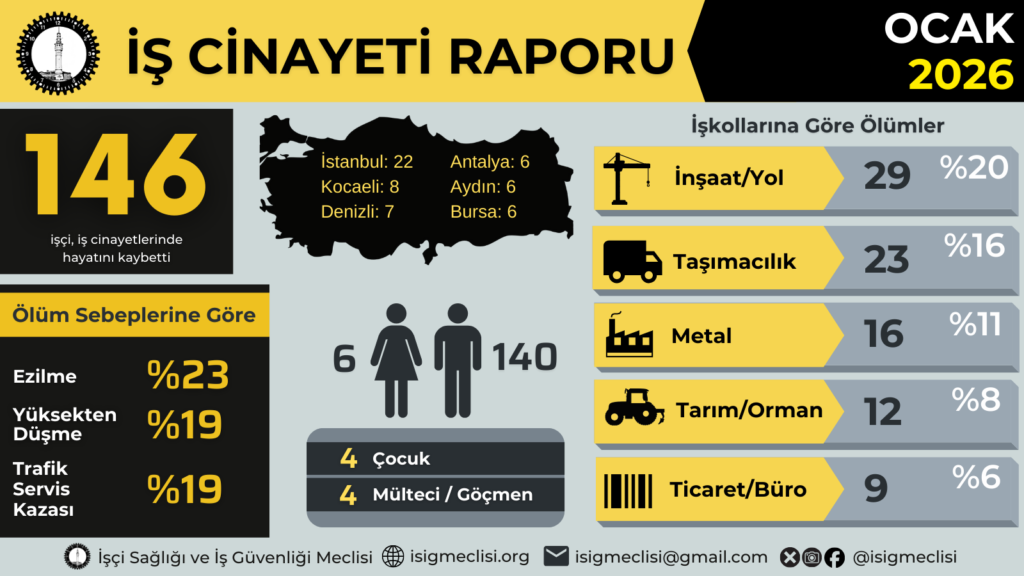
At least 146 workers died in work-related incidents across Turkey in January, according to a new report from the Health and Safety Labour Watch Turkey (İSİG).
Construction saw the heaviest losses in January with 29 deaths, accounting for 20 percent of all fatalities. It was followed by transportation with 16 percent and the metals industry with 11 percent.
The report, compiled using information gathered from national and local media, trade unions and workers’ families, found that among the victims were six women and four minors. Four were refugees or migrants from Algeria (1), Iraq (1), Syria (1) and Egypt (1). Rights groups have long warned that migrant and child laborers face higher risks due to informal employment and inadequate inspections.
Crush incidents were the leading cause of death, accounting for 23 percent of all fatalities, followed by falling from a height at 19 percent and traffic accidents, also at 19 percent, İSİG said.
İstanbul recorded the highest number of fatalities with 22 deaths, followed by Kocaeli (8) and Denizli (7).
The group also referred to three worker deaths that occurred on January 8 during severe lodos storms, powerful southwesterly winds, that affected much of Turkey. The workers died after falling from a height or being struck by falling objects. Despite official storm warnings, no adequate precautions were taken, the report said, adding that work may be suspended in hazardous conditions under Turkey’s Labor Law.
The group said nearly 100 workers die by suicide each year due to poor working and living conditions.
İSİG documented 2,105 work-related deaths in 2025, highest annual total in at least a decade, indicating that workplace safety in Turkey is worsening rather than improving.
Workplace accidents remain a chronic problem in Turkey, where lax enforcement of occupational health and safety standards continues to cost lives.
Turkey made progress in aligning its occupational health and safety legislation with European Union standards after it became an EU candidate country in 1999 and also ratified the relevant International Labour Organization conventions in 2005. However, implementation and enforcement of these standards have been far less effective. In recent years an influx of migrants and growing economic instability have further undermined workplace safety, as investments in safety measures declined and informal employment increased.
Turkey’s poor record on labor rights has also been highlighted internationally. A yearly report produced by the International Trade Union Confederation (ITUC) on labor rights revealed that Turkey is one of the 10 worst countries in the world for workers in industrial sectors. According to the Brussels-based ITUC, workers’ freedoms and rights have been further denied since police crackdowns on protests in Turkey in 2025, while strikes and attempts to unionize were prevented by the authorities.