A survey of 1,629 people dismissed from Turkey’s civil service after a July 2016 coup attempt found that nearly two-thirds had been unable to secure a job registered with the social security system, while acquittals often did not end blacklisting or professional exclusion, according to a report released Tuesday.
The Italian Federation for Human Rights (FIDU) said emergency measures adopted after the coup attempt had produced a lasting condition of “civil death,” in which people retain their citizenship but face exclusion from employment, financial services, regulated professions, public benefits and civic life, according to Turkish Minute.
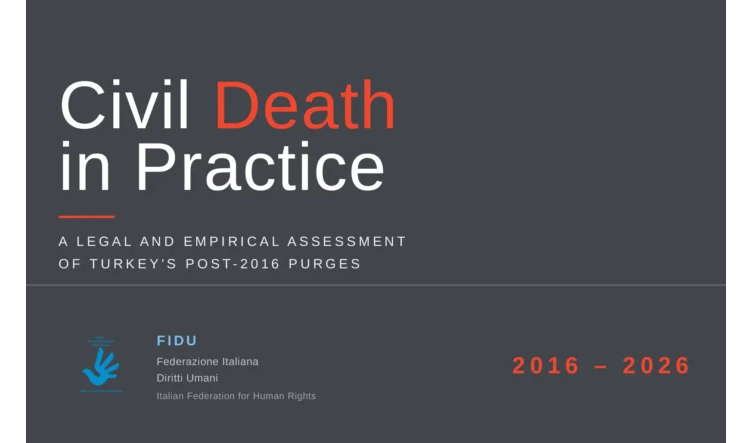
The report, titled “Civil Death in Practice: A Legal and Empirical Assessment of Turkey’s Post-2016 Purges,” was written by lawyer Ali Yıldız, economist Mustafa Günaydın and political science researcher Mustafa Sağır.
It comes ahead of the 10th anniversary of the coup attempt and examines what happened to 162,239 public servants dismissed through emergency decrees and subsequent summary procedures, a figure cited by a ruling party lawmaker in parliament earlier this year.
Turkey declared a state of emergency after the coup attempt and issued 32 decrees over the following two years. The dismissals primarily targeted people accused of links to the faith-based Gülen movement, which Turkish authorities blame for the attempted overthrow of President Recep Tayyip Erdoğan.
President Erdoğan has targeted followers of the Gülen movement, inspired by the US-based cleric Fethullah Gülen, who died in 2024, since corruption investigations in December 2013 implicated him as well as some members of his family and inner circle. He dismissed the probes as a Gülenist conspiracy and later designated the movement as a terrorist organization in May 2016, intensifying a sweeping crackdown after a coup attempt in July of the same year that he accused Gülen of orchestrating.
The movement denies involvement in the coup attempt or any terrorist activity.
The survey was conducted online between October 13 and November 4, 2025, through networks used by dismissed public servants. The authors said the self-selected sample was not statistically representative of everyone dismissed and that its percentages should not be treated as national estimates.
Among respondents, 70.9 percent said an employer had rejected their application or dismissed them after learning of their status under an emergency decree, known in Turkey by the initials KHK.
Some 65.3 percent said they had been unable to find employment registered with Turkey’s social security system after their dismissal.
The report found that a favorable outcome in criminal proceedings often had no effect on the administrative penalties imposed on respondents.
Among those who reported the outcome of a criminal case, 48.3 percent had been acquitted, had charges dismissed or had received a decision of non-prosecution, a larger share than those convicted.
The report said nearly two-thirds of respondents cleared of criminal liability still could not find registered employment and more than two-thirds continued to encounter employment rejection because of their KHK status. No acquitted respondent reported being reinstated to public service.
Some respondents who were eventually acquitted said they had spent between nine days and two years in pretrial detention, while proceedings ending in acquittal lasted between four and nine years.
The report identified an administrative designation known as “36/OHAL/KHK” as a mechanism that continues to make the dismissals visible years later.
The code appears in records held by Turkey’s Social Security Institution and Turkish Employment Agency and can be seen during formal employment procedures. Some respondents also reported encountering related warnings during banking, land registry, notarial and welfare transactions.
More than half of respondents, 52.9 percent, said they had encountered the designation in government records.
FIDU said the system reproduces discrimination automatically because the designation contains no record of an acquittal, no expiration date and no clear procedure through which an individual can challenge its use.
Respondents reported loan and credit applications being rejected, routine banking transactions being blocked and their names being marked as problematic or suspicious during property transactions despite the absence of a court order restricting their assets.
The report also found that the effects extended to family members.
Some 35.7 percent of respondents said a first-degree relative had also been dismissed under an emergency decree. Another 29.7 percent said a spouse or child without KHK status had faced discrimination because of the respondent’s dismissal.
Reported cases included children barred from entering professions such as policing, spouses removed from doctoral programs and family members encountering restrictions in employment and financial transactions.
Turkey established the State of Emergency Inquiry Commission to review dismissals and other emergency measures. The commission completed its work in January 2023 after accepting 17,960 of 127,292 applications and rejecting 109,332.
Ali Özkaya, a lawmaker from Erdoğan’s ruling Justice and Development Party (AKP), told parliament in January that 24,368 of the 162,239 dismissed public servants had been reinstated.
Özkaya defended the government’s approach, arguing that an acquittal in a criminal case did not require the administration to rehire a person because criminal liability and disciplinary standards were separate matters.
FIDU said the separation of the criminal and administrative processes had instead allowed permanent sanctions to survive even when courts found no criminal liability.
The report cited the European Court of Human Rights’ 2023 judgment in Yüksel Yalçınkaya v. Turkey and its May 2026 ruling in Yasak v. Turkey, both of which raised concerns about convictions of people accused of Gülen movement links without an adequate assessment of individual criminal responsibility.
FIDU called on Turkey to remove the Code 36 designation from state databases, automatically reinstate people acquitted or cleared of charges, repeal professional bans not based on individual court findings and provide compensation to affected families.
It also urged the European Union to make progress on the treatment of dismissed public servants a condition for any upgrade in relations with Turkey and to consider KHK dismissal status when assessing asylum and subsidiary protection applications.
The report is available in English and Turkish on FIDU’s website.