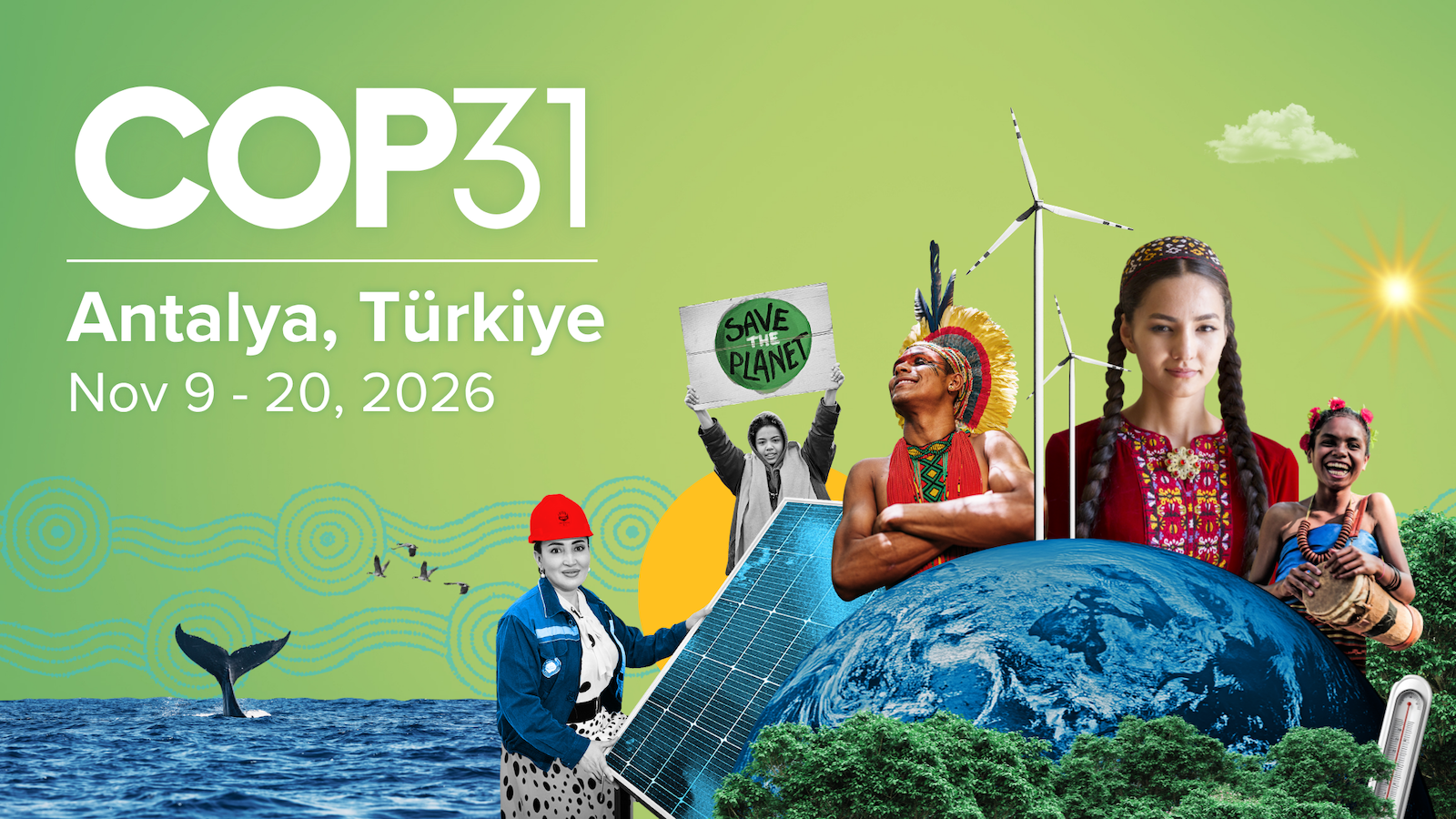
Amnesty International has urged Germany and the international community to raise Turkey’s human rights record at the highest political level before and during the United Nations Climate Change Conference (COP31), which opens Monday in the Mediterranean city of Antalya.
The human rights organization accused the Turkish government of intensifying a systematic campaign against independent voices, including journalists, environmental activists and lesbian, gay, bisexual, transgender and queer (LGBTQ) people.
“Those who speak about protecting our shared future must not ignore serious human rights violations in the host country,” Julia Duchrow, secretary general of Amnesty International Germany, said in a statement published Thursday.
A UN climate conference could only be credible if people could express their views and protest peacefully without fear of discrimination or arbitrary punishment, she added.
Amnesty criticized politically motivated investigations, prosecutions and unlawful convictions, along with restrictions on expression, peaceful assembly and association and Turkey’s failure to implement international court rulings.
The organization cited human rights defender and businessman Osman Kavala, who has been imprisoned for more than nine years despite European Court of Human Rights (ECtHR) rulings requiring his release. Kavala has been deprived of his liberty since October 2017, with the court first ordering his immediate release in December 2019.
Amnesty also raised concerns about the treatment of environmental activists, citing Esra Işık, who was sentenced July 6 to more than two years in prison on a charge of resisting a public official following a protest against land expropriations for a coal mine expansion near Akbelen Forest in southwestern Turkey.
The protest was peaceful, and Işık was free pending appeal when Amnesty issued an update on her case in July.
In September police carried out nationwide operations targeting organizations, activists and human rights defenders working on LGBTQ rights. More than 100 people were detained, many of whom were subsequently jailed pending trial, Amnesty documented.
Access to more than 1,000 social media accounts belonging to human rights organizations and other independent voices was also blocked, including Amnesty International Turkey’s account on X, the organization said.
On October 14 police raided the İstanbul headquarters of the Halk TV opposition broadcaster during an investigation into its owner, Cafer Mahiroğlu, over allegations of bribery, bid rigging and money laundering. A court ordered the seizure of companies linked to Mahiroğlu and appointed the Savings Deposit Insurance Fund (TMSF), Turkey’s state deposit insurer, as trustee. Halk TV’s live broadcasts were halted.
Mahiroğlu denied the allegations and described the operation as politically motivated.
The takeover prompted calls from the Committee to Protect Journalists (CPJ) for control of the broadcaster to be returned to its staff. A trustee had also been appointed to opposition broadcaster TELE1 in October 2025.
Amnesty also pointed to restrictions imposed before the NATO summit in Ankara on July 7 and 8. Police and gendarmes detained 209 people in raids across the capital June 23, with the detention tally reaching 225 by June 25. At least 170 had been jailed pending trial by July 2.
The Ankara Governor’s Office also banned gatherings, demonstrations, press statements and the distribution of leaflets from June 28 through July 10.
Human Rights Watch (HRW) raised concerns about Turkey’s treatment of environmental activists in a November 4 statement. Restrictions on expression, association and peaceful assembly raised questions about whether independent civil society groups could participate safely in COP31, the organization warned.
HRW called on governments attending the conference to press Turkey to protect environmental defenders and ensure that civil society groups could participate without intimidation.
Concerns also extend to the Host Country Agreement between Turkey and the UN climate secretariat governing COP31.
The agreement, which entered into force on September 18, requires participants enjoying privileges and immunities to respect Turkish laws and regulations and to refrain from interfering in the country’s internal affairs under Article 11.11.
The provision was absent from the agreement for last year’s climate conference in Brazil. Amnesty has warned that the wording could discourage criticism of the Turkish government and deter journalists, activists and human rights defenders from speaking freely.
The agreement also contains safeguards. Its preamble commits Turkey and the UN climate secretariat to upholding participants’ human rights, while another provision requires security personnel to follow professional and ethical standards. It also grants accredited participants immunity from legal action over words and acts connected with their participation.
Murat Kurum, Turkey’s environment minister and COP31 president-designate, has sought to reassure civil society groups. Speaking to journalists in September, he said his team would “try to meet” requests from civil society and give participants space to express their views, Climate Home News reported.
A separate declaration sent to speakers and panelists in the Green Zone, the event area managed by Turkey, requires them to pledge compliance with Turkish law and “public morality,” Spot Basın Kooperatifi reported Thursday.
The declaration does not explicitly list sexual orientation or gender identity among its grounds for protection against discrimination. It also allows organizers to interrupt speeches or remove speakers over violations of provisions concerning “public morality” or “propaganda.”
Lawyer Özlem Altıparmak, who received the document before a scheduled appearance, warned that its wording could restrict criticism and encourage self-censorship. The declaration concerns the Green Zone, separate from the UN-administered Blue Zone where negotiations take place.
Civil society organizations are also preparing an alternative People’s Climate Summit in Antalya November 14-18, beginning with a march and rally November 14 and continuing with discussions and workshops, organizers announced.
COP31 will run November 9-20, bringing together government representatives, climate negotiators, scientists and civil society groups to discuss responses to climate change. Turkey will host the conference, while Australia will lead the formal negotiations under a partnership agreement between the two countries.
This article is republished from Turkish Minute.