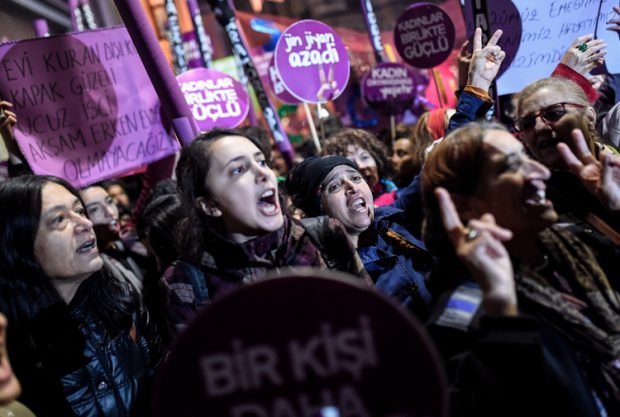
Rights advocates in Turkey say the country has too few shelters for women fleeing violence, warning that limited capacity and failures to enforce protection orders can leave women without a safe place to go, İlke TV reported.
Turkey has 150 women’s shelters nationwide, 112 of them operated by the Ministry of Family and Social Services, according to 2026 government figures. The ministry’s most recent detailed capacity data show space for 3,650 people.
Lawyer Mehtap Sert told İlke TV that the protection system was inadequate, saying women can be referred to other institutions or transferred to another city when shelters are full. A woman leaving a violent home has no guarantee of immediately reaching a safe place or receiving effective state protection, she said.
International monitoring bodies have also criticized Turkey’s shelter capacity. GREVIO, the Council of Europe body that monitors implementation of the Istanbul Convention, said in its 2018 evaluation that Turkey needed to continue expanding shelters to provide them in sufficient numbers. The U.N. Committee on the Elimination of Discrimination against Women (CEDAW) also cited an insufficient number of shelters in its 2022 findings on Turkey.
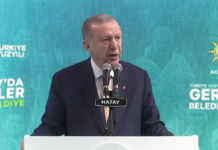
Turkey was the first country to sign and ratify the Istanbul Convention, which opened for signature in İstanbul in 2011. President Recep Tayyip Erdoğan announced Turkey’s withdrawal by presidential decree in March 2021, a move that sparked criticism from rights organizations, which warned that it weakened protections for victims of domestic violence and accountability for perpetrators.
A September 2025 monitoring report by the Women’s Solidarity Foundation (Kadın Dayanışma Vakfı) described the number of shelters in Turkey as extremely limited relative to the country’s population and demand, saying some provinces lacked shelters and existing facilities had insufficient capacity.
Didem Erkıvanç Türkay, a volunteer with the Antalya Women’s Counseling Center and Solidarity Association (Antalya Kadın Danışma Merkezi ve Dayanışma Derneği), said a lack of shelter space cannot justify sending a woman back to a violent environment. Authorities should instead provide temporary free accommodation in public guesthouses, dormitories or similar facilities, or transfer women elsewhere when necessary for their safety, she said.
Sert said the problem extends beyond shelter capacity to failures in enforcing protection orders, with violations not always sanctioned and some orders not effectively implemented. The We Will Stop Femicide Platform (Kadın Cinayetlerini Durduracağız Platformu)recorded 23 women killed in 2025 despite having protection orders.
Turkey’s Law No. 6284 on the Protection of the Family and Prevention of Violence Against Women provides for measures including safe accommodation and protection orders for women facing violence. Sert said the main problem was not the law itself but shortcomings in its implementation and oversight.
The Ministry of Family and Social Services said it was working to open four additional women’s shelters in Adıyaman, Hatay, İstanbul and Kocaeli. Turkey also operates 86 Violence Prevention and Monitoring Centers (ŞÖNİM), which coordinate services for people facing violence.
Sert said Turkey’s withdrawal from the Istanbul Convention weakened oversight and enforcement mechanisms, with Law No. 6284 remaining Turkey’s main domestic legal framework for combating violence against women.