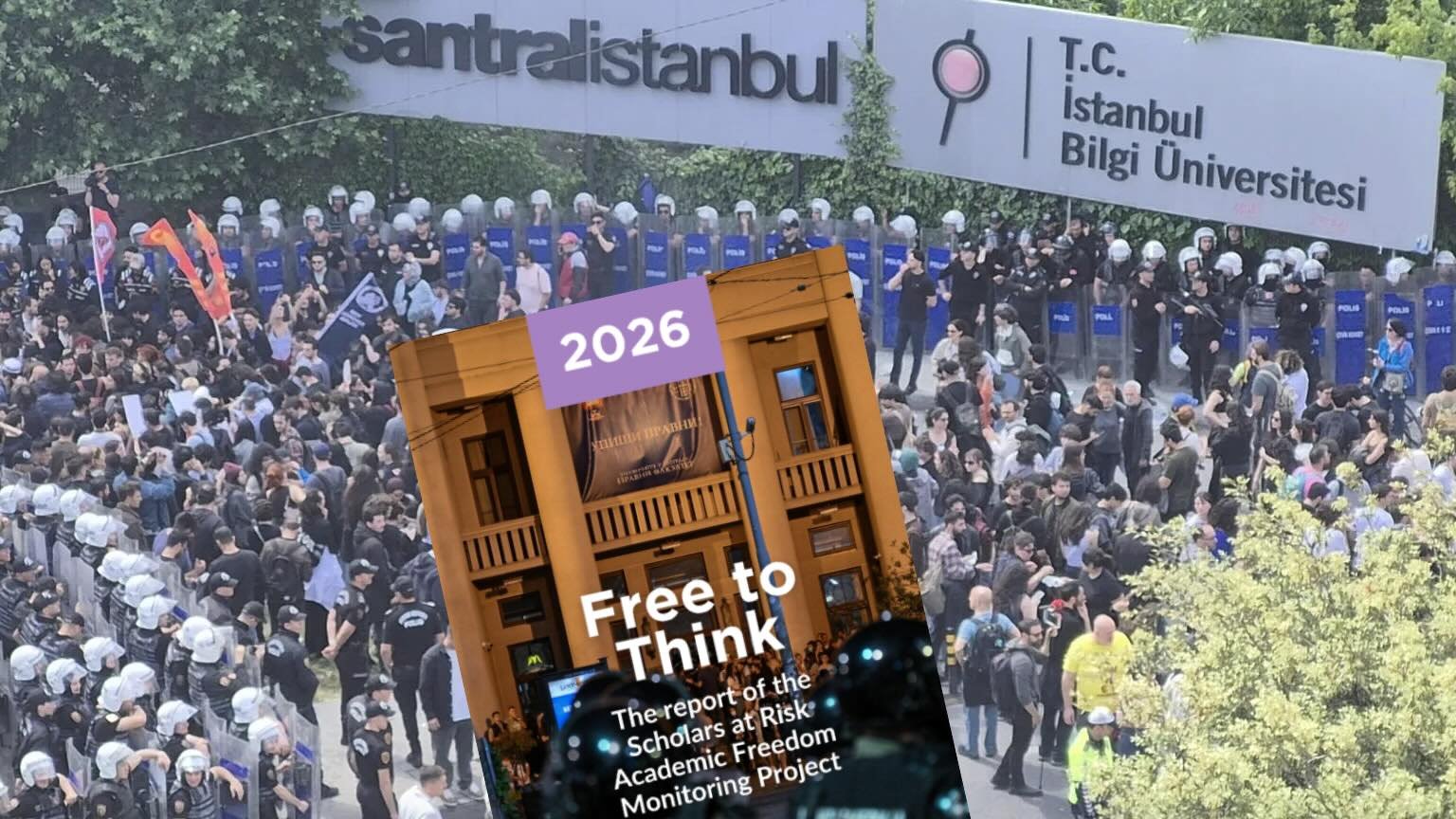
Political interference in university governance, prosecutions of academics and restrictions on student protests continue to erode academic freedom in Turkey, according to a new report released by Scholars at Risk (SAR), an international network that promotes academic freedom and supports threatened scholars.
Turkey scored just 0.09 on a scale of zero to one in the 2025 Academic Freedom Index cited in the report, placing it in the bottom 10 percent of countries worldwide and in the category where academic freedom is considered “completely restricted.”
The annual “Free to Think 2026” report, released September 15 and covering the period from July 1, 2025 to June 30, 2026, documented 382 attacks on higher education communities in 59 countries and territories.
SAR’s definition includes imprisonment and prosecution as well as physical attacks, dismissals and other forms of coercion.
In Turkey, the report describes pressure on higher education as taking several forms, from political control over university leadership to criminal proceedings against academics and intervention in student protests.
One of the most consequential developments, SAR said, was legislation adopted on July 1, 2025 that reaffirmed the president’s authority to appoint rectors at public and private foundation universities, a system first introduced in 2016 when rector elections were abolished by emergency decree.
The law followed a 2024 Constitutional Court ruling that struck down provisions of the previous system and gave lawmakers a year to adopt new legislation governing rector appointments.
The new arrangement again leaves the appointment of rectors to the president, although boards of trustees at foundation universities can recommend candidates.
The European University Association criticized the legislation, saying public university communities had no role in choosing their leaders and describing the system as interference in university autonomy.
Concerns over executive power in higher education were also illustrated by the brief closure of İstanbul Bilgi University in May.

A presidential decision revoked the university’s operating license, leaving more than 20,000 students and around 1,000 academics facing uncertainty over exams, graduation, transfers and employment.
Bilgi was part of Can Holding, whose assets had been seized in September 2025 as part of an investigation into allegations including fraud, tax evasion and money laundering, and the university had been placed under trustee management.
The closure lasted only a few days. Erdoğan reversed the decision following protests by students and academics. SAR cited the episode as an example of direct executive intervention in higher education.
The report also points to pressure on individual academics.
Political scientist Emrah Gülsunar spent 36 days in jail pending trial over a social media poll asking whether seeking foreign assistance to overthrow a dictatorial regime could be considered legitimate.
Gülsunar said the poll was prompted by debate surrounding Venezuelan opposition leader María Corina Machado and had nothing to do with Turkey. He was released in November 2025 under a travel ban after arguing that an academic discussion had been criminalized.
Students, meanwhile, have faced restrictions on protests and campus activity.
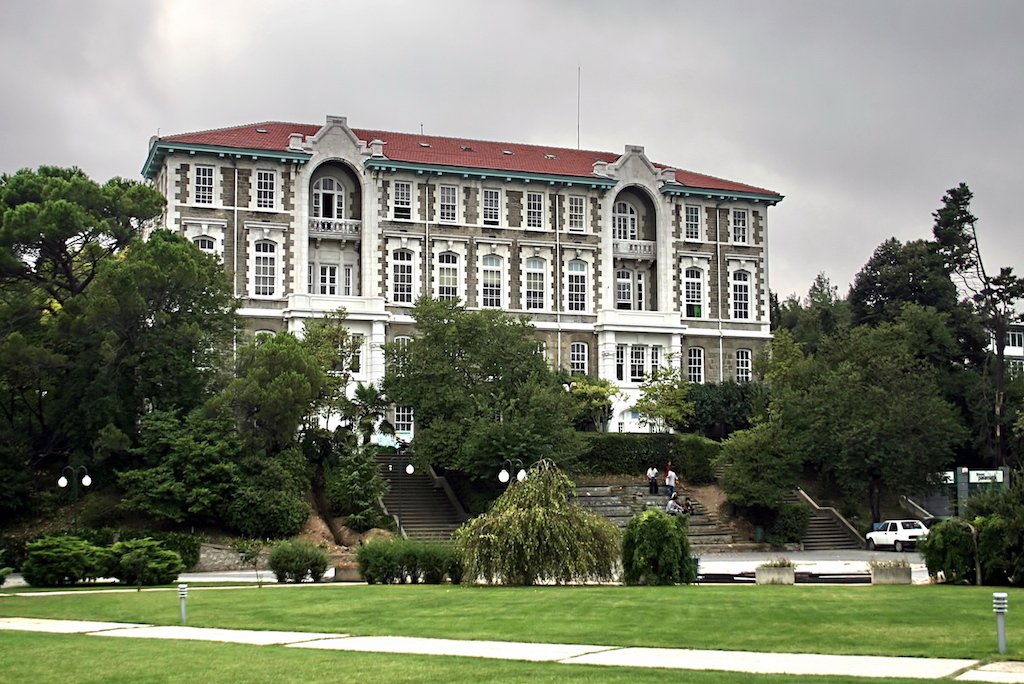
At Boğaziçi University, where protests over presidential appointments of rectors have continued since 2021, classes were moved online and access to the campus was restricted ahead of Erdoğan’s visit on February 13.
Scholars at Risk reported that police detained students Ayşe Cebecioğlu and Sude Şener after they displayed a banner protesting Erdoğan’s visit. They were released the following day under judicial supervision and barred from traveling abroad.
SAR also documented the prosecution of İstanbul University students who protested military operations in Kurdish residential areas of the Syrian city of Aleppo and the use of force by private security personnel against students protesting a cafeteria reservation system at Anadolu University in central province of Eskişehir.
At Ege University in western İzmir province, SAR recorded two consecutive attacks on April 14 by people allegedly linked to the ultranationalist Gray Wolves movement. Three students were reported injured in the first attack, while a further 19 people were injured in a second attack outside the hospital where the initial victims had been taken. SAR said the attackers were armed with machetes.
Taken together, the cases illustrate what SAR describes as an erosion of both university autonomy and the ability of academics and students to speak, organize and protest without fear of punishment.
The trend predates the period covered by the latest report. More than 7,000 academics and other university personnel were dismissed in the crackdown that followed a failed coup in 2016, while the system of university elections for rectors was dismantled that same year.
Presidential control over rector appointments was subsequently expanded, removing university communities from the selection process.
SAR urged governments to refrain from political interference in university governance, curricula and operations, warning that such pressure encourages self-censorship and undermines universities’ role in independent research and public debate.
This article is republished from Turkish Minute.