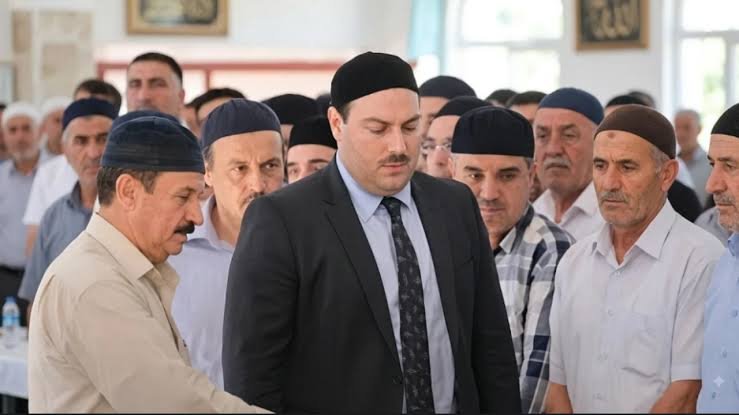
A Turkish court has arrested Alihan Kuriş, leader of the religious community commonly known as the Süleymancılar, whose members identify themselves as “Süleymanlılar,” which has been targeted for months by politicians and media figures close to the government, the state-run Anadolu news agency reported.
The Ankara Chief Public Prosecutor’s Office said on Sunday that all 38 suspects brought before prosecutors had been referred to court with requests for their arrest in an investigation into alleged money laundering, fraud and tax offenses. The court arrested 32 of them, including Kuriş, and placed six others under house arrest.
The Süleymancılar, whose members identify themselves as “Süleymanlılar,” were founded by followers of Islamic scholar Süleyman Hilmi Tunahan. The religious community operates Quran courses and student dormitories in Turkey as well as associations and educational institutions abroad, particularly in Germany. Kuriş took over its leadership in 2016.
Prosecutors describe the organization under investigation as a profit-driven criminal network led by Kuriş, and the government says the case does not target the Süleymancılar as a religious community.
The allegations include establishing and leading a criminal organization, membership in a criminal organization, laundering criminal proceeds, defrauding public institutions and violating Turkey’s Tax Procedure Law.
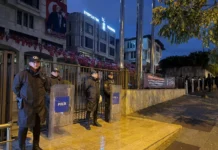
The arrests followed police raids in 17 provinces on August 13.
Police searched 43 locations belonging to individuals and 80 locations linked to 33 companies and initially detained 30 people.
The investigation is based partly on a report by Turkey’s Financial Crimes Investigation Board (MASAK). According to information reported by Turkish media, the agency found an unusual increase in the volume of transactions conducted by the suspects and related companies beginning in 2020.
The report allegedly found that newly established companies with large amounts of capital operated in provinces and industries unrelated to their parent companies. Some had no substantial commercial activity or assets apart from their declared capital, while company owners allegedly used large cash deposits of unexplained origin to finance capital increases.
Kuriş denied the accusations during questioning by police and prosecutors, according to testimony reported by Turkish media on Monday. He denied claims that he led a criminal organization or was involved in money laundering or fraud and said he had not issued orders to anyone.
He described himself as the “heir and representative” of his grandfather, Tunahan, who founded the religious community. “Those who love him love me,” he was quoted as saying.
Pro-government media reported that investigators found a $3 million promissory note and gold and jewelry valued at TL 27.5 million in a safe at Kuriş’s home. The reports also said authorities were examining 191 properties registered to members of the Kuriş family: 138 to his mother, 26 to his late father, 14 to Kuriş and 13 to his brother, Hilmi Tuna Kuriş.
Judicial sources later told Anadolu that police found 200 kilograms (441 pounds) of gold bullion of unknown origin at an location searched during efforts to find Hilmi Tuna Kuriş, who remains at large.
Justice Minister Akın Gürlek said the investigation did not target a religious belief, religious community or civil society organization.
“This is an operation aimed entirely at the financial structure,” Gürlek said.
Interior Minister Mustafa Çiftçi said the authorities had been preparing for the operation for some time, claiming the group had begun operating with greater secrecy after Kuriş took over its leadership in 2016.
Çiftçi also said the group was constructing a new headquarters in Cologne, Germany, which he valued at $70 million. Authorities believed the group planned to move its operations there after the building was completed, he added.
The Süleymancılar operate in Germany through the Association of Islamic Cultural Centers, known by its German abbreviation VIKZ. The Cologne complex, which is expected to include offices, classrooms, a prayer hall, student housing, a guesthouse and a library, is reportedly scheduled for completion in 2027.
VIKZ operates approximately 300 local communities and is one of Germany’s oldest major Muslim umbrella organizations. German President Frank-Walter Steinmeier attended its 50th anniversary celebration in 2023, praising the organization for training its imams in Germany since the 1980s.
He said its male and female religious teachers were now largely born or raised in Germany and represented Islam’s roots in the country.
Neither Kuriş’s lawyers nor VIKZ had issued a separate public statement about the investigation as of Monday.
Kuriş, a grandson of Tunahan, assumed the group’s leadership following the death of his maternal uncle Arif Ahmet Denizolgun in 2016. Trained as an architect, Kuriş was also involved in architecture and construction before becoming the group’s leader.
Prosecutors allege that individuals associated with the community have links to companies operating in construction, food, healthcare, tourism, textiles and real estate.
The latest operation followed more than a year of public accusations against the Süleymancılar by politicians and media figures close to President Recep Tayyip Erdoğan’s government.
In a May 14, 2025 speech Erdoğan described what he called a “dark organization” that had spread beyond İstanbul like an octopus, reaching municipalities, public institutions, businesses, the media, religious groups and intelligence services.
His remarks were primarily directed at an investigation into the İstanbul Metropolitan Municipality and its jailed mayor, Ekrem İmamoğlu, but some pro-government commentators subsequently claimed the description also applied to the Süleymancılar, according to a report in the German newspaper Frankfurter Rundschau. Erdoğan did not identify the religious group by name.
The nationalist Aydınlık newspaper reported that four people allegedly connected to the Süleymancılar were detained in Ankara shortly after the speech, including a senior judicial official.
Around the same time, pro-government columnist Fuat Uğur wrote that it was “the Süleymancılar’s turn” after the faith-based Gülen movement and the group led by convicted cult leader Adnan Oktar, both of which had been subjected to large-scale government crackdowns.
Fatih Süleyman Denizolgun, another grandson of Tunahan and a former lawmaker from Erdoğan’s ruling Justice and Development Party (AKP), had separately called for a “financial operation” against companies, foundations and associations linked to the Süleymancılar.
Denizolgun, who is Kuriş’s cousin, has repeatedly accused him and his associates of criminal activity. In one social media post, the former lawmaker described the group under Kuriş as “the largest terrorist organization in world history” and a “network of betrayal.” The Süleymancılar have not been officially designated as a terrorist organization.
Denizolgun later alleged that Ali Erbaş, then-head of Turkey’s Directorate of Religious Affairs, told him Erdoğan had ordered an operation against the group. The directorate denied the allegation.
Journalist Ruşen Çakır suggested in May 2025 that the government might be targeting the group because it had not supported the AKP and was rumored to have moved closer to the main opposition Republican People’s Party (CHP) and İmamoğlu. Çakır stressed that the extent of any such political alignment was unclear.
The operation targeting the Süleymancılar also comes against the backdrop of a continuing crackdown on the Gülen movement, another Islamic group that was once allied with Erdoğan before the two sides had a falling out.
Turkey officially designated the movement as a terrorist organization in May 2016 and accuses it of orchestrating an abortive coup that July. The movement denies involvement in the coup attempt and rejects the terrorist designation.
Since then, Turkish authorities have investigated hundreds of thousands of people over alleged links to the movement, detained or arrested tens of thousands, dismissed more than 120,000 public employees and seized companies, schools and other assets.
Critics have warned that the government could use tactics employed against the Gülen movement against other religious communities that withdraw political support or are viewed as close to Erdoğan’s opponents. The government maintains that its operations target criminal activity rather than religious belief.
This article is republished from Turkish Minute.