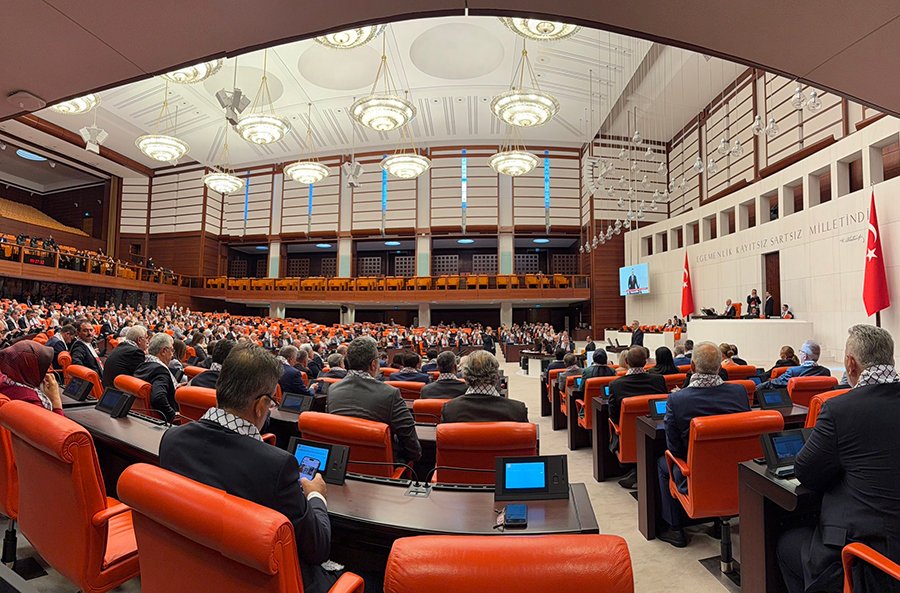
The Turkish Parliament has acknowledged that its investigation into a coup attempt in 2016 produced no legally valid final report, despite the government blaming the faith-based Gülen movement and pursuing a decade-long crackdown involving mass arrests, convictions and dismissals.
According to the TR724 news website, the acknowledgement appeared in a June 15 written response signed by Deputy Parliament Speaker Bekir Bozdağ to opposition lawmaker Ömer Faruk Gergerlioğlu, who had asked why the parliamentary commission’s report was never published or debated.
Bozdağ said the report was never formally published as an official parliamentary document and became void when the legislative term ended and could not be subjected to any further parliamentary procedure during the current term. Parliament has previously said there was no agreed text that met the legal requirements to qualify as an official parliamentary inquiry report.
The response leaves parliament without an adopted account of one of the most consequential events in Turkey’s recent history, even as the government and courts have treated responsibility for the coup attempt as established.
Turkey experienced a controversial military coup attempt on the night of July 15, 2016, which, according to many was a false flag operation aimed at entrenching the authoritarian rule of President Recep Tayyip Erdoğan by rooting out dissidents and eliminating powerful actors such as the military in his desire for absolute power.
Justice Minister Akın Gürlek said this month that since the failed coup, authorities had taken legal action against 720,580 people on accusations of membership in the Gülen movement and that 127,102 had been convicted. He said all 289 trials concerning direct participation in the coup had concluded, although appeals remained pending in some cases.
Those figures cover both prosecutions directly related to the coup attempt and the much broader crackdown on alleged membership in the movement.
Turkish President Recep Tayyip Erdoğan has targeted followers of the Gülen movement, inspired by the late Muslim cleric Fethullah Gülen, since corruption investigations in December 2013 implicated him as well as some members of his family and inner circle. He dismissed the probes as a Gülenist conspiracy and designated the movement as a terrorist organization in May 2016, intensifying a sweeping crackdown after the coup attempt in July of the same year that he accused Gülen of orchestrating. The movement denies involvement in the abortive putsch or any terrorist activity.
A parliamentary commission was established on July 26, 2016, less than two weeks after the attempted coup. It began its work on October 4, 2016, and its mandate expired on January 4, 2017. Its chairman, ruling party lawmaker Reşat Petek, submitted what he described as the commission’s report to parliament on July 12, 2017.
Two days later, members from the main opposition Republican People’s Party (CHP) objected, saying the document submitted to parliament was not the same text that had been given to commission members. They said changes and additions went far beyond editing and that they had not been given an opportunity to respond to the revised material.
The dispute was not resolved before a new legislative term began on June 24, 2018. Under parliament’s rules, unfinished inquiries from a previous term become void.
Parliament said in a 2022 statement that no report existed on which commission members had agreed and which therefore carried the legal status of a parliamentary inquiry report. It said the commission’s hearing transcripts remained publicly accessible but that no further formal action could be taken on the inquiry.
Gergerlioğlu, a lawmaker from the pro-Kurdish Peoples’ Equality and Democracy Party (DEM Party), submitted a new parliamentary question on April 30, 2026, asking where the report was and why it had never been made public.
Lawyer Turan Canpolat later circulated copies of the correspondence on social media, arguing that the absence of a valid report meant parliament had no legally operative finding identifying the perpetrators of the attack.
Canpolat said the document should be submitted in pending cases before Turkey’s Supreme Court of Appeals and Constitutional Court as well as proceedings before international bodies including the European Court of Human Rights (ECtHR).